




B2B Web Portals
Ordering, account and document areas for the businesses you sell to, with company hierarchies, approval steps and tie-ins to your ERP or CRM.
[Web Portal Development]
A web portal gives customers, partners, patients, staff or vendors one secure place to sign in, find what is theirs and get things done. AppVertices designs and builds portals around your users and your existing systems, from the first role matrix to a release you can hand to your own team.








Portals differ most in who signs in and what they need to do once they are inside. These are the ten kinds we are asked to build most often. Each is scoped around its own users, permissions and integrations, and any of them can be a first release that grows into a larger platform.
Ordering, account and document areas for the businesses you sell to, with company hierarchies, approval steps and tie-ins to your ERP or CRM.
A single sign-in where customers see orders, invoices, requests and conversations, so fewer questions need a phone call or an email thread.
Member areas, discussion, events and directories for associations and user groups, with moderation tools and roles that match how your community runs.
Workspaces where teams draft, review, approve and publish content, with versioning, permissions and a clear trail of who changed what.
Catalogues, quotes and repeat orders for trade and wholesale buyers, with account-specific pricing and payment and shipping connections.
Course delivery, enrolment, assessments and progress tracking for staff training or customer education, with reporting for the people who run it.
Secure access to appointments, results and messages, built with privacy in mind and reviewed against the healthcare rules that apply to you.
Pipelines, price books, collateral and commission views for sales teams and channel partners, drawing on the data your CRM already holds.
Tools for people to update details, raise tickets, download documents and find answers without waiting for someone on your team.
Onboarding, purchase orders, invoicing and compliance documents for suppliers, so your procurement team stops chasing attachments.
10+
Years of Industry Experience
500+
Professionals
800+
Projects Completed
98%
Client Satisfaction
People use the two words as if they meant the same thing, but they are built and judged differently. A website tells everyone the same story. A portal knows who is asking and shows them their own information and tools. Knowing which one you need keeps the scope, the budget and the security plan honest.
Six stages take a portal from a list of user groups to a live release. Each stage ends with something you can open and react to, and you decide at every stage whether to carry on.
We list the user groups, what each one needs to do and which systems hold the data. From that we agree a scope, a role matrix and the first release, before any design starts.
Wireframes and clickable prototypes for each user group's main journeys, tested with a few real users where we can. Navigation, empty states and error messages get as much care as the dashboards.
We build in short cycles and show working software at the end of each one. Authentication and permissions come first, then the features users need most, with automated tests alongside.
We connect the portal to your CRM, ERP, payment, identity and messaging services through their APIs, and test the awkward cases: failed calls, duplicate records and out-of-date data.
Functional, cross-browser and mobile testing, plus checks that one user can never reach another user's data. Performance is tested with realistic numbers of users and records.
We prepare hosting, monitoring and backups, migrate your existing accounts and content, and release in stages where the risk calls for it. Your team gets documentation and a walkthrough.
The Challenge
A property platform serving buyers abroad needed to be easy to search and trust on any phone or connection, while giving agents and developers a clear way to present their listings.
Our Approach
We designed search and listing pages around how buyers actually look for property, with account areas and a layout that stays readable on a small screen.
The Impact








The same portal idea looks different in every sector, because the users, the data and the rules around it differ. These are six areas where we build portals, and in each we start with who signs in and what they must be protected from, not with a template.






If people still email spreadsheets, chase approvals or answer the same account questions all day, a portal may be the fix. Tell us how the work moves today and we will say whether a portal is the right shape for it, and what it would take.
Four things to expect when AppVertices builds your portal: software shaped to how your users work, security treated as part of the build, a design that does not need rewriting at ten times the users, and people who stay available after launch.
Your roles, workflows and integrations shape the build. We do not squeeze your business into a template and call it a portal.
Role-based access, encrypted data and audit logging are designed in from the start, and we test that users cannot reach each other's records.
We design for the users and records you expect next year, with caching, efficient queries and load testing, so growth does not mean a rebuild.
Maintenance, security updates, monitoring and new features after launch, on terms that are agreed in writing before the release.
Recognized for delivering high-quality software, mobile applications, and digital products that help businesses turn ideas into working technology. Our achievements reflect the experience, technical expertise, and commitment behind the products we build for startups, growing businesses, and established organizations.
America's Fastest Growing Companies
America's Fastest Growing Top Web Development Agencies 2023

Silver Awards Winner 2020

Top 1000 Companies

Top Mobile App Development Company 2023

Top Entertainment App Developers

Best Mobile App Developer
Top App Development Companies

Web Excellence Awards
Top Entertainment App Developers
Excellence in Web Creativity & Digital Communication
It depends on scope. A focused portal with a few roles and one or two integrations is typically a matter of months rather than weeks, while a large multi-role platform takes longer. After a discovery call we give you a milestone plan with dates before development starts, and we release in stages so you see working software early.
Tell us what you are building, who it is for and when it needs to be live. You will get a written scope, a realistic range, and a named engineer on the call rather than a sales deck.

[Web Portal Development]
A web portal gives customers, partners, patients, staff or vendors one secure place to sign in, find what is theirs and get things done. AppVertices designs and builds portals around your users and your existing systems, from the first role matrix to a release you can hand to your own team.
Portals differ most in who signs in and what they need to do once they are inside. These are the ten kinds we are asked to build most often. Each is scoped around its own users, permissions and integrations, and any of them can be a first release that grows into a larger platform.
Ordering, account and document areas for the businesses you sell to, with company hierarchies, approval steps and tie-ins to your ERP or CRM.
A single sign-in where customers see orders, invoices, requests and conversations, so fewer questions need a phone call or an email thread.
Member areas, discussion, events and directories for associations and user groups, with moderation tools and roles that match how your community runs.
Workspaces where teams draft, review, approve and publish content, with versioning, permissions and a clear trail of who changed what.
Catalogues, quotes and repeat orders for trade and wholesale buyers, with account-specific pricing and payment and shipping connections.
Course delivery, enrolment, assessments and progress tracking for staff training or customer education, with reporting for the people who run it.
Secure access to appointments, results and messages, built with privacy in mind and reviewed against the healthcare rules that apply to you.
Pipelines, price books, collateral and commission views for sales teams and channel partners, drawing on the data your CRM already holds.
Tools for people to update details, raise tickets, download documents and find answers without waiting for someone on your team.
Onboarding, purchase orders, invoicing and compliance documents for suppliers, so your procurement team stops chasing attachments.
People use the two words as if they meant the same thing, but they are built and judged differently. A website tells everyone the same story. A portal knows who is asking and shows them their own information and tools. Knowing which one you need keeps the scope, the budget and the security plan honest.
Six stages take a portal from a list of user groups to a live release. Each stage ends with something you can open and react to, and you decide at every stage whether to carry on.
We list the user groups, what each one needs to do and which systems hold the data. From that we agree a scope, a role matrix and the first release, before any design starts.
Wireframes and clickable prototypes for each user group's main journeys, tested with a few real users where we can. Navigation, empty states and error messages get as much care as the dashboards.
We build in short cycles and show working software at the end of each one. Authentication and permissions come first, then the features users need most, with automated tests alongside.
We connect the portal to your CRM, ERP, payment, identity and messaging services through their APIs, and test the awkward cases: failed calls, duplicate records and out-of-date data.
Functional, cross-browser and mobile testing, plus checks that one user can never reach another user's data. Performance is tested with realistic numbers of users and records.
We prepare hosting, monitoring and backups, migrate your existing accounts and content, and release in stages where the risk calls for it. Your team gets documentation and a walkthrough.
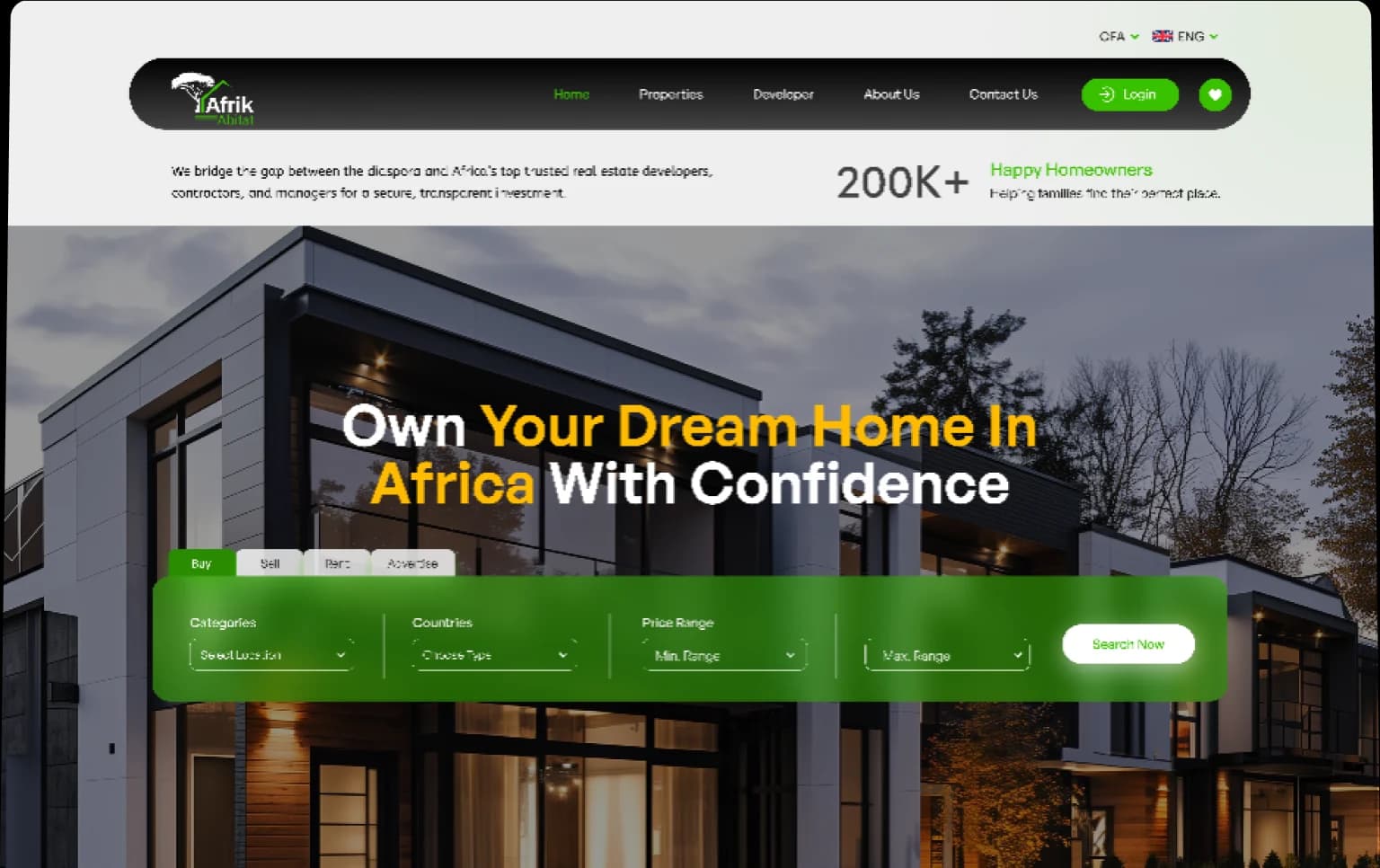
A property platform serving buyers abroad needed to be easy to search and trust on any phone or connection, while giving agents and developers a clear way to present their listings.
We designed search and listing pages around how buyers actually look for property, with account areas and a layout that stays readable on a small screen.
























The same portal idea looks different in every sector, because the users, the data and the rules around it differ. These are six areas where we build portals, and in each we start with who signs in and what they must be protected from, not with a template.
If people still email spreadsheets, chase approvals or answer the same account questions all day, a portal may be the fix. Tell us how the work moves today and we will say whether a portal is the right shape for it, and what it would take.
Let’s Connect!Four things to expect when AppVertices builds your portal: software shaped to how your users work, security treated as part of the build, a design that does not need rewriting at ten times the users, and people who stay available after launch.
Your roles, workflows and integrations shape the build. We do not squeeze your business into a template and call it a portal.
Role-based access, encrypted data and audit logging are designed in from the start, and we test that users cannot reach each other's records.
We design for the users and records you expect next year, with caching, efficient queries and load testing, so growth does not mean a rebuild.
Maintenance, security updates, monitoring and new features after launch, on terms that are agreed in writing before the release.
It depends on scope. A focused portal with a few roles and one or two integrations is typically a matter of months rather than weeks, while a large multi-role platform takes longer. After a discovery call we give you a milestone plan with dates before development starts, and we release in stages so you see working software early.
A website shows the same public content to every visitor. A web portal asks people to sign in and then shows them information and tools specific to their role, usually drawn from systems such as your CRM, ERP or billing platform. That is why portals need more work on access control, integrations and data protection.
Usually, yes. We connect portals to CRMs, ERPs, payment providers, identity services and databases through their APIs or, where there is no API, through a careful intermediate layer. We review the systems during planning and tell you what is feasible and what the risks are.
We design the permissions model first, enforce it on the server rather than only in the interface, encrypt data in transit and at rest, log sensitive actions and test that users cannot reach each other's records. Where sector rules apply, such as healthcare privacy rules, we build to them and say clearly what we have and have not reviewed.
Yes. We offer maintenance plans covering security updates, dependency upgrades, monitoring and fixes, plus ongoing development for new features. The scope and response times are agreed in writing before launch.