



Get a QuoteGet a Quote

[Our Blogs]

Top AI Agents Explained: 15 Best Autonomous AI Tools Changing the Future of Work in 2027

The right technology decision starts long before development begins. Practical insight on building mobile apps, AI products, custom software and cloud platforms — aimed at the questions businesses need answered before they invest.

Blog16 November 202620 minute read
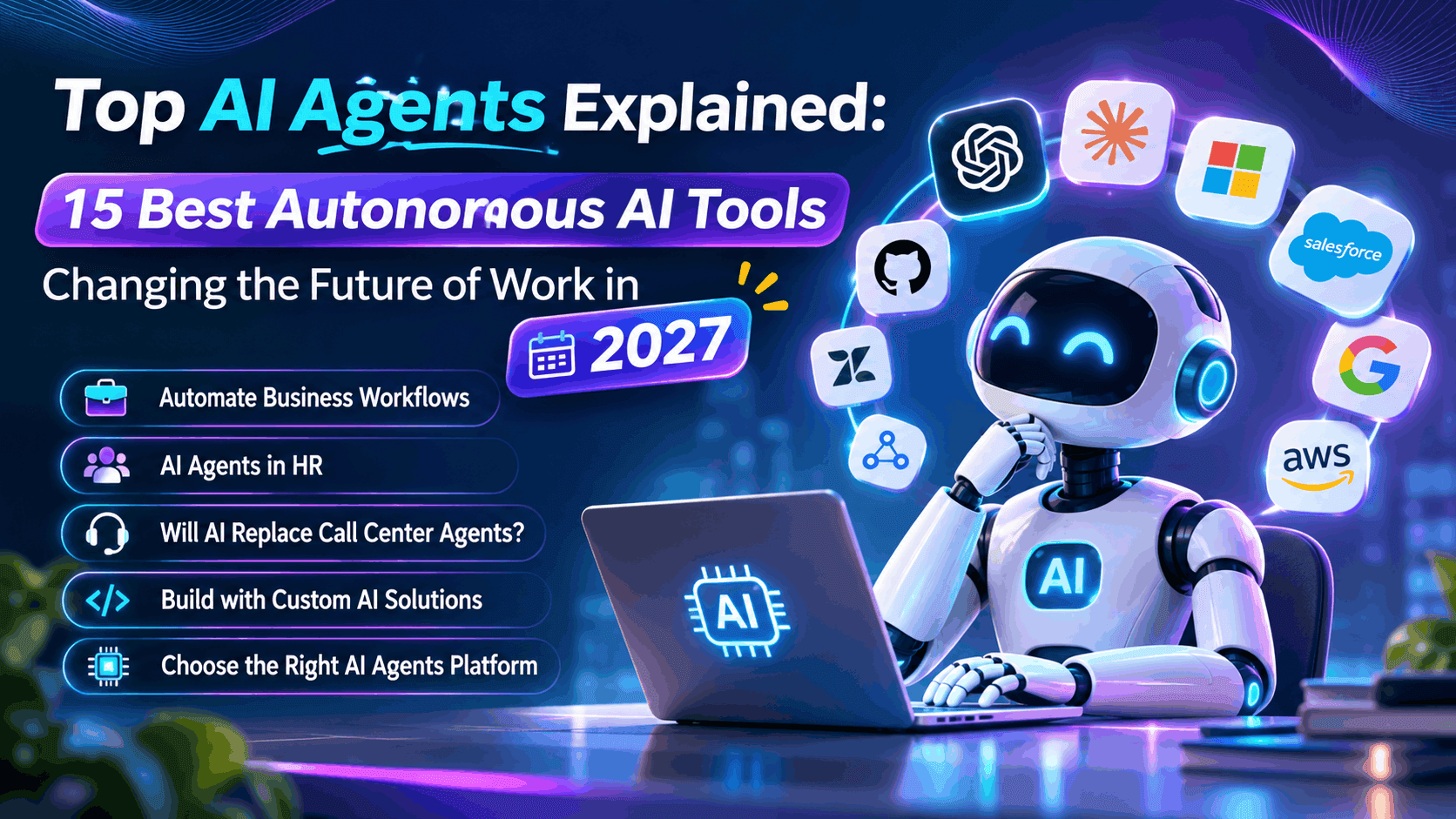
Top AI Agents 2027 featuring an AI robot, autonomous AI tools, and leading AI platforms transforming business automation.

Artificial intelligence is moving beyond answering questions and generating content. The next major development is AI that can actually complete work, make decisions within defined boundaries, and coordinate multiple tasks with minimal human intervention.

Imagine an AI assistant that doesn't just draft a customer email but also checks the customer's order history, identifies the problem, suggests a resolution, and updates the CRM. Or an AI system that reviews job applications, identifies qualified candidates, and helps recruiters schedule interviews.

These are examples of what autonomous AI agents can accomplish.

As businesses prepare for 2027, understanding the top AI agents is becoming increasingly important. From customer service and marketing to software development and human resources, agent-based systems are creating new opportunities to automate repetitive processes and improve operational efficiency.

However, not every AI tool offers the same level of autonomy. Some act as intelligent assistants, while others can execute complex workflows using external applications and business data.

This guide explores 15 leading AI agents and development platforms to consider for 2027, including their capabilities, practical applications, limitations, and suitability for different businesses.

Editor's note: This article reviews documented capabilities available as of November 2026 and discusses their relevance for 2027. It is not a claim that all products have been independently tested or ranked based on future performance.

What Are AI Agents and How Do They Work?

AI agents are software systems that use artificial intelligence to understand goals, plan actions, interact with tools, and complete tasks with varying levels of autonomy.

Unlike traditional chatbots that primarily respond to individual questions, AI agents can carry out multiple steps toward a defined objective.

For example, a standard chatbot might explain how to prepare a sales report. An AI agent connected to approved business systems could retrieve sales records, organize the data, identify trends, and prepare a report for review.

Most modern AI agents use several components:

  • AI models: Interpret instructions, analyze information, and support reasoning.
  • Planning capabilities: Break complex objectives into manageable tasks.
  • Tool integrations: Connect with applications, APIs, databases, and external services.
  • Memory or context: Retain relevant information during a task or across authorized workflows.
  • Action execution: Perform approved activities such as updating records or creating documents.
  • Human oversight: Require confirmation or escalate situations when appropriate.

According to OpenAI's guidance on working with agents, effective agentic systems combine models, tools, and safeguards that help humans remain in control.

AI Agents vs. Traditional Chatbots

FeatureTraditional chatbotAI agent
Primary functionAnswer questionsComplete objectives
WorkflowUsually conversationalPotentially multistep
Decision-makingMainly response generationCan select actions
External toolsOptionalOften essential
AutonomyGenerally limitedConfigurable
Human involvementFrequent promptingOversight and approvals
Business applicationFAQs and assistanceWorkflow execution and automation

The distinction matters because adding a language model to a chatbot does not automatically make it a reliable autonomous agent.

15 Top AI Agents to Explore in 2027

The following tools represent different categories of agentic AI, including general-purpose assistants, enterprise platforms, customer service agents, and developer frameworks.

They are presented as a practical comparison rather than a performance-tested ranking.

1. ChatGPT Work — Best for Complex Business Tasks and Research

ChatGPT Work provides agentic capabilities for handling multistep assignments involving research, documents, tools, and connected business applications.

Rather than simply generating instructions, it can work through an assignment and produce deliverables that users review and refine.

Key capabilities:

  • Research and information synthesis
  • Multistep document and file workflows
  • Data analysis and reporting
  • Work across supported tools and connected applications
  • Human review and guidance

Best for: Professionals, analysts, marketing teams, and organizations managing research-intensive workflows.

Practical example: A marketing manager can delegate competitor research, ask the agent to compare market positioning, and receive a structured strategy document.

Important consideration: Access to specific systems depends on supported integrations, permissions, and product availability. Sensitive actions should remain subject to human review.

OpenAI's current product guidance identifies ChatGPT Work as an option for longer, multistep work, replacing the former standalone ChatGPT agent mode.

2. Claude — Best for Document Analysis and Computer-Based Tasks

Claude, developed by Anthropic, offers AI capabilities for complex reasoning, coding, document processing, and agent development.

Through Claude's developer platform, applications can use computer interaction tools to navigate software interfaces and perform actions.

Key capabilities:

  • Long-document analysis
  • Programming assistance
  • Tool-based task execution
  • Computer and browser interaction
  • Structured information processing

Best for: Developers, researchers, operational teams, and businesses working with complex information.

Practical example: A developer could build a Claude-powered agent that checks an internal application interface, extracts relevant information, and prepares a structured summary.

Anthropic documents computer-use capabilities involving screenshots, mouse and keyboard actions, and browser interaction. These features require appropriate implementation and safeguards.

3. Microsoft Copilot Studio — Best for Microsoft-Based Enterprises

Microsoft Copilot Studio allows businesses to create, customize, and manage intelligent AI agents that seamlessly integrate with existing applications, automate workflows, and improve operational efficiency.

It is particularly relevant for companies already using Microsoft's business technology ecosystem.

Key capabilities:

  • Custom conversational agents
  • Business process automation
  • Enterprise data connections
  • Event-triggered agent workflows
  • Governance and administrative controls

Best for: Organizations using Microsoft 365, Teams, SharePoint, and Power Platform.

Practical example: An employee could request an internal policy document, while an authorized agent retrieves relevant information and initiates an approval workflow.

Microsoft supports autonomous capabilities within Copilot Studio, although individual features may have different release statuses or licensing requirements.

4. Salesforce Agentforce — Best AI Agent for CRM Automation and Customer Relationship Management

Salesforce Agentforce focuses on creating agents that work with customer data, business processes, and CRM applications.

It is especially useful for businesses seeking intelligent sales and service workflows.

Key capabilities:

  • Customer service automation
  • CRM-connected responses
  • Sales workflow assistance
  • Business data retrieval
  • Agent monitoring and security controls

Best for: Sales-driven organizations and businesses with established Salesforce environments.

Practical example: An AI agent can help a service team retrieve account information, answer routine questions, and recommend an appropriate next action.

Agentforce combines business data, workflow logic, and AI-based reasoning, with capabilities dependent on implementation and permissions.

5. Google Vertex AI Agent Builder — Best for Developing Scalable, Cloud-Based AI Agents and Intelligent Business Applications

Google Cloud provides tools for building AI agents that interact with enterprise information and connected services.

Vertex AI's agent development capabilities are relevant to businesses developing scalable, cloud-based applications.

Key capabilities:

  • Enterprise AI agent development
  • Integration with cloud services
  • Data retrieval and knowledge grounding
  • Custom workflow orchestration
  • Application deployment infrastructure

Best for: Cloud engineering teams and businesses building custom intelligent applications.

Practical example: A logistics company could develop an AI agent that retrieves shipment information, detects exceptions, and prepares operational updates.

Organizations should evaluate the specific Google Cloud agent products, model support, pricing, and regional availability before implementation.

6. Amazon Bedrock Agents — Best for AWS-Based Automation

Amazon Bedrock Agents helps developers create applications that use foundation models to work through tasks and interact with enterprise systems.

AWS also offers AgentCore infrastructure to help teams deploy and operate agents.

Key capabilities:

  • Task orchestration
  • Enterprise API connections
  • Knowledge retrieval
  • AWS service integration
  • Agent deployment and management

Best for: Organizations already running cloud applications on AWS.

Practical example: An e-commerce business could connect an agent to approved inventory and order systems to answer product availability questions or assist fulfillment teams.

AWS describes Bedrock and AgentCore as tools for developing and operating AI agents, including support for different frameworks and models.

7. AI by Zapier — Best for No-Code Business Automation

AI by Zapier combines language-model reasoning with established workflow automation features.

It is a practical choice for businesses that want to introduce AI into repeatable processes without building a complete software application.

Key capabilities:

  • AI-assisted workflow steps
  • Trigger-based automation
  • Information classification
  • Application integrations
  • Conditional workflow execution

Best for: Small businesses, marketing teams, and operations departments.

Practical example: When a lead submits a form, an AI-enabled workflow could classify the inquiry, generate a personalized response draft, and update the CRM.

Importantly, Zapier's former standalone Agents product has been migrating into AI by Zapier. Businesses researching tools for 2027 should use the current product terminology rather than relying on outdated setup guides.

8. n8n — Best for Custom Workflow Orchestration

n8n is a powerful workflow automation platform that enables businesses to build AI-driven processes, connect multiple applications, and streamline complex tasks through seamless integrations.

It appeals to technical teams seeking flexibility in how business processes are structured.

Key capabilities:

  • Visual workflow building
  • AI model integrations
  • API and webhook connections
  • Custom business logic
  • Self-hosting options

Best for: Developers, automation specialists, and businesses requiring tailored workflows.

Practical example: A support workflow could receive customer requests, classify their urgency, retrieve account details, and create tickets for human agents.

Key limitation: Workflow reliability depends on correct configuration, robust error handling, credential security, and appropriate approval controls.

9. CrewAI — Best for Multi-Agent Collaboration

CrewAI is designed for building workflows in which multiple AI agents perform specialized roles.

Instead of requiring one system to complete every task, developers can organize several agents into a coordinated process.

Key capabilities:

  • Role-based agent collaboration
  • Task delegation
  • Workflow orchestration
  • Custom tool connections
  • Multistep process development

Best for: Development teams building sophisticated automation systems.

Practical example: A content production workflow could use separate research, outlining, editorial, and verification agents.

However, assigning different responsibilities to multiple agents does not automatically improve accuracy. The system still needs quality checks, clear instructions, and reliable source data.

10. LangGraph — Best for Stateful AI Workflows

LangGraph is an advanced AI development framework that enables developers to create intelligent, stateful workflows and build sophisticated AI agent applications capable of managing complex, multistep tasks.

It gives developers greater control over how an AI system progresses between stages, uses tools, and handles interruptions.

Key capabilities:

  • Stateful execution
  • Custom agent workflows
  • Human-in-the-loop checkpoints
  • Tool orchestration
  • Complex task management

Best for: Experienced developers building production-oriented AI systems.

Practical example: An insurance application could gather submitted information, identify missing documents, request clarification, and route the case for human review.

LangGraph is not a ready-made business assistant. It is a development framework that requires engineering, testing, and ongoing maintenance.

11. LlamaIndex — Best for Knowledge-Based AI Agents

LlamaIndex helps developers create AI applications that retrieve information from documents, databases, and other knowledge sources.

Its tools are useful when agents need to reason over organization-specific information.

Key capabilities:

  • Retrieval-augmented generation
  • Document-based AI applications
  • Data source connections
  • Agent workflows
  • Knowledge retrieval

Best for: Organizations managing large volumes of documents and internal information.

Practical example: A legal operations team could create a controlled research assistant that finds relevant contract clauses and cites the original documents for review.

The quality of the results depends heavily on document accuracy, retrieval configuration, and access permissions.

12. GitHub Copilot — Best for Software Development

GitHub Copilot helps developers write, review, and maintain code. Its agentic coding capabilities can support more complex development activities beyond code suggestions.

Key capabilities:

Code generation

  • Coding task assistance
  • Codebase exploration
  • Test creation
  • Development workflow support
  • Best for: Software engineers, application development companies, and technical teams.

Practical example: A development team could assign a well-defined coding task, inspect the proposed changes, and review test results before merging.

AI-generated code still requires security testing, architectural review, and validation against application requirements.

13. Fin — Best for Customer Support Automation

Fin is a customer-facing AI agent designed to handle service conversations and other supported customer interactions.

It can use approved knowledge sources and configured policies to respond to customers and take supported actions.

Key capabilities:

Automated customer conversations

  • Help-center knowledge retrieval
  • Multichannel support
  • Customer inquiry handling
  • Escalation to human teams
  • Best for: SaaS businesses, e-commerce companies, and customer support departments.

Practical example: A customer asks about changing a subscription. Fin can explain available options and, where configured, assist with the next steps.

Its effectiveness depends on accurate support content, correct integration settings, and well-designed escalation rules.

14. Zendesk AI Agents — Best for High-Volume Support Operations

Zendesk offers AI-powered customer service capabilities for organizations managing support across different channels.

Its agents are designed to help resolve routine requests while allowing human teams to focus on more complex interactions.

Key capabilities:

  • Customer inquiry automation
  • Help-center integrations
  • Support workflow assistance
  • Conversation routing
  • Customer service analytics

Best for: Support-focused companies and organizations with established ticketing systems.

Practical example: A retailer could use an AI agent to respond to common delivery questions, retrieve approved order information, and escalate exceptions.

Businesses should evaluate how well the system handles unsupported questions, unusual cases, and sensitive customer information.

15. Relevance AI — Best for Creating Intelligent AI Workforces and Automating Complex

Relevance AI provides tools for creating and coordinating AI agents that perform defined business functions.

Its approach is useful for organizations exploring multiple specialized agents across departments.

Key capabilities:

  • Custom agent configuration
  • Business workflow automation
  • Tool integrations
  • Multi-agent coordination
  • Operational task execution

Best for: Startups, operational teams, and organizations experimenting with agent-based business workflows.

Practical example: A company could configure different agents to qualify inbound leads, prepare meeting briefs, and organize follow-up activities.

As with other autonomous systems, businesses need clear ownership, access restrictions, performance monitoring, and approval rules.

Quick Comparison: Which AI Agent Is Best for Your Business?

AI tool or platformPrimary strengthIdeal users
ChatGPT WorkMultistep knowledge workProfessionals and analysts
ClaudeReasoning and computer interactionResearchers and developers
Microsoft Copilot StudioEnterprise workflow automationMicrosoft-based organizations
Salesforce AgentforceCRM and customer operationsSales and service teams
Google Vertex AICloud AI application developmentCloud engineering teams
Amazon Bedrock AgentsAWS agent developmentAWS users
AI by ZapierNo-code AI workflowsSmall businesses
n8nFlexible automationTechnical operations teams
CrewAIMulti-agent collaborationAI developers
LangGraphStateful agent orchestrationSoftware engineering teams
LlamaIndexData-connected AI agentsKnowledge-intensive businesses
GitHub CopilotSoftware engineeringDevelopers
FinCustomer-facing conversationsSupport and sales teams
Zendesk AI AgentsSupport automationCustomer service organizations
Relevance AISpecialized business agentsOperations teams

Which should you choose? For an existing CRM or support environment, evaluate agents integrated into that system first. For custom applications, consider a development framework or cloud agent platform. For general research and knowledge work, begin with an agentic assistant that supports your actual tasks.

The ideal AI agent varies from business to business, depending on its specific goals, operational requirements, existing technology, and automation needs.

How Are AI Agents Transforming the Future of Work?

AI agents are changing how organizations think about productivity and business processes.

Traditional automation works best when every step is predictable. Agentic AI can handle some tasks that require interpreting information, choosing between options, and responding to changing conditions.

However, the biggest business advantage is not simply replacing human effort. It is designing better workflows where AI handles appropriate tasks and employees retain responsibility for important decisions.

1. AI Agents in HR and Recruitment

One emerging application is the use of AI agents in HR.

Human resource departments handle repetitive activities involving candidate communication, employee onboarding, policy questions, and administrative records.

AI agents can assist by:

  • Organizing incoming job applications
  • Answering common employee questions
  • Scheduling interviews and onboarding sessions
  • Preparing recruitment communication
  • Finding relevant internal HR policies
  • Identifying incomplete employee documentation

Real-world scenario: A growing company receives hundreds of job applications. An AI-enabled workflow could organize candidates according to clearly defined job requirements and prepare interview scheduling options for recruiters.

This does not mean organizations should allow AI to make unsupervised hiring or rejection decisions.

Recruitment tools must be evaluated for bias, privacy, accessibility, legal compliance, and transparency. Human reviewers should remain accountable for employment decisions.

2. AI Agents in Marketing and Sales

Marketing and sales teams often spend significant time collecting information, qualifying prospects, and maintaining customer records.

AI agents can help automate selected activities while supporting more personalized customer communication.

Potential applications include:

  • Lead classification
  • Competitor monitoring
  • Campaign performance summaries
  • CRM record updates
  • Sales meeting preparation
  • Content research and planning

For example, an agency could connect an AI agent to approved reporting systems and request a weekly summary of campaign spending, lead quality, and conversion performance.

The agent could identify unusual changes and recommend areas for investigation.

However, marketing decisions should still rely on verified campaign data rather than AI-generated assumptions.

3. Will AI Replace Call Center Agents?

One of the most frequently asked questions is: Will AI replace call center agents?

The answer is that AI will likely automate portions of call center work, but complete replacement is neither inevitable nor appropriate for every business.

AI agents are increasingly capable of handling routine customer interactions, including basic troubleshooting, appointment scheduling, and answering standard service questions.

Yet human agents remain important when situations involve emotional sensitivity, complex complaints, exceptions, negotiation, or decisions with significant consequences.

Customer service activityAI suitabilityHuman involvement
Answering routine FAQsHighKnowledge review
Appointment schedulingHighException handling
Basic order-status requestsHighEscalation when needed
Complex technical troubleshootingVariableOften important
Sensitive complaintsLimited or variableStrongly recommended
High-impact financial decisionsRestrictedRequired oversight

For many businesses, adopting a hybrid customer support model that combines AI-powered automation with human expertise can deliver greater efficiency, faster response times, and improved customer satisfaction.

AI handles well-defined requests, while human agents supervise difficult cases and improve the customer experience.

Businesses adopting AI support should monitor resolution accuracy, escalation rates, customer satisfaction, and unintended customer harm.

How to Choose the Right AI Agents Platform

Selecting an AI agents platform requires more than comparing product descriptions or looking for the most advanced language model.

The right solution must fit your business objectives, existing technology, security requirements, and available resources.

Step 1: Identify the Business Problem

Start with a specific workflow rather than a broad goal such as automating the entire company.

For example, instead of requesting a complete customer service transformation, begin with a narrower objective: reducing the time needed to answer routine order-status questions.

Define the outcome you want to improve and how you will measure it.

Step 2: Evaluate Integration Capabilities

An AI agent becomes more useful when it can access authorized business applications.

Review compatibility with your:

  • CRM platform
  • Customer support system
  • Internal databases
  • Email and collaboration tools
  • Project management software
  • Enterprise APIs

Do not assume that a vendor's advertised integrations cover every feature your organization needs.

Step 3: Check Security and Privacy

AI agents may interact with customer records, internal documents, and business-critical systems.

Before deployment, verify data handling practices, user permissions, logging capabilities, and contractual requirements.

An agent that can read information should not automatically have permission to modify or delete it.

Step 4: Test Performance Before Deployment

Evaluate shortlisted tools using realistic tasks and representative data.

For example, a customer service pilot could measure:

  • Percentage of requests resolved correctly
  • Accuracy of information provided
  • Frequency of unnecessary escalation
  • Average handling time
  • Customer satisfaction
  • Cost per successful resolution

Compare performance with your existing process. A tool that completes tasks quickly but introduces frequent errors may increase costs rather than reduce them.

Step 5: Calculate Total Ownership Costs

Agent pricing can involve subscriptions, model usage, API calls, integrations, infrastructure, and implementation expenses.

Also consider ongoing maintenance, human oversight, security reviews, and employee training.

A lower subscription price does not necessarily mean a lower total cost.

Custom AI Development Services vs. Ready-Made AI Agents

Off-the-shelf tools can be effective for common business requirements. However, organizations with specialized workflows may need greater control.

This is where custom AI development services become relevant.

Custom-built systems can integrate with proprietary software, enforce company-specific business rules, and connect multiple departments through controlled automation.

For example, an insurance company might require an agent that gathers approved customer information, validates application completeness, communicates with internal systems, and sends potentially sensitive cases to licensed personnel.

A ready-made chatbot might not support all these requirements.

By working with a provider offering AI development solutions, businesses can design an architecture around their processes rather than trying to force every process into a standard product.

When Should You Choose Custom AI Development?

Consider a custom approach when:

  • You rely on proprietary business software.
  • Your workflow requires specialized integrations.
  • You need detailed control over permissions and approvals.
  • Your operations involve sensitive or regulated information.
  • You require advanced monitoring and auditability.
  • Existing tools cannot reliably accomplish the task.

Custom development is not always necessary. For common workflows, a configured platform may be faster to deploy and easier to maintain.

The Role of Custom AI Chatbot Development Services

Custom AI chatbot development services can provide an entry point into agent-based automation.

A basic chatbot typically answers predefined questions or retrieves information.

A more advanced chatbot can become an agent when it is connected to approved tools and given the ability to perform controlled actions.

For example, a customer support chatbot may evolve from answering delivery questions to retrieving shipping information, initiating approved support requests, and escalating unusual cases.

The important distinction is not how naturally the chatbot speaks. It is whether the system can safely complete useful business tasks.

Challenges and Risks of Autonomous AI Agents

Although the potential benefits are significant, autonomous AI systems introduce challenges that businesses should address before adopting them at scale.

1. Incorrect Decisions and Hallucinations

AI agents can misunderstand requests, rely on incomplete information, or produce incorrect conclusions.

When an agent is allowed to take action, these errors may affect real business systems.

Organizations should use reliable data sources, validation rules, and approval checkpoints for consequential tasks.

2. Data Security and Unauthorized Actions

An agent connected to external systems may have access to sensitive business information.

Permissions should be restricted to what the agent genuinely needs.

Security testing should also consider prompt injection, where malicious instructions embedded in documents, emails, or webpages attempt to influence the agent's actions.

3. Unexpected Operating Costs

Complex agent workflows may involve repeated model requests, external API usage, and additional computing resources.

Without monitoring, costs can become difficult to predict.

Set usage limits, track execution costs, and review whether automation is generating measurable value.

4. Excessive Dependence on AI

Employees may begin trusting agent-generated results without sufficient verification.

This can reduce the effectiveness of human oversight.

Businesses should establish clear responsibilities for reviewing critical outputs and correcting mistakes.

5. Legal and Compliance Requirements

An AI agent's permissions may need to be restricted based on industry regulations, contractual obligations, and data protection requirements.

High-impact areas such as employment, healthcare, insurance, and finance require particularly careful assessment.

The most successful AI deployments are likely to combine useful autonomy with clear accountability.

How to Implement Your First AI Agent: A Practical Example

Consider a growing online business that wants to reduce the workload of its customer support team.

Instead of immediately introducing a fully autonomous system, it can follow a controlled implementation process.

Phase 1: Define the task. Choose routine order-status inquiries as the initial use case.

Phase 2: Prepare accurate information. Connect a test environment containing approved order data and customer support policies.

Phase 3: Configure access. Allow the agent to retrieve relevant order information, but restrict refunds, cancellations, and account changes.

Phase 4: Test real scenarios. Evaluate delayed orders, incorrect order numbers, unavailable shipments, and requests requiring human intervention.

Phase 5: Launch a limited pilot. Deploy the agent to a small share of suitable conversations while monitoring accuracy and customer feedback.

Phase 6: Improve gradually. Expand the scope only when testing demonstrates acceptable performance and reliable escalation.

This approach reduces implementation risk and provides evidence that automation delivers genuine value.

The Future of AI Agents in 2027 and Beyond

The coming year could bring broader adoption of agentic workflows, particularly as organizations become more comfortable connecting AI systems to real business processes.

Several developments are worth monitoring.

Multi-Agent Systems

Businesses may increasingly experiment with specialized agents collaborating on complex assignments.

For example, one agent could collect relevant data, another could analyze the information, and a third could prepare a report for review.

However, multi-agent systems also create coordination challenges and additional costs. They should be used when specialization provides measurable benefits.

Greater Business Application Integration

Agent platforms are expanding beyond text generation toward interaction with documents, applications, and business records.

This could make AI agents more useful for administrative work, operational reporting, and customer service.

Improved Human-Agent Collaboration

Organizations are likely to focus more on defining which actions agents can complete independently and which require approval.

This is especially important for workflows involving financial transactions, customer data, or legal obligations.

More Industry-Specific AI Solutions

Generic AI agents cannot address every specialized business requirement.

Demand may grow for industry-specific implementations in healthcare administration, logistics, insurance operations, e-commerce, and professional services.

For these applications, custom architecture, reliable integrations, and domain expertise may matter more than the name of the underlying AI model.

These are plausible directions rather than confirmed predictions. Product capabilities, availability, and regulations will continue evolving.

Frequently Asked Questions About Top AI Agents

What are the top AI agents for 2027?

Leading options to evaluate include ChatGPT Work, Claude, Microsoft Copilot Studio, Salesforce Agentforce, Amazon Bedrock Agents, and AI by Zapier. The best choice depends on whether you need general productivity, enterprise automation, customer service, or custom agent development.

What is the difference between AI agents and AI assistants?

An AI assistant typically helps users produce information or complete tasks through conversation. An AI agent can also plan and execute multistep workflows using tools, subject to its configured permissions and oversight.

Can AI agents work without human supervision?

Some AI agents can complete limited tasks independently. However, high-impact activities involving sensitive data, financial transactions, or legal consequences should include appropriate human oversight, monitoring, and approval mechanisms.

What Is the Best AI Agent Platform for Small Businesses?

Small businesses often benefit from tools such as AI by Zapier or n8n for workflow automation. The appropriate platform depends on integration requirements, technical expertise, security needs, and the complexity of the workflow.

How are AI agents used in HR?

AI agents in HR can support interview scheduling, employee onboarding, document organization, policy assistance, and candidate communication. Organizations should avoid unreviewed automated employment decisions and evaluate applicable fairness and privacy requirements.

Will AI replace call center agents in 2027?

AI is expected to automate more routine call center tasks, but complete replacement is not certain. Human agents remain important for complex cases, sensitive conversations, and situations requiring judgment or empathy.

Are custom AI agents better than ready-made solutions?

Custom AI agents can provide more flexibility and control over integrations, business logic, and security. Ready-made platforms are often easier to deploy for standard use cases. The better option depends on the organization's requirements and resources.

How much does it cost to develop an AI agent?

Costs vary based on workflow complexity, model usage, integrations, hosting, security requirements, and maintenance. Developing a basic AI agent using an established platform is generally more cost-effective than building a fully customized enterprise-level AI solution from scratch.

Businesses should obtain estimates based on defined functional requirements.

Conclusion: Are AI Agents Worth Investing In?

The top AI agents are changing what businesses can automate, but the technology is most valuable when applied to well-defined problems.

From AI-assisted research and software development to customer service and HR operations, agentic systems offer opportunities to reduce repetitive work and improve access to useful information.

Yet choosing the most advanced platform does not guarantee a successful implementation.

Businesses should prioritize reliability, security, measurable outcomes, and human accountability.

For organizations preparing for 2027, the practical starting point is simple: identify a repetitive workflow, choose an appropriate platform, test its performance, and expand only when the results justify further investment.

If your business needs specialized automation, working with experienced professionals offering custom AI development services can help you evaluate suitable technologies and build solutions around your actual requirements.

Ready to explore AI-powered business automation? Connect with App Vertices to discuss custom AI applications, intelligent chatbot development, and workflow automation tailored to your business goals.

Merry Lana

Digital and AI Content Strategist

Subscription: Subscribe to our newsletter and receive a selection of cool articles every weeks

[Our Blogs]

Top AI Agents Explained: 15 Best Autonomous AI Tools Changing the Future of Work in 2027

The right technology decision starts long before development begins. Practical insight on building mobile apps, AI products, custom software and cloud platforms — aimed at the questions businesses need answered before they invest.

  • Blog
  • 16 November 2026
  • 20 minute read
Top AI Agents 2027 featuring an AI robot, autonomous AI tools, and leading AI platforms transforming business automation.

Artificial intelligence is moving beyond answering questions and generating content. The next major development is AI that can actually complete work, make decisions within defined boundaries, and coordinate multiple tasks with minimal human intervention.

Imagine an AI assistant that doesn't just draft a customer email but also checks the customer's order history, identifies the problem, suggests a resolution, and updates the CRM. Or an AI system that reviews job applications, identifies qualified candidates, and helps recruiters schedule interviews.

These are examples of what autonomous AI agents can accomplish.

As businesses prepare for 2027, understanding the top AI agents is becoming increasingly important. From customer service and marketing to software development and human resources, agent-based systems are creating new opportunities to automate repetitive processes and improve operational efficiency.

However, not every AI tool offers the same level of autonomy. Some act as intelligent assistants, while others can execute complex workflows using external applications and business data.

This guide explores 15 leading AI agents and development platforms to consider for 2027, including their capabilities, practical applications, limitations, and suitability for different businesses.

Editor's note: This article reviews documented capabilities available as of November 2026 and discusses their relevance for 2027. It is not a claim that all products have been independently tested or ranked based on future performance.

What Are AI Agents and How Do They Work?

AI agents are software systems that use artificial intelligence to understand goals, plan actions, interact with tools, and complete tasks with varying levels of autonomy.

Unlike traditional chatbots that primarily respond to individual questions, AI agents can carry out multiple steps toward a defined objective.

For example, a standard chatbot might explain how to prepare a sales report. An AI agent connected to approved business systems could retrieve sales records, organize the data, identify trends, and prepare a report for review.

Most modern AI agents use several components:

  • AI models: Interpret instructions, analyze information, and support reasoning.
  • Planning capabilities: Break complex objectives into manageable tasks.
  • Tool integrations: Connect with applications, APIs, databases, and external services.
  • Memory or context: Retain relevant information during a task or across authorized workflows.
  • Action execution: Perform approved activities such as updating records or creating documents.
  • Human oversight: Require confirmation or escalate situations when appropriate.

According to OpenAI's guidance on working with agents, effective agentic systems combine models, tools, and safeguards that help humans remain in control.

AI Agents vs. Traditional Chatbots

FeatureTraditional chatbotAI agent
Primary functionAnswer questionsComplete objectives
WorkflowUsually conversationalPotentially multistep
Decision-makingMainly response generationCan select actions
External toolsOptionalOften essential
AutonomyGenerally limitedConfigurable
Human involvementFrequent promptingOversight and approvals
Business applicationFAQs and assistanceWorkflow execution and automation

The distinction matters because adding a language model to a chatbot does not automatically make it a reliable autonomous agent.

15 Top AI Agents to Explore in 2027

The following tools represent different categories of agentic AI, including general-purpose assistants, enterprise platforms, customer service agents, and developer frameworks.

They are presented as a practical comparison rather than a performance-tested ranking.

1. ChatGPT Work — Best for Complex Business Tasks and Research

ChatGPT Work provides agentic capabilities for handling multistep assignments involving research, documents, tools, and connected business applications.

Rather than simply generating instructions, it can work through an assignment and produce deliverables that users review and refine.

Key capabilities:

  • Research and information synthesis
  • Multistep document and file workflows
  • Data analysis and reporting
  • Work across supported tools and connected applications
  • Human review and guidance

Best for: Professionals, analysts, marketing teams, and organizations managing research-intensive workflows.

Practical example: A marketing manager can delegate competitor research, ask the agent to compare market positioning, and receive a structured strategy document.

Important consideration: Access to specific systems depends on supported integrations, permissions, and product availability. Sensitive actions should remain subject to human review.

OpenAI's current product guidance identifies ChatGPT Work as an option for longer, multistep work, replacing the former standalone ChatGPT agent mode.

2. Claude — Best for Document Analysis and Computer-Based Tasks

Claude, developed by Anthropic, offers AI capabilities for complex reasoning, coding, document processing, and agent development.

Through Claude's developer platform, applications can use computer interaction tools to navigate software interfaces and perform actions.

Key capabilities:

  • Long-document analysis
  • Programming assistance
  • Tool-based task execution
  • Computer and browser interaction
  • Structured information processing

Best for: Developers, researchers, operational teams, and businesses working with complex information.

Practical example: A developer could build a Claude-powered agent that checks an internal application interface, extracts relevant information, and prepares a structured summary.

Anthropic documents computer-use capabilities involving screenshots, mouse and keyboard actions, and browser interaction. These features require appropriate implementation and safeguards.

3. Microsoft Copilot Studio — Best for Microsoft-Based Enterprises

Microsoft Copilot Studio allows businesses to create, customize, and manage intelligent AI agents that seamlessly integrate with existing applications, automate workflows, and improve operational efficiency.

It is particularly relevant for companies already using Microsoft's business technology ecosystem.

Key capabilities:

  • Custom conversational agents
  • Business process automation
  • Enterprise data connections
  • Event-triggered agent workflows
  • Governance and administrative controls

Best for: Organizations using Microsoft 365, Teams, SharePoint, and Power Platform.

Practical example: An employee could request an internal policy document, while an authorized agent retrieves relevant information and initiates an approval workflow.

Microsoft supports autonomous capabilities within Copilot Studio, although individual features may have different release statuses or licensing requirements.

4. Salesforce Agentforce — Best AI Agent for CRM Automation and Customer Relationship Management

Salesforce Agentforce focuses on creating agents that work with customer data, business processes, and CRM applications.

It is especially useful for businesses seeking intelligent sales and service workflows.

Key capabilities:

  • Customer service automation
  • CRM-connected responses
  • Sales workflow assistance
  • Business data retrieval
  • Agent monitoring and security controls

Best for: Sales-driven organizations and businesses with established Salesforce environments.

Practical example: An AI agent can help a service team retrieve account information, answer routine questions, and recommend an appropriate next action.

Agentforce combines business data, workflow logic, and AI-based reasoning, with capabilities dependent on implementation and permissions.

5. Google Vertex AI Agent Builder — Best for Developing Scalable, Cloud-Based AI Agents and Intelligent Business Applications

Google Cloud provides tools for building AI agents that interact with enterprise information and connected services.

Vertex AI's agent development capabilities are relevant to businesses developing scalable, cloud-based applications.

Key capabilities:

  • Enterprise AI agent development
  • Integration with cloud services
  • Data retrieval and knowledge grounding
  • Custom workflow orchestration
  • Application deployment infrastructure

Best for: Cloud engineering teams and businesses building custom intelligent applications.

Practical example: A logistics company could develop an AI agent that retrieves shipment information, detects exceptions, and prepares operational updates.

Organizations should evaluate the specific Google Cloud agent products, model support, pricing, and regional availability before implementation.

6. Amazon Bedrock Agents — Best for AWS-Based Automation

Amazon Bedrock Agents helps developers create applications that use foundation models to work through tasks and interact with enterprise systems.

AWS also offers AgentCore infrastructure to help teams deploy and operate agents.

Key capabilities:

  • Task orchestration
  • Enterprise API connections
  • Knowledge retrieval
  • AWS service integration
  • Agent deployment and management

Best for: Organizations already running cloud applications on AWS.

Practical example: An e-commerce business could connect an agent to approved inventory and order systems to answer product availability questions or assist fulfillment teams.

AWS describes Bedrock and AgentCore as tools for developing and operating AI agents, including support for different frameworks and models.

7. AI by Zapier — Best for No-Code Business Automation

AI by Zapier combines language-model reasoning with established workflow automation features.

It is a practical choice for businesses that want to introduce AI into repeatable processes without building a complete software application.

Key capabilities:

  • AI-assisted workflow steps
  • Trigger-based automation
  • Information classification
  • Application integrations
  • Conditional workflow execution

Best for: Small businesses, marketing teams, and operations departments.

Practical example: When a lead submits a form, an AI-enabled workflow could classify the inquiry, generate a personalized response draft, and update the CRM.

Importantly, Zapier's former standalone Agents product has been migrating into AI by Zapier. Businesses researching tools for 2027 should use the current product terminology rather than relying on outdated setup guides.

8. n8n — Best for Custom Workflow Orchestration

n8n is a powerful workflow automation platform that enables businesses to build AI-driven processes, connect multiple applications, and streamline complex tasks through seamless integrations.

It appeals to technical teams seeking flexibility in how business processes are structured.

Key capabilities:

  • Visual workflow building
  • AI model integrations
  • API and webhook connections
  • Custom business logic
  • Self-hosting options

Best for: Developers, automation specialists, and businesses requiring tailored workflows.

Practical example: A support workflow could receive customer requests, classify their urgency, retrieve account details, and create tickets for human agents.

Key limitation: Workflow reliability depends on correct configuration, robust error handling, credential security, and appropriate approval controls.

9. CrewAI — Best for Multi-Agent Collaboration

CrewAI is designed for building workflows in which multiple AI agents perform specialized roles.

Instead of requiring one system to complete every task, developers can organize several agents into a coordinated process.

Key capabilities:

  • Role-based agent collaboration
  • Task delegation
  • Workflow orchestration
  • Custom tool connections
  • Multistep process development

Best for: Development teams building sophisticated automation systems.

Practical example: A content production workflow could use separate research, outlining, editorial, and verification agents.

However, assigning different responsibilities to multiple agents does not automatically improve accuracy. The system still needs quality checks, clear instructions, and reliable source data.

10. LangGraph — Best for Stateful AI Workflows

LangGraph is an advanced AI development framework that enables developers to create intelligent, stateful workflows and build sophisticated AI agent applications capable of managing complex, multistep tasks.

It gives developers greater control over how an AI system progresses between stages, uses tools, and handles interruptions.

Key capabilities:

  • Stateful execution
  • Custom agent workflows
  • Human-in-the-loop checkpoints
  • Tool orchestration
  • Complex task management

Best for: Experienced developers building production-oriented AI systems.

Practical example: An insurance application could gather submitted information, identify missing documents, request clarification, and route the case for human review.

LangGraph is not a ready-made business assistant. It is a development framework that requires engineering, testing, and ongoing maintenance.

11. LlamaIndex — Best for Knowledge-Based AI Agents

LlamaIndex helps developers create AI applications that retrieve information from documents, databases, and other knowledge sources.

Its tools are useful when agents need to reason over organization-specific information.

Key capabilities:

  • Retrieval-augmented generation
  • Document-based AI applications
  • Data source connections
  • Agent workflows
  • Knowledge retrieval

Best for: Organizations managing large volumes of documents and internal information.

Practical example: A legal operations team could create a controlled research assistant that finds relevant contract clauses and cites the original documents for review.

The quality of the results depends heavily on document accuracy, retrieval configuration, and access permissions.

12. GitHub Copilot — Best for Software Development

GitHub Copilot helps developers write, review, and maintain code. Its agentic coding capabilities can support more complex development activities beyond code suggestions.

Key capabilities:

Code generation

  • Coding task assistance
  • Codebase exploration
  • Test creation
  • Development workflow support
  • Best for: Software engineers, application development companies, and technical teams.

Practical example: A development team could assign a well-defined coding task, inspect the proposed changes, and review test results before merging.

AI-generated code still requires security testing, architectural review, and validation against application requirements.

13. Fin — Best for Customer Support Automation

Fin is a customer-facing AI agent designed to handle service conversations and other supported customer interactions.

It can use approved knowledge sources and configured policies to respond to customers and take supported actions.

Key capabilities:

Automated customer conversations

  • Help-center knowledge retrieval
  • Multichannel support
  • Customer inquiry handling
  • Escalation to human teams
  • Best for: SaaS businesses, e-commerce companies, and customer support departments.

Practical example: A customer asks about changing a subscription. Fin can explain available options and, where configured, assist with the next steps.

Its effectiveness depends on accurate support content, correct integration settings, and well-designed escalation rules.

14. Zendesk AI Agents — Best for High-Volume Support Operations

Zendesk offers AI-powered customer service capabilities for organizations managing support across different channels.

Its agents are designed to help resolve routine requests while allowing human teams to focus on more complex interactions.

Key capabilities:

  • Customer inquiry automation
  • Help-center integrations
  • Support workflow assistance
  • Conversation routing
  • Customer service analytics

Best for: Support-focused companies and organizations with established ticketing systems.

Practical example: A retailer could use an AI agent to respond to common delivery questions, retrieve approved order information, and escalate exceptions.

Businesses should evaluate how well the system handles unsupported questions, unusual cases, and sensitive customer information.

15. Relevance AI — Best for Creating Intelligent AI Workforces and Automating Complex

Relevance AI provides tools for creating and coordinating AI agents that perform defined business functions.

Its approach is useful for organizations exploring multiple specialized agents across departments.

Key capabilities:

  • Custom agent configuration
  • Business workflow automation
  • Tool integrations
  • Multi-agent coordination
  • Operational task execution

Best for: Startups, operational teams, and organizations experimenting with agent-based business workflows.

Practical example: A company could configure different agents to qualify inbound leads, prepare meeting briefs, and organize follow-up activities.

As with other autonomous systems, businesses need clear ownership, access restrictions, performance monitoring, and approval rules.

Quick Comparison: Which AI Agent Is Best for Your Business?

AI tool or platformPrimary strengthIdeal users
ChatGPT WorkMultistep knowledge workProfessionals and analysts
ClaudeReasoning and computer interactionResearchers and developers
Microsoft Copilot StudioEnterprise workflow automationMicrosoft-based organizations
Salesforce AgentforceCRM and customer operationsSales and service teams
Google Vertex AICloud AI application developmentCloud engineering teams
Amazon Bedrock AgentsAWS agent developmentAWS users
AI by ZapierNo-code AI workflowsSmall businesses
n8nFlexible automationTechnical operations teams
CrewAIMulti-agent collaborationAI developers
LangGraphStateful agent orchestrationSoftware engineering teams
LlamaIndexData-connected AI agentsKnowledge-intensive businesses
GitHub CopilotSoftware engineeringDevelopers
FinCustomer-facing conversationsSupport and sales teams
Zendesk AI AgentsSupport automationCustomer service organizations
Relevance AISpecialized business agentsOperations teams

Which should you choose? For an existing CRM or support environment, evaluate agents integrated into that system first. For custom applications, consider a development framework or cloud agent platform. For general research and knowledge work, begin with an agentic assistant that supports your actual tasks.

The ideal AI agent varies from business to business, depending on its specific goals, operational requirements, existing technology, and automation needs.

How Are AI Agents Transforming the Future of Work?

AI agents are changing how organizations think about productivity and business processes.

Traditional automation works best when every step is predictable. Agentic AI can handle some tasks that require interpreting information, choosing between options, and responding to changing conditions.

However, the biggest business advantage is not simply replacing human effort. It is designing better workflows where AI handles appropriate tasks and employees retain responsibility for important decisions.

1. AI Agents in HR and Recruitment

One emerging application is the use of AI agents in HR.

Human resource departments handle repetitive activities involving candidate communication, employee onboarding, policy questions, and administrative records.

AI agents can assist by:

  • Organizing incoming job applications
  • Answering common employee questions
  • Scheduling interviews and onboarding sessions
  • Preparing recruitment communication
  • Finding relevant internal HR policies
  • Identifying incomplete employee documentation

Real-world scenario: A growing company receives hundreds of job applications. An AI-enabled workflow could organize candidates according to clearly defined job requirements and prepare interview scheduling options for recruiters.

This does not mean organizations should allow AI to make unsupervised hiring or rejection decisions.

Recruitment tools must be evaluated for bias, privacy, accessibility, legal compliance, and transparency. Human reviewers should remain accountable for employment decisions.

2. AI Agents in Marketing and Sales

Marketing and sales teams often spend significant time collecting information, qualifying prospects, and maintaining customer records.

AI agents can help automate selected activities while supporting more personalized customer communication.

Potential applications include:

  • Lead classification
  • Competitor monitoring
  • Campaign performance summaries
  • CRM record updates
  • Sales meeting preparation
  • Content research and planning

For example, an agency could connect an AI agent to approved reporting systems and request a weekly summary of campaign spending, lead quality, and conversion performance.

The agent could identify unusual changes and recommend areas for investigation.

However, marketing decisions should still rely on verified campaign data rather than AI-generated assumptions.

3. Will AI Replace Call Center Agents?

One of the most frequently asked questions is: Will AI replace call center agents?

The answer is that AI will likely automate portions of call center work, but complete replacement is neither inevitable nor appropriate for every business.

AI agents are increasingly capable of handling routine customer interactions, including basic troubleshooting, appointment scheduling, and answering standard service questions.

Yet human agents remain important when situations involve emotional sensitivity, complex complaints, exceptions, negotiation, or decisions with significant consequences.

Customer service activityAI suitabilityHuman involvement
Answering routine FAQsHighKnowledge review
Appointment schedulingHighException handling
Basic order-status requestsHighEscalation when needed
Complex technical troubleshootingVariableOften important
Sensitive complaintsLimited or variableStrongly recommended
High-impact financial decisionsRestrictedRequired oversight

For many businesses, adopting a hybrid customer support model that combines AI-powered automation with human expertise can deliver greater efficiency, faster response times, and improved customer satisfaction.

AI handles well-defined requests, while human agents supervise difficult cases and improve the customer experience.

Businesses adopting AI support should monitor resolution accuracy, escalation rates, customer satisfaction, and unintended customer harm.

How to Choose the Right AI Agents Platform

Selecting an AI agents platform requires more than comparing product descriptions or looking for the most advanced language model.

The right solution must fit your business objectives, existing technology, security requirements, and available resources.

Step 1: Identify the Business Problem

Start with a specific workflow rather than a broad goal such as automating the entire company.

For example, instead of requesting a complete customer service transformation, begin with a narrower objective: reducing the time needed to answer routine order-status questions.

Define the outcome you want to improve and how you will measure it.

Step 2: Evaluate Integration Capabilities

An AI agent becomes more useful when it can access authorized business applications.

Review compatibility with your:

  • CRM platform
  • Customer support system
  • Internal databases
  • Email and collaboration tools
  • Project management software
  • Enterprise APIs

Do not assume that a vendor's advertised integrations cover every feature your organization needs.

Step 3: Check Security and Privacy

AI agents may interact with customer records, internal documents, and business-critical systems.

Before deployment, verify data handling practices, user permissions, logging capabilities, and contractual requirements.

An agent that can read information should not automatically have permission to modify or delete it.

Step 4: Test Performance Before Deployment

Evaluate shortlisted tools using realistic tasks and representative data.

For example, a customer service pilot could measure:

  • Percentage of requests resolved correctly
  • Accuracy of information provided
  • Frequency of unnecessary escalation
  • Average handling time
  • Customer satisfaction
  • Cost per successful resolution

Compare performance with your existing process. A tool that completes tasks quickly but introduces frequent errors may increase costs rather than reduce them.

Step 5: Calculate Total Ownership Costs

Agent pricing can involve subscriptions, model usage, API calls, integrations, infrastructure, and implementation expenses.

Also consider ongoing maintenance, human oversight, security reviews, and employee training.

A lower subscription price does not necessarily mean a lower total cost.

Custom AI Development Services vs. Ready-Made AI Agents

Off-the-shelf tools can be effective for common business requirements. However, organizations with specialized workflows may need greater control.

This is where custom AI development services become relevant.

Custom-built systems can integrate with proprietary software, enforce company-specific business rules, and connect multiple departments through controlled automation.

For example, an insurance company might require an agent that gathers approved customer information, validates application completeness, communicates with internal systems, and sends potentially sensitive cases to licensed personnel.

A ready-made chatbot might not support all these requirements.

By working with a provider offering AI development solutions, businesses can design an architecture around their processes rather than trying to force every process into a standard product.

When Should You Choose Custom AI Development?

Consider a custom approach when:

  • You rely on proprietary business software.
  • Your workflow requires specialized integrations.
  • You need detailed control over permissions and approvals.
  • Your operations involve sensitive or regulated information.
  • You require advanced monitoring and auditability.
  • Existing tools cannot reliably accomplish the task.

Custom development is not always necessary. For common workflows, a configured platform may be faster to deploy and easier to maintain.

The Role of Custom AI Chatbot Development Services

Custom AI chatbot development services can provide an entry point into agent-based automation.

A basic chatbot typically answers predefined questions or retrieves information.

A more advanced chatbot can become an agent when it is connected to approved tools and given the ability to perform controlled actions.

For example, a customer support chatbot may evolve from answering delivery questions to retrieving shipping information, initiating approved support requests, and escalating unusual cases.

The important distinction is not how naturally the chatbot speaks. It is whether the system can safely complete useful business tasks.

Challenges and Risks of Autonomous AI Agents

Although the potential benefits are significant, autonomous AI systems introduce challenges that businesses should address before adopting them at scale.

1. Incorrect Decisions and Hallucinations

AI agents can misunderstand requests, rely on incomplete information, or produce incorrect conclusions.

When an agent is allowed to take action, these errors may affect real business systems.

Organizations should use reliable data sources, validation rules, and approval checkpoints for consequential tasks.

2. Data Security and Unauthorized Actions

An agent connected to external systems may have access to sensitive business information.

Permissions should be restricted to what the agent genuinely needs.

Security testing should also consider prompt injection, where malicious instructions embedded in documents, emails, or webpages attempt to influence the agent's actions.

3. Unexpected Operating Costs

Complex agent workflows may involve repeated model requests, external API usage, and additional computing resources.

Without monitoring, costs can become difficult to predict.

Set usage limits, track execution costs, and review whether automation is generating measurable value.

4. Excessive Dependence on AI

Employees may begin trusting agent-generated results without sufficient verification.

This can reduce the effectiveness of human oversight.

Businesses should establish clear responsibilities for reviewing critical outputs and correcting mistakes.

5. Legal and Compliance Requirements

An AI agent's permissions may need to be restricted based on industry regulations, contractual obligations, and data protection requirements.

High-impact areas such as employment, healthcare, insurance, and finance require particularly careful assessment.

The most successful AI deployments are likely to combine useful autonomy with clear accountability.

How to Implement Your First AI Agent: A Practical Example

Consider a growing online business that wants to reduce the workload of its customer support team.

Instead of immediately introducing a fully autonomous system, it can follow a controlled implementation process.

Phase 1: Define the task. Choose routine order-status inquiries as the initial use case.

Phase 2: Prepare accurate information. Connect a test environment containing approved order data and customer support policies.

Phase 3: Configure access. Allow the agent to retrieve relevant order information, but restrict refunds, cancellations, and account changes.

Phase 4: Test real scenarios. Evaluate delayed orders, incorrect order numbers, unavailable shipments, and requests requiring human intervention.

Phase 5: Launch a limited pilot. Deploy the agent to a small share of suitable conversations while monitoring accuracy and customer feedback.

Phase 6: Improve gradually. Expand the scope only when testing demonstrates acceptable performance and reliable escalation.

This approach reduces implementation risk and provides evidence that automation delivers genuine value.

The Future of AI Agents in 2027 and Beyond

The coming year could bring broader adoption of agentic workflows, particularly as organizations become more comfortable connecting AI systems to real business processes.

Several developments are worth monitoring.

Multi-Agent Systems

Businesses may increasingly experiment with specialized agents collaborating on complex assignments.

For example, one agent could collect relevant data, another could analyze the information, and a third could prepare a report for review.

However, multi-agent systems also create coordination challenges and additional costs. They should be used when specialization provides measurable benefits.

Greater Business Application Integration

Agent platforms are expanding beyond text generation toward interaction with documents, applications, and business records.

This could make AI agents more useful for administrative work, operational reporting, and customer service.

Improved Human-Agent Collaboration

Organizations are likely to focus more on defining which actions agents can complete independently and which require approval.

This is especially important for workflows involving financial transactions, customer data, or legal obligations.

More Industry-Specific AI Solutions

Generic AI agents cannot address every specialized business requirement.

Demand may grow for industry-specific implementations in healthcare administration, logistics, insurance operations, e-commerce, and professional services.

For these applications, custom architecture, reliable integrations, and domain expertise may matter more than the name of the underlying AI model.

These are plausible directions rather than confirmed predictions. Product capabilities, availability, and regulations will continue evolving.

Frequently Asked Questions About Top AI Agents

What are the top AI agents for 2027?

Leading options to evaluate include ChatGPT Work, Claude, Microsoft Copilot Studio, Salesforce Agentforce, Amazon Bedrock Agents, and AI by Zapier. The best choice depends on whether you need general productivity, enterprise automation, customer service, or custom agent development.

What is the difference between AI agents and AI assistants?

An AI assistant typically helps users produce information or complete tasks through conversation. An AI agent can also plan and execute multistep workflows using tools, subject to its configured permissions and oversight.

Can AI agents work without human supervision?

Some AI agents can complete limited tasks independently. However, high-impact activities involving sensitive data, financial transactions, or legal consequences should include appropriate human oversight, monitoring, and approval mechanisms.

What Is the Best AI Agent Platform for Small Businesses?

Small businesses often benefit from tools such as AI by Zapier or n8n for workflow automation. The appropriate platform depends on integration requirements, technical expertise, security needs, and the complexity of the workflow.

How are AI agents used in HR?

AI agents in HR can support interview scheduling, employee onboarding, document organization, policy assistance, and candidate communication. Organizations should avoid unreviewed automated employment decisions and evaluate applicable fairness and privacy requirements.

Will AI replace call center agents in 2027?

AI is expected to automate more routine call center tasks, but complete replacement is not certain. Human agents remain important for complex cases, sensitive conversations, and situations requiring judgment or empathy.

Are custom AI agents better than ready-made solutions?

Custom AI agents can provide more flexibility and control over integrations, business logic, and security. Ready-made platforms are often easier to deploy for standard use cases. The better option depends on the organization's requirements and resources.

How much does it cost to develop an AI agent?

Costs vary based on workflow complexity, model usage, integrations, hosting, security requirements, and maintenance. Developing a basic AI agent using an established platform is generally more cost-effective than building a fully customized enterprise-level AI solution from scratch.

Businesses should obtain estimates based on defined functional requirements.

Conclusion: Are AI Agents Worth Investing In?

The top AI agents are changing what businesses can automate, but the technology is most valuable when applied to well-defined problems.

From AI-assisted research and software development to customer service and HR operations, agentic systems offer opportunities to reduce repetitive work and improve access to useful information.

Yet choosing the most advanced platform does not guarantee a successful implementation.

Businesses should prioritize reliability, security, measurable outcomes, and human accountability.

For organizations preparing for 2027, the practical starting point is simple: identify a repetitive workflow, choose an appropriate platform, test its performance, and expand only when the results justify further investment.

If your business needs specialized automation, working with experienced professionals offering custom AI development services can help you evaluate suitable technologies and build solutions around your actual requirements.

Ready to explore AI-powered business automation? Connect with App Vertices to discuss custom AI applications, intelligent chatbot development, and workflow automation tailored to your business goals.

Merry LanaDigital and AI Content Strategist

Subscription: Subscribe to our newsletter and receive a selection of cool articles every weeks

The Latest

You May Also Like