



[Our Blogs]
Mobile App Development Houston: How Custom Mobile Apps Help Businesses Grow
The right technology decision starts long before development begins. Practical insight on building mobile apps, AI products, custom software and cloud platforms — aimed at the questions businesses need answered before they invest.

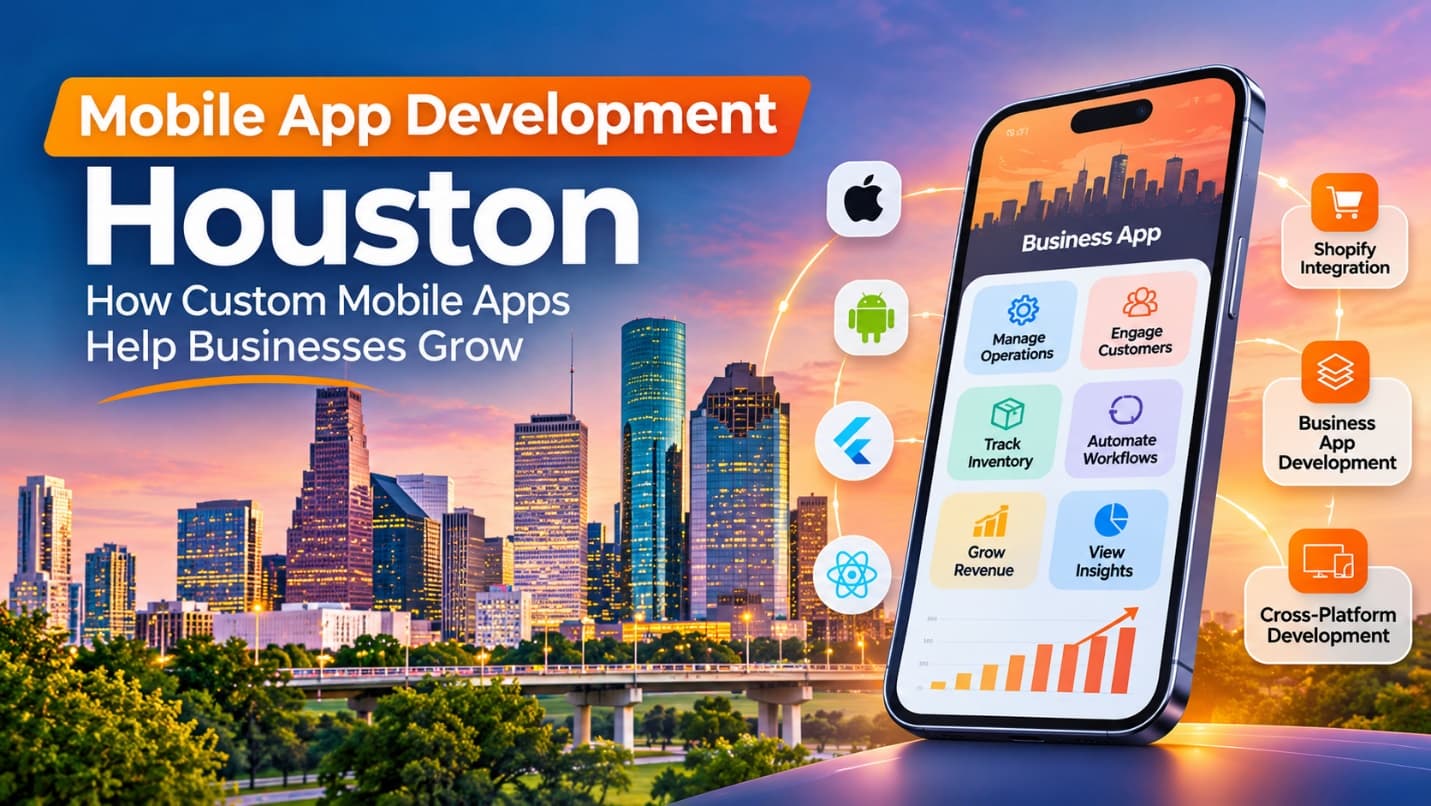
Running a business becomes complicated when customer requests, employee schedules, inventory records, and sales information are spread across different systems. A Houston retailer might struggle to manage online orders, while a logistics company could lose valuable time coordinating deliveries through phone calls and spreadsheets.
This is where mobile app development Houston services help businesses overcome operational challenges through customized digital solutions.
Rather than adding another piece of technology, a well-designed mobile application connects essential business activities, improves accessibility, and simplifies everyday operations.
For startups, small businesses, and established enterprises, custom applications can address challenges that ordinary software cannot fully solve.
App Vertices, a mobile app and custom software development company serving Houston and businesses across the United States, offers development solutions for organizations exploring digital transformation.
This guide explains how custom mobile applications solve operational problems, which technologies businesses should consider, what development may cost, and how to evaluate a project's potential return on investment.
What Is Custom Mobile App Development?
Custom mobile app development is the process of designing, building, and maintaining mobile applications tailored to a company's specific business requirements, users, and operational workflows.
Unlike ready-made software, custom applications can integrate directly with existing business systems and support specialized processes.
For example, a Houston property management company might need an application that allows tenants to submit maintenance requests, upload photographs, track repairs, and communicate with property managers.
Although subscription-based software may provide some of these features, custom development becomes valuable when integration requirements, workflows, or customer experiences demand greater flexibility.
However, businesses should first determine whether an existing solution can meet their needs at a lower total cost.
Why Mobile App Development in Houston Matters for Growing Businesses
Houston's diverse business environment creates different technology requirements across healthcare, energy, logistics, retail, and professional services.
For instance, healthcare organizations may need secure appointment management and patient communication. Meanwhile, logistics companies may benefit from driver tracking, delivery confirmation, and real-time dispatch updates.
Similarly, energy service providers can use mobile applications for field inspections, equipment reporting, and workforce coordination.
The value of mobile app development in Houston comes from solving these industry-specific challenges rather than simply launching an application.
Businesses should identify measurable operational problems before deciding which mobile technologies to invest in.
7 Business Problems Custom Mobile Apps Can Solve
1. Poor Customer Engagement and Retention
Customers may stop interacting with a business when booking services, checking orders, or accessing support becomes inconvenient.
A customer-facing application can simplify these interactions through personalized accounts, loyalty programs, service reminders, and relevant notifications.
For example, a Houston retail store could offer loyalty rewards and convenient reordering through its mobile application.
Potential benefit: A smoother customer experience may encourage repeat purchases and strengthen long-term relationships.
2. Time-Consuming Manual Business Processes
Manual data entry, paper forms, and repetitive administrative tasks consume employee time and increase the possibility of mistakes.
Custom business app development can automate activities such as appointment scheduling, invoice generation, expense approvals, and service reporting.
For example, a Houston maintenance company could replace paper inspection forms with mobile checklists that automatically update its central database.
As a result, managers gain faster access to completed reports while employees spend less time on administrative work.
3. Inefficient Employee Communication
Field employees and office teams often depend on disconnected communication channels.
A workforce application can centralize task assignments, project updates, document sharing, and shift schedules.
For instance, a Houston construction contractor could provide field supervisors with an application displaying updated work orders and safety documentation.
Consequently, employees can access relevant information without repeatedly contacting the office.
4. Disconnected Sales and Inventory Systems
When inventory, sales, and order management systems operate independently, businesses may encounter stock discrepancies and delayed fulfillment.
A custom application can connect point-of-sale systems, inventory databases, and eCommerce platforms through appropriate integrations.
For example, a retailer operating multiple Houston locations could synchronize stock information between stores and online sales channels.
This creates better inventory visibility and reduces the need for duplicate data entry.
5. Limited Access to Business Services
Customers increasingly expect convenient ways to interact with businesses outside traditional office hours.
Mobile applications can provide self-service features such as appointment booking, payment processing, account management, and request tracking.
A Houston real estate agency, for example, could allow prospective buyers to save properties, schedule viewings, and receive updates.
Importantly, these services remain accessible without requiring immediate assistance from an employee.
6. Difficulty Managing Business Growth
Processes that work for a small team may become inefficient as customer demand, locations, and employee numbers increase.
A scalable application can introduce standardized workflows, centralized permissions, and automated task routing.
For example, a Houston delivery company expanding into additional Texas markets could use one operational platform to coordinate drivers, dispatchers, and customers.
However, successful scaling also requires reliable infrastructure, monitoring, and ongoing technical maintenance.
7. Lack of Useful Customer and Operational Insights
Businesses sometimes collect large amounts of data without having a practical way to interpret it.
Mobile applications can connect analytics dashboards with customer interactions, service requests, sales records, and operational activities.
For instance, a service provider could identify recurring appointment cancellations or unusually long response times.
These insights help managers investigate problems and make more informed decisions instead of relying on assumptions.
How Custom Mobile Apps Support Business Growth
Custom mobile applications support business growth by improving the processes that influence customer satisfaction, productivity, and service delivery.
A thoughtfully designed application can make customer interactions more convenient, reduce repetitive work, and improve access to business information.
Furthermore, mobile technology can introduce revenue opportunities through subscriptions, digital bookings, mobile commerce, or premium services.
However, an application does not automatically produce business growth.
Results depend on customer adoption, product usability, integration quality, ongoing support, and whether the application solves a meaningful problem.
How should businesses calculate mobile app ROI?
Compare measurable financial benefits, such as additional contribution profit and labor savings, against development, hosting, maintenance, marketing, and operating costs.
For example, saving 20 employee hours monthly creates value only when those hours translate into meaningful cost savings or productive capacity.
Cross Platform Mobile App Development Services vs. Native Development
Cross platform mobile app development services allow businesses to create applications for iOS and Android using a largely shared codebase.
Popular frameworks include Flutter and React Native.
Flutter uses its own rendering approach, while React Native connects JavaScript or TypeScript application logic with native platform capabilities.
Native applications, on the other hand, are developed specifically for individual operating systems, commonly using Swift for iOS and Kotlin for Android.
| Decision factor | Cross-platform | Native |
|---|---|---|
| Codebase | Largely shared | Platform-specific |
| Development effort | Often lower for two platforms | Often higher for two platforms |
| Performance | Strong for many business apps | Greater direct platform control |
| Device integration | Plugins or native modules | Direct platform APIs |
| Maintenance | Shared logic simplifies updates | Separate platform maintenance |
| Best suited for | MVPs, retail, enterprise workflows | Specialized or demanding experiences |
For startups targeting both platforms, cross-platform development can be an efficient starting point.
However, applications requiring intensive graphics, specialized hardware access, or highly platform-specific experiences may benefit from native development.
The right decision depends on requirements, not framework popularity.
Business App Development: Essential Features for Modern Companies
Successful business app development begins with identifying the features users genuinely need.
Common requirements include:
- Secure authentication: Protect accounts through appropriate login and verification methods.
- CRM and ERP integrations: Connect customer records, inventory, and business operations.
- Real-time notifications: Communicate relevant updates without overwhelming users.
- Payment integrations: Support secure transactions through established payment providers.
- Booking and scheduling: Reduce appointment-related administrative work.
- Analytics dashboards: Monitor meaningful operational indicators.
- Role-based access: Restrict sensitive information according to employee responsibilities.
- Offline functionality: Support field workers operating with unreliable connectivity.
- Security controls: Apply encryption, access management, and privacy safeguards.
- Scalable backend architecture: Support increasing demand through appropriate infrastructure.
More importantly, businesses should prioritize features based on user needs and measurable outcomes.
An MVP, or minimum viable product, should contain enough functionality to test the core business idea without unnecessary complexity.
How Shopify App Development Services Help eCommerce Businesses
Shopify app development services can help retailers connect storefront operations, customer experiences, and internal workflows.
However, two different solutions are often confused.
A customer-facing mobile shopping app allows shoppers to browse products, manage accounts, receive notifications, and complete purchases.
A Shopify app extends a merchant's store functionality through integrations, administrative tools, or customized commerce features.
For example, a Houston clothing retailer could develop a mobile shopping experience connected to its Shopify catalog, customer accounts, and order information.
Meanwhile, a custom Shopify application could automate inventory synchronization or connect the store with warehouse software.
Both approaches can improve operational consistency, although implementation depends on Shopify's supported APIs, permissions, and integration requirements.
How Much Does Mobile App Development Cost in Houston?
Mobile application costs vary considerably according to functionality, complexity, and technical requirements.
A straightforward scheduling application generally requires less development effort than a healthcare platform involving sensitive information, multiple integrations, and complex permissions.
Major cost factors include interface design, supported platforms, backend systems, integrations, security requirements, testing, deployment, and maintenance.
Businesses should also account for hosting, third-party subscriptions, ongoing improvements, and application store requirements.
Instead of relying on a generic price estimate, request a detailed project proposal outlining deliverables, assumptions, timelines, exclusions, and maintenance responsibilities.
A well-defined scope makes competing development quotations easier to compare.
Step-by-Step Process for Building a Successful Business Mobile App
A structured development process reduces uncertainty and helps teams make better investment decisions.
- Business discovery: Identify operational problems, target users, business objectives, and existing technology constraints.
- Market research: Review competitors, user expectations, and alternative solutions before committing to development.
- MVP planning: Prioritize essential features and define measurable success criteria.
- UI/UX design: Create wireframes and interactive prototypes to test usability before coding.
- Technology selection: Choose native or cross-platform development based on requirements and long-term maintenance.
- Development and integration: Build application features, backend services, and connections with existing systems.
- Quality assurance: Test functionality, accessibility, performance, security, and supported devices.
- Launch and optimization: Release the application, monitor usage, resolve issues, and improve features using real feedback.
A focused MVP may take several months, while complex enterprise applications can require considerably longer. Timelines should reflect actual scope and dependencies.
How App Vertices Helps Houston Businesses Build Scalable Mobile Applications
App Vertices provides mobile application and custom software development capabilities for businesses exploring new digital products or improvements to existing systems.
Its relevant service areas include iOS and Android development, Flutter and React Native applications, UI/UX design, enterprise software, AI-related solutions, and ongoing application support.
For example, a startup could explore an MVP that validates customer demand before a larger investment.
Similarly, an established Houston business could evaluate custom integrations that connect mobile workflows with existing operational systems.
For eCommerce businesses, Shopify-connected development may help align customer-facing shopping experiences with internal order management.
The appropriate solution should emerge from a clear understanding of business requirements, technical constraints, and expected operational value.
How to Choose the Right Mobile App Development Company in Houston
Selecting a development partner requires more than comparing initial quotations.
Evaluate whether the company understands your industry, can explain its technology choices, and provides a transparent delivery process.
Review relevant portfolio examples, technical capabilities, project communication practices, security procedures, and testing methods.
Furthermore, ask who owns the source code, how project changes are handled, and what support is available after launch.
A reliable proposal should clarify deliverables, responsibilities, assumptions, and ongoing costs before development begins.
Frequently Asked Questions About Mobile App Development in Houston
What is mobile app development in Houston?
Mobile app development in Houston involves designing, developing, testing, and maintaining applications for businesses and customers in the Houston market. These applications may support iOS, Android, or both platforms. Businesses commonly use custom mobile apps to improve customer experiences, automate workflows, manage employees, and connect existing software systems.
How much does it cost to develop a custom mobile app in Houston?
The cost depends on application complexity, features, integrations, platform requirements, and security needs. A simple MVP generally costs less than a complex enterprise application. Businesses should request itemized estimates covering design, development, testing, deployment, and ongoing maintenance rather than relying on a universal price range.
How can mobile apps help small businesses grow?
Mobile applications can help small businesses simplify bookings, improve customer communication, automate repetitive activities, and support online transactions. For example, a Houston service provider could introduce mobile appointment scheduling and automated reminders. These improvements may reduce administrative workload and create a more convenient customer experience.
Are cross platform mobile app development services suitable for startups?
Yes. Cross-platform development is often suitable for startups that want to reach both iOS and Android users while sharing much of their application code. Flutter and React Native can support MVP development and future improvements. However, startups should evaluate performance requirements, integration complexity, and maintenance needs before selecting a framework.
How do Shopify app development services benefit eCommerce businesses?
Shopify app development services can help businesses customize store functionality, integrate external systems, automate order-related workflows, and improve inventory management. Additionally, customer-facing mobile applications can connect with Shopify to provide mobile shopping experiences. The appropriate solution depends on whether the business needs storefront improvements, operational automation, or both.
How can App Vertices help businesses develop custom mobile applications?
App Vertices offers mobile application and custom software development services relevant to startups, growing companies, and enterprises. Businesses can explore iOS, Android, cross-platform development, UI/UX design, and software integrations. A project discussion can help clarify requirements, evaluate technical options, and establish an appropriate development scope.
Conclusion: Build a Smarter Business with Custom Mobile Applications
Investing in mobile technology should begin with a clear business objective, not simply the desire to have an application.
Whether the challenge involves customer retention, disconnected systems, manual workflows, or expanding operations, custom mobile applications can provide practical ways to improve business performance.
For organizations exploring mobile app development Houston solutions, choosing the right features, development approach, and technology partner is essential.
App Vertices can help businesses evaluate custom application requirements and explore development solutions aligned with their operational goals.
Planning a Custom Mobile App for Your Houston Business?
Whether you're building a startup MVP, modernizing internal operations, or developing a customer-facing application, explore your requirements with App Vertices.
Visit App Vertices to discuss your mobile app development project.