



[Our Blogs]
Janitor AI Development: How to Build an AI Character Chatbot Platform in 2027
The right technology decision starts long before development begins. Practical insight on building mobile apps, AI products, custom software and cloud platforms — aimed at the questions businesses need answered before they invest.

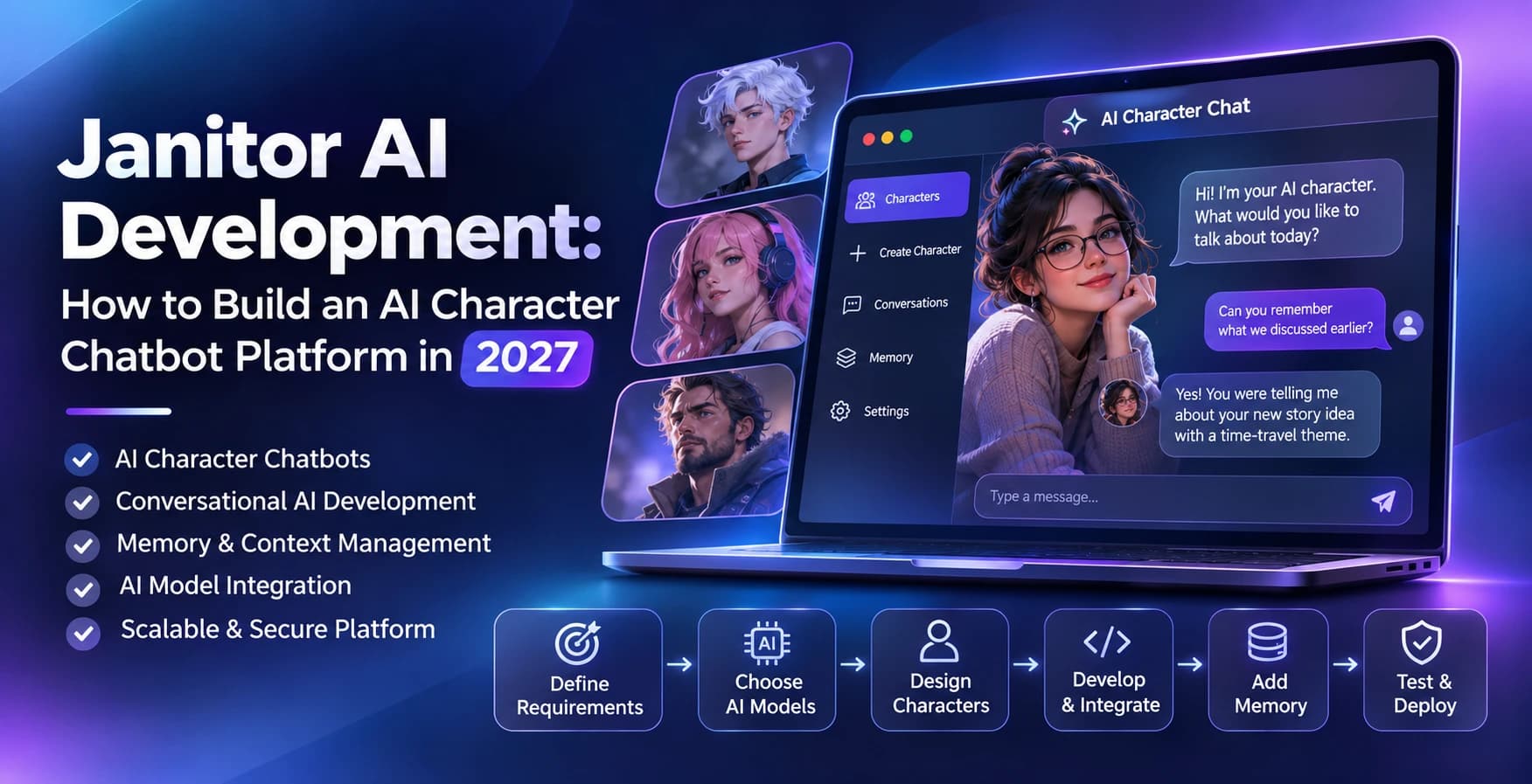
Building an AI chatbot that responds to messages is relatively straightforward. Creating one that remembers conversations, maintains a believable personality, and delivers consistent interactions is considerably more challenging.
Janitor AI demonstrates the appeal of character-based conversational experiences, where users interact with customizable AI personalities rather than conventional question-and-answer bots.
However, developing an independent platform with similar functionality requires more than connecting a large language model (LLM) to a chat interface. Developers must solve problems involving character consistency, conversation memory, response accuracy, privacy, and infrastructure costs.
For startups and businesses exploring AI chatbot development in 2027, understanding these technical challenges is essential.
This guide explains how to build an AI character chatbot platform, choose suitable technologies, implement reliable memory systems, and manage development costs without unnecessarily complicating the architecture.
What Is Janitor AI and How Does It Work?
Janitor AI is a character-based AI chat platform that allows users to interact with virtual personalities through natural-language conversations.
Unlike traditional customer support chatbots, which primarily answer questions or resolve service requests, character chatbots focus on personality, dialogue continuity, and interactive experiences.
A typical character chatbot operates through five components:
- Character configuration: Defines personality, background, behavior, and conversational style.
- Language model: Generates responses based on the conversation.
- Prompt management: Combines character instructions with relevant dialogue.
- Context management: Maintains information needed for coherent responses.
- Chat interface: Displays messages and manages user interactions.
The language model predicts responses using the instructions and context it receives. It does not automatically possess reliable long-term memory.
These components describe a general conversational AI architecture, not Janitor AI's proprietary implementation.
Why Build a Platform Similar to Janitor AI in 2027?
A character-based AI chatbot platform can support applications beyond casual conversation. Businesses can use conversational personalities to create interactive experiences tailored to specific audiences.
Potential applications include:
- Interactive entertainment: Fictional characters that participate in evolving stories.
- Educational simulations: Historical figures or fictional tutors that support guided learning.
- Virtual companions: Personalized conversational experiences with appropriate safety boundaries.
- Digital storytelling: Characters that respond dynamically to player decisions.
- Branded AI experiences: Virtual representatives that explain products through engaging conversations.
For example, a hypothetical language-learning startup could develop AI characters representing different conversational scenarios. Learners could practice ordering food, attending interviews, or navigating unfamiliar cities.
The business opportunity depends on whether the experience solves a meaningful user problem, not simply whether the chatbot produces entertaining responses.
Essential Features of a Janitor AI-Like Chatbot Platform
A reliable AI character chatbot needs features that support personalization, usability, safety, and sustainable operations.
| Essential feature | Problem it solves |
|---|---|
| Customizable characters | Gives each chatbot a distinct personality and conversational style |
| Context-aware conversations | Reduces irrelevant or contradictory replies |
| Conversation memory | Preserves useful details across interactions |
| AI model integration | Enables flexible model selection and upgrades |
| Character creation dashboard | Simplifies character management |
| User accounts | Supports saved conversations and preferences |
| Moderation and privacy controls | Helps protect users and sensitive information |
| Mobile-friendly interface | Improves accessibility across devices |
| Scalable infrastructure | Handles changing traffic without excessive delays |
Developers should prioritize a stable conversation experience before introducing advanced customization.
For example, sophisticated character avatars provide limited value if the chatbot frequently forgets the user's name or contradicts its established personality.
How to Build an AI Character Chatbot Platform: Step-by-Step Guide
Developing a Janitor AI-like platform involves designing a complete conversational system, from model selection to production monitoring.
Step 1: Define the Target Audience and Platform Requirements
Identify the primary users and the problems the platform should solve.
Determine whether the product supports entertainment, education, storytelling, or business interactions.
Document essential requirements, including supported languages, character customization, conversation storage, moderation policies, and expected usage.
Start with a minimum viable product (MVP) instead of implementing every feature immediately.
Step 2: Select the Right Large Language Model
The language model determines much of the chatbot's conversational capability.
Developers can evaluate hosted models or suitable open-weight alternatives.
Compare candidates based on:
- Response quality and instruction-following
- Context-window capacity
- Inference latency
- Pricing and deployment requirements
- Privacy and content policies
Test several models using identical character scenarios. The most expensive model is not necessarily the best choice for every application.
Step 3: Design Character Personalities and Prompt Structures
Character consistency requires structured instructions.
A character definition should specify personality traits, speaking style, background information, behavioral boundaries, and relevant fictional knowledge.
Separate permanent character instructions from temporary conversation context.
For example, a fictional detective character might use concise language, ask investigative questions, and avoid revealing information unavailable within the story.
Use evaluation conversations to identify personality drift and contradictory behavior.
Step 4: Develop the Chatbot Backend and API Integrations
The backend connects users, character configurations, language models, and stored conversations.
Developers can use Python with FastAPI or JavaScript with Node.js to create application endpoints.
Implement authentication, rate limiting, API-key protection, error handling, and streaming responses.
Never expose model-provider credentials directly in frontend code.
Step 5: Implement Context Management and Long-Term Memory
AI memory systems help characters reference relevant previous interactions.
Short-term memory uses recent messages, while long-term memory can retrieve selected details from stored conversations.
A practical approach combines conversation summaries, structured user preferences, and semantic retrieval through vector storage.
However, storing every message indefinitely increases costs and privacy risks.
Implement retention limits, deletion controls, and retrieval filters. Avoid treating retrieved memories as automatically trustworthy instructions.
Step 6: Build an Intuitive Chat Interface
Use React, Next.js, or Flutter to create a responsive conversational interface.
Prioritize readable messages, character profiles, loading indicators, conversation history, and clear error messages.
Streaming generated text can improve perceived responsiveness.
Test the interface on mobile devices and slower connections before introducing complex animations or visual effects.
Step 7: Integrate Safety, Privacy, and Content Moderation
Safety should be part of the architecture rather than an optional feature.
Implement input and output moderation, age-appropriate access controls where needed, abuse reporting, and secure data handling.
Protect personal information through encryption, access restrictions, and appropriate retention policies.
For agent-enabled systems, require explicit authorization before executing external actions.
Step 8: Test, Deploy, and Optimize the Platform
Evaluate the chatbot against realistic conversation scenarios.
Measure character consistency, factual accuracy, response latency, memory retrieval quality, and moderation performance.
Use automated regression tests alongside human evaluation.
Deploy gradually, monitor failures, and optimize model usage based on observed performance rather than assumptions.
Recommended Technology Stack for AI Character Chatbot Development
The right technology stack depends on platform requirements, available expertise, infrastructure costs, and privacy expectations.
| Component | Technology options | Purpose |
|---|---|---|
| Frontend | React, Next.js, Flutter | User interface |
| Backend | Python, FastAPI, Node.js | Application logic and APIs |
| AI models | Hosted or open-weight LLMs | Conversation generation |
| Database | PostgreSQL, MongoDB | User and chat data |
| Vector storage | pgvector, Pinecone | Semantic memory retrieval |
| Infrastructure | AWS, Azure, Google Cloud | Hosting and scalability |
For an MVP, PostgreSQL with pgvector may simplify operations by keeping application data and vector search within one database environment.
More specialized infrastructure becomes useful when actual traffic, retrieval complexity, or operational requirements justify it.
Common Challenges in Janitor AI-Like Development and How to Solve Them
Character chatbot development introduces several recurring engineering problems.
| Problem | Common cause | Practical solution |
|---|---|---|
| Inconsistent personality | Weak character instructions | Structured prompts and regression testing |
| Forgotten context | Limited context windows | Summaries and selective memory retrieval |
| Hallucinated information | Unsupported model generation | Grounding, verification, and uncertainty handling |
| Slow responses | Model latency or excessive context | Streaming, caching, and prompt optimization |
| High API expenses | Long prompts and unnecessary requests | Token budgets and model routing |
| Unsafe outputs | Insufficient moderation | Layered safety checks and reporting |
| Privacy risks | Excessive storage or weak access controls | Data minimization, encryption, and deletion tools |
| Scaling failures | Infrastructure bottlenecks | Queues, autoscaling, and load testing |
The most effective solutions address the underlying system design rather than relying exclusively on stronger language models.
How Custom AI Development Services Support Chatbot Development
Professional custom ai development services can help businesses develop platforms requiring specialized integrations, privacy controls, or complex conversational workflows.
Typical responsibilities include architecture planning, AI model integration, backend development, memory implementation, testing, and deployment.
Custom development becomes particularly valuable when a platform needs proprietary business data, strict security requirements, or integration with existing applications.
However, businesses should first validate their product concept. A narrowly scoped MVP can reveal user needs before substantial infrastructure investment.
How Agentic AI Can Improve Character Chatbot Platforms
Traditional conversational AI primarily generates responses. Agentic AI can additionally plan and execute authorized actions through connected tools.
An agentic ai development company may help implement capabilities such as information retrieval, scheduling, workflow execution, and controlled API interactions.
For example, an educational character could retrieve approved learning materials and generate a personalized study plan.
Agentic ai development services can support these multi-step workflows through tool orchestration, permission checks, and execution monitoring.
However, a standard storytelling chatbot generally does not need autonomous agents.
Adding agentic functionality without a clear use case increases complexity, security exposure, and operating costs.
How Much Does It Cost to Build a Janitor AI-Like Platform in 2027?
AI chatbot development cost depends on product scope, model usage, engineering requirements, and ongoing infrastructure consumption.
The largest cost drivers typically include development labor, AI inference, conversation memory, cloud hosting, security, testing, and maintenance.
A basic MVP with hosted model APIs may require less initial infrastructure investment than a heavily customized platform using self-hosted models.
However, recurring inference expenses can increase as conversation volume and context length grow.
To estimate costs, calculate expected monthly conversations, average tokens per interaction, model pricing, storage requirements, and operational support.
Because 2027 pricing and vendor offerings remain uncertain, businesses should obtain current quotations and build adjustable financial projections rather than rely on fixed future estimates.
Frequently Asked Questions About Janitor AI Development
What is Janitor AI used for?
Janitor AI is used for character-based conversations, interactive roleplay, and fictional dialogue experiences. Users can interact with AI personalities through natural-language messages. Its character-focused approach differs from conventional customer service chatbots, which primarily handle support questions and predefined business workflows.
Can you build your own chatbot like Janitor AI?
Yes. Developers can create an independent character chatbot using language models, custom prompts, conversation storage, and a web or mobile interface. Building a reliable platform also requires authentication, moderation, memory management, and infrastructure monitoring. The resulting product should use its own branding and architecture.
What Is the Best Programming Language for Developing AI Chatbots?
Python is a practical choice because of its AI ecosystem and backend frameworks. JavaScript or TypeScript is also suitable, particularly for teams developing full-stack web applications. The best language depends on existing expertise, deployment requirements, and the integrations needed.
How much does it cost to create an AI character chatbot?
Costs vary according to development complexity, model selection, usage volume, infrastructure, and security requirements. A limited prototype and a production platform have substantially different resource needs. Businesses should estimate development and recurring operational expenses separately before committing to a budget.
Can agentic AI improve character chatbot functionality?
Yes. Agentic AI can enable authorized tool usage, information retrieval, and multi-step task execution. These capabilities are useful when characters need to perform actions beyond conversation. However, ordinary roleplay and storytelling applications can often operate effectively without agentic architecture.
Final Thoughts
Developing a platform inspired by Janitor AI requires careful attention to character design, conversational quality, memory, privacy, and operating efficiency.
The strongest development strategy starts with a focused use case, validates the conversation experience, and introduces advanced capabilities only when they solve demonstrated user problems.
Businesses exploring custom AI development can benefit from an experienced development partner when their requirements involve complex integrations, specialized architecture, or production-scale deployment.
Ultimately, a successful AI character chatbot is defined not by the number of features it offers, but by how reliably those features serve its users.