



[Our Blogs]
How a Travel App Development Company Can Transform Your Tourism Business
The right technology decision starts long before development begins. Practical insight on building mobile apps, AI products, custom software and cloud platforms — aimed at the questions businesses need answered before they invest.

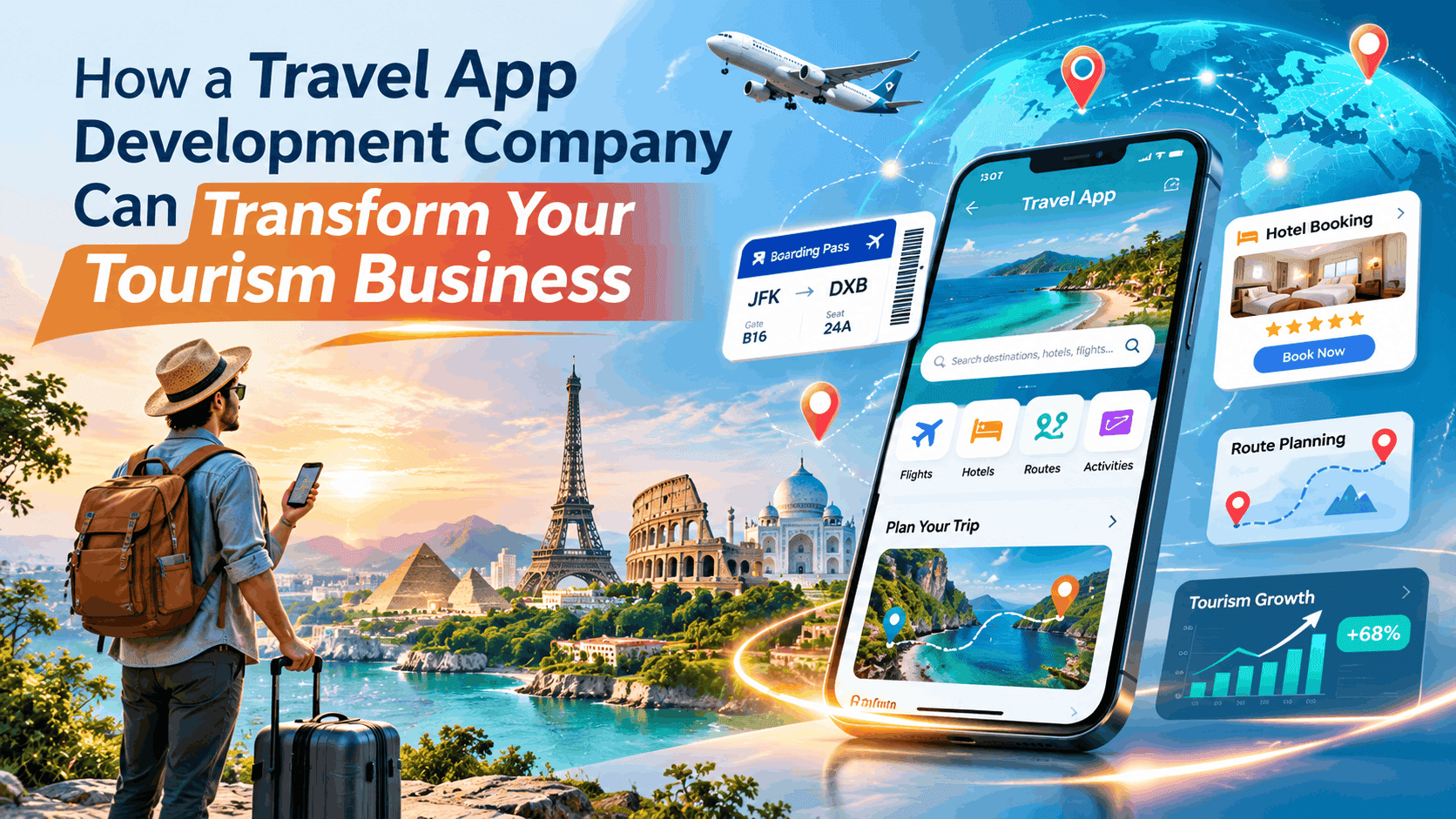
Imagine a traveler finding the perfect vacation package on your website, only to abandon the booking because the payment process is complicated. Meanwhile, your team is busy answering repetitive inquiries, manually confirming reservations, and updating availability across multiple platforms.
These challenges can quietly reduce revenue and frustrate potential customers.
A professional travel app development company helps tourism businesses overcome these problems by creating mobile applications that simplify reservations, automate operations, and deliver convenient travel experiences.
Moreover, custom travel technology allows businesses to manage customer relationships directly rather than depending entirely on third-party booking platforms.
Whether you operate a travel agency, hotel, tour company, or tourism startup, investing in the right mobile application can improve efficiency and support long-term growth.
Let's explore how travel mobile app development can address everyday business challenges and create measurable opportunities.
Why Tourism Businesses Need Digital Transformation
Modern travelers expect more than attractive destinations and competitive prices. They want convenient booking, transparent pricing, instant confirmations, and reliable information throughout their journeys.
However, many tourism businesses still depend on disconnected systems, manual spreadsheets, and lengthy reservation processes.
For example, a tour operator managing reservations through email may accidentally accept two bookings for the same limited-capacity excursion. Consequently, the company must issue refunds, handle complaints, and repair customer relationships.
Digital tourism solutions help prevent such problems through centralized availability management and automated booking workflows.
Furthermore, mobile applications can support:
- Convenient reservations: Customers can book travel services without calling an agent.
- Personalized planning: Travelers receive suggestions based on preferences and previous interactions.
- Real-time communication: Booking changes and relevant updates reach customers quickly.
- Digital payments: Secure payment integrations simplify transactions.
- Customer retention: Loyalty benefits and convenient rebooking encourage repeat business.
Ultimately, tourism business digital transformation is about reducing unnecessary friction for both travelers and employees.
How a Travel App Development Company Transforms Your Tourism Business
A skilled travel app development company does more than create an attractive mobile interface. It connects booking processes, customer information, payments, and operational tools into a more efficient digital experience.
Here are seven practical ways travel application development can improve tourism operations.
1. Simplifies Travel Bookings and Reservations
Complicated reservations are a common reason potential customers abandon purchases.
Travel booking app development addresses this challenge by allowing users to explore destinations, compare packages, check availability, and complete reservations within one application.
For instance, a customer booking a weekend getaway could select accommodation, transportation, and activities without switching between multiple websites.
Additionally, secure payment gateways and automated confirmations reduce unnecessary steps.
As a result, businesses can create a smoother purchasing journey while reducing manual booking errors.
2. Improves Customer Experience Through Personalization
Not every traveler wants the same experience. Some prefer budget-friendly adventures, while others prioritize luxury accommodation or family activities.
Therefore, custom tourism mobile applications can use customer preferences, travel history, and selected interests to provide more relevant recommendations.
AI-powered travel applications may also help generate itinerary suggestions or organize destination information.
However, effective personalization requires reliable data, user consent where applicable, and sensible recommendation rules.
For example, a family planning a holiday could receive suggestions for child-friendly attractions rather than unrelated adventure packages.
3. Automates Time-Consuming Business Operations
Manual administration becomes increasingly difficult as booking volumes grow.
Fortunately, travel applications can automate repetitive activities such as reservation confirmations, payment receipts, cancellation requests, and itinerary notifications.
Consider a travel agency handling dozens of daily bookings. Instead of manually emailing every customer, its system can automatically send confirmations and update reservation records.
Meanwhile, employees can focus on complex customer requests and supplier coordination.
Consequently, automation improves consistency while allowing teams to use their working hours more effectively.
4. Creates New Revenue Opportunities
A travel application can become an additional sales channel rather than simply a booking tool.
For example, hotels can offer airport transfers, breakfast upgrades, or guided excursions during the reservation process.
Similarly, tour operators can recommend complementary activities based on a customer's destination and itinerary.
Additional revenue opportunities include premium packages, membership benefits, local experiences, and relevant travel add-ons.
However, recommendations should remain useful rather than overwhelming customers with unnecessary offers.
5. Provides Real-Time Travel Information
Travel plans can change unexpectedly because of transportation delays, weather conditions, or service disruptions.
Therefore, timely communication is essential.
Travel applications can provide booking updates, itinerary changes, destination alerts, and push notifications through connected information services.
For instance, an airport transportation provider could notify passengers when their assigned driver is approaching.
Nevertheless, real-time accuracy depends on reliable APIs, third-party data availability, and appropriate system integrations.
6. Strengthens Customer Loyalty and Retention
Attracting customers is important, but encouraging them to return can be equally valuable.
Travel applications support retention through saved preferences, personalized offers, loyalty rewards, and convenient rebooking.
Additionally, in-app customer support and feedback tools make it easier to resolve concerns after a trip.
For example, a returning traveler could access previous itineraries and book a similar holiday without entering every detail again.
As a result, repeat purchasing becomes more convenient.
7. Supports Business Scalability
As tourism businesses expand, their technology must accommodate additional destinations, service providers, and booking activity.
A properly designed application can support this growth through modular architecture, scalable cloud infrastructure, and dependable integrations.
Furthermore, centralized administrative systems help businesses manage multiple locations without creating entirely separate workflows.
However, scalability requires ongoing performance monitoring, infrastructure planning, and maintenance rather than simply choosing a cloud provider.
Essential Features Every Modern Travel App Should Include
The most effective travel applications prioritize features that solve genuine customer and operational problems.
| Feature | Business value | Priority |
|---|---|---|
| Registration and user profiles | Saves customer preferences and booking details | MVP |
| Destination search and filters | Helps travelers discover suitable options | MVP |
| Booking and availability management | Supports accurate reservations | MVP |
| Secure payment integration | Enables convenient transactions | MVP |
| Booking alerts | Communicates confirmations and changes | MVP |
| Administrative dashboard | Centralizes bookings and customer requests | MVP |
| Interactive maps | Supports destination and location discovery | Advanced |
| Personalized itineraries | Improves trip planning | Advanced |
| Multilingual and multicurrency support | Serves international audiences | As needed |
| In-app customer support | Simplifies assistance | As needed |
| Ratings and reviews | Collects useful customer feedback | Advanced |
| Offline travel information | Provides access without connectivity | Advanced |
| Analytics and reporting | Reveals booking and customer trends | Advanced |
An MVP, or minimum viable product, contains the essential functionality needed to launch and validate an application.
For example, a small tour operator might initially need only package listings, booking management, payments, and confirmations.
Subsequently, the business can introduce AI recommendations, loyalty programs, and advanced analytics based on customer demand.
This phased approach helps control development costs and reduces the risk of investing in unnecessary features.
How Custom Mobile App Development Services Benefit Travel Businesses
Prebuilt travel software can be a practical solution for businesses that need simple and efficient booking management.
However, standardized platforms may become restrictive when operations involve specialized pricing, supplier relationships, or reservation rules.
Custom mobile app development services allow businesses to design applications around their actual workflows.
For instance, a wildlife tour operator may require seasonal availability, group-size restrictions, equipment reservations, and guide assignments.
A generic booking platform might not support these requirements without complicated workarounds.
In contrast, a custom application can integrate those rules directly into its reservation system.
Moreover, custom development provides greater flexibility over branding, third-party APIs, reporting, and future enhancements.
Data ownership and portability should also be defined contractually, including access rights, hosting arrangements, and export capabilities.
Although custom development generally requires greater initial planning, it can provide better long-term alignment with specialized business needs.
The Role of an On Demand App Development Company in Tourism
An on demand app development company builds applications that connect customers with services available at a particular time or location.
In tourism, this model is especially useful for instant bookings and location-based experiences.
For example, travelers arriving in an unfamiliar city could use an application to reserve airport transportation, discover available local guides, or book last-minute activities.
Additionally, location services can help customers identify nearby experiences.
However, on-demand platforms require accurate supplier availability, dependable scheduling, cancellation policies, and timely communication.
Therefore, this model works best when tourism providers can reliably fulfill requests within clearly defined service windows.
Why iOS App Development Services Matter for Travel Businesses
For tourism companies serving iPhone users, professional ios app development services can deliver a responsive, accessible, and well-integrated mobile experience.
Native iOS applications can take advantage of supported Apple technologies, including Apple Pay, location services, and platform-specific accessibility features.
Furthermore, developers can optimize navigation, performance, and security around Apple's ecosystem.
However, native iOS development is not automatically the best choice for every tourism business.
Cross-platform frameworks such as Flutter and React Native can help companies serve Android and iOS audiences through a shared codebase.
Ultimately, the decision should depend on customer demographics, required functionality, maintenance resources, and budget.
Regardless of the approach, applications must satisfy relevant App Store policies and privacy requirements.
How to Choose the Right Travel App Development Company
Selecting the ideal development partner involves assessing their technical expertise, industry experience, and ability to understand your business goals.
First, examine whether the company understands booking systems, payment processing, supplier integrations, and travel-specific customer journeys.
Next, review its approach to UI/UX design, security, application testing, and scalable architecture.
Additionally, ask potential development partners these questions:
- Have you developed applications involving complex booking workflows?
- How will the application integrate with existing reservation systems?
- What security measures protect customer and payment information?
- How are project milestones, costs, and changes managed?
- Which technologies best support our target audience?
Moreover, request a clear project scope and ownership agreement before development begins.
A dependable partner should explain technical trade-offs, identify integration risks, and help prioritize features rather than recommending every possible capability.
How App Vertices Can Help Build Your Travel Application
App Vertices delivers tailored mobile app development and innovative technology solutions designed to meet the unique digital needs of tourism businesses.
Its development capabilities can help companies plan, design, build, test, and maintain applications tailored to their operational needs.
For example, a travel agency might require custom booking workflows, payment integrations, customer dashboards, and cloud-based reservation management.
Additionally, App Vertices can help businesses evaluate native and cross-platform development approaches according to their requirements.
By focusing on practical functionality, integration planning, and maintainable architecture, tourism companies can develop applications that support both customer convenience and business operations.
Conclusion
A professional travel app development company can help tourism businesses simplify bookings, automate administrative work, personalize customer experiences, and build stronger customer relationships.
Moreover, well-planned travel applications create opportunities for direct sales, better operational visibility, and future expansion.
However, successful development begins with understanding customer needs, defining realistic priorities, and choosing appropriate technology.
Whether you're launching a tourism startup or modernizing an established travel business, a custom application can provide a practical foundation for digital growth.
Partner with App Vertices to transform your travel business ideas into a powerful, scalable, and user-friendly mobile application tailored to your unique business goals.
Frequently Asked Questions (FAQs)
In What Ways Can a Travel App Development Company Help Tourism Businesses Grow?
A travel app development company creates customized mobile applications that streamline tourism operations, improve customer experiences, and support sustainable business growth. These solutions simplify travel reservations, itinerary planning, secure payment processing, and customer communication while helping businesses manage their services more efficiently.
What Factors Determine the Cost of Custom Travel App Development?
The cost of developing a travel app varies based on its features, design requirements, chosen platform, third-party integrations, security measures, and long-term maintenance needs. For example, a basic booking MVP generally requires fewer development resources than a marketplace featuring multiple suppliers and real-time availability. Therefore, a requirements-based estimate is more reliable than a universal price.
What Key Features Should a Successful Tourism Mobile App Have?
A tourism application should typically include destination search, booking management, secure payments, customer profiles, and reservation notifications. Additionally, businesses may benefit from maps, itinerary management, multilingual support, and customer service features. However, the initial feature set should reflect the target audience and core business model.
What Is the Typical Timeframe for Developing a Custom Travel Booking App?
Development timelines depend on project scope, technical complexity, design requirements, and third-party integrations. A focused MVP generally takes less time than a comprehensive travel marketplace. Furthermore, supplier API approvals, testing, and payment integrations can affect delivery schedules. A development partner should provide milestones after reviewing the requirements.
Why should tourism businesses choose App Vertices for travel app development?
App Vertices offers custom mobile app development capabilities that can support travel booking systems, customer-facing applications, cloud integrations, and specialized business workflows. Additionally, its broader technology services allow tourism businesses to explore solutions aligned with their operational needs, target customers, and long-term application strategy.