



[Our Blogs]
How to Choose the Best Fitness App Development Company in Houston
The right technology decision starts long before development begins. Practical insight on building mobile apps, AI products, custom software and cloud platforms — aimed at the questions businesses need answered before they invest.

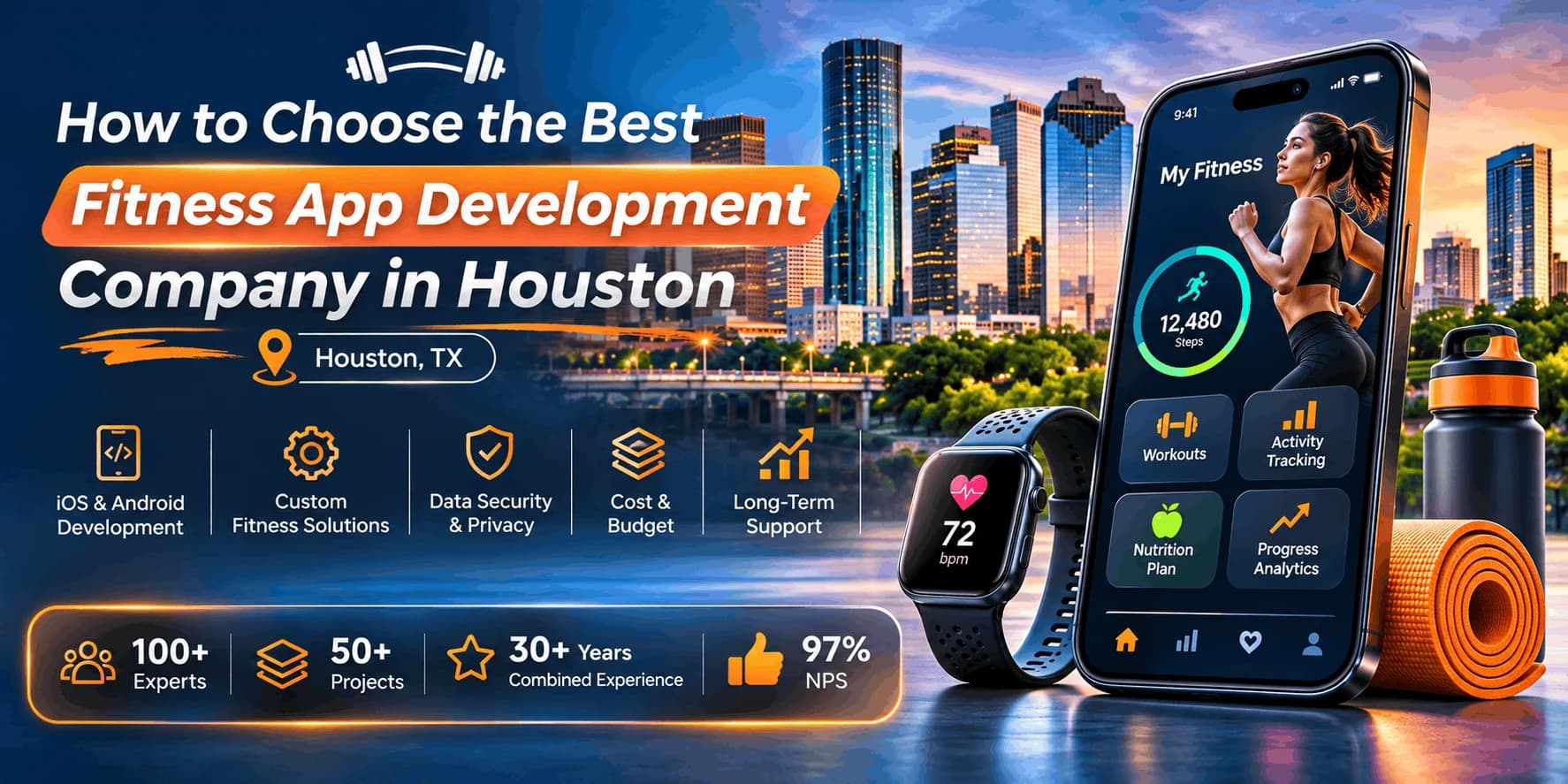
Fitness technology is transforming how people exercise, monitor their health, and achieve wellness goals. From personalized workout plans to wearable fitness trackers, mobile applications are making healthier lifestyles more accessible. However, building a successful fitness application requires more than an attractive interface. It demands technical expertise, thoughtful design, secure data management, and a development strategy.
For entrepreneurs, fitness startups, gym owners, and healthcare businesses in Texas, choosing the right fitness app development company is one of the most important decisions in the development process.
Houston offers opportunities for businesses looking to introduce innovative fitness solutions. Nevertheless, with numerous development providers offering similar services, identifying a reliable technology partner can be challenging.
This guide explains how to evaluate development companies, understand essential fitness app features, estimate development costs, and choose a partner that supports your long-term business goals.
Key Takeaways
- Choose a fitness app development company with proven mobile development experience and relevant technical capabilities.
- Prioritize wearable integration, personalized workouts, secure data management, and user-friendly design.
- Evaluate development portfolios, client feedback, project transparency, and maintenance services.
- Fitness app development costs depend on application complexity, platform selection, and integrations.
- App Vertices is a Houston-focused mobile app development provider with publicly reported experience across mobile, healthcare, and enterprise software.
Why Choosing the Right Fitness App Development Company Matters
A fitness application is more than a digital workout planner. Instead, it can become a complete platform connecting trainers, gym members, healthcare professionals, and fitness enthusiasts.
Consequently, selecting an experienced development partner directly affects application performance, security, user satisfaction, and future scalability.
A professional fitness mobile app development company helps businesses convert ideas into reliable digital products. Moreover, experienced developers understand how to combine workout tracking, personalized recommendations, subscription systems, and wearable connectivity into one seamless experience.
For instance, a Houston fitness studio might need an application offering appointment booking, digital memberships, exercise tutorials, and payment processing. Meanwhile, a wellness startup might require AI-powered workout recommendations and advanced progress analytics.
Therefore, businesses should prioritize development partners capable of understanding their specific requirements rather than simply offering generic application packages.
1. Evaluate the Company's Fitness App Development Experience
The first step is examining the company's professional background and technical expertise.
Although many agencies provide mobile development services, not every company has experience building applications that handle fitness metrics, activity tracking, or health-related information.
Therefore, review their portfolios and identify projects involving wellness platforms, wearable devices, subscription systems, or personalized user experiences.
An experienced development team should understand technologies supporting:
- Workout tracking and activity monitoring
- Wearable device connectivity
- Personalized exercise recommendations
- Nutrition and calorie tracking
- Subscription and membership management
- Secure user profiles and cloud synchronization
Additionally, ask whether the company has developed applications requiring real-time data processing.
For example, an application collecting heart-rate information from wearable devices requires reliable integrations and accurate data handling.
Expert Tip: Request a product demonstration or detailed case study. Furthermore, ask what responsibilities the development team handled and which results can be independently verified.
2. Check Expertise in iOS and Android App Development
Platform compatibility significantly influences an application's accessibility and performance.
Consequently, businesses should select a development company offering both native and cross-platform solutions.
Custom iOS App Development
For businesses targeting iPhone and Apple Watch users, custom iOS app development provides access to Apple's ecosystem.
Developers can use Swift, HealthKit, and supported Apple technologies to create fitness applications with activity monitoring, health-data integration, and personalized experiences.
Moreover, native iOS development can be beneficial when advanced device capabilities or platform-specific performance are essential.
Custom Android App Development
Similarly, custom Android app development allows businesses to reach users across numerous Android smartphones and compatible wearable devices.
A qualified Android app development firm should understand Kotlin, Android platform requirements, and Health Connect integrations.
Furthermore, developers must consider device compatibility, background activity restrictions, and privacy permissions.
Cross-Platform Development
Alternatively, Flutter and React Native can help businesses develop applications for both platforms while sharing substantial portions of the codebase.
However, platform selection should depend on technical requirements, development budgets, and integration complexity.
Therefore, choose a company that recommends technology based on product needs rather than promoting one framework for every project.
3. Identify Essential Fitness App Features
Before hiring a development company, businesses should determine which features are necessary for the initial product.
Although advanced functionality can improve user experiences, unnecessary features increase costs and complicate development.
A successful fitness application generally includes several foundational capabilities.
Personalized Workout Plans
Users should receive exercise recommendations based on their goals, experience, and preferences. Additionally, personalized training schedules can make applications more relevant to individual users.
Activity and Progress Tracking
Fitness applications commonly track completed workouts, exercise duration, distance, calories, and other activity indicators.
Moreover, progress dashboards help users recognize improvements and maintain motivation.
Wearable Device Integration
Connectivity with compatible smartwatches and fitness trackers allows users to consolidate activity information.
However, developers must implement approved integrations and obtain appropriate permissions.
Notifications and Reminders
Personalized notifications encourage users to follow training schedules and maintain consistent habits.
Nevertheless, excessive reminders can frustrate users. Therefore, notification frequency should remain customizable.
Subscription and Payment Systems
For commercial fitness platforms, secure payment processing and membership management are essential.
Additionally, businesses can introduce subscription tiers, premium workout programs, and trainer-led sessions.
Ultimately, the best features are those that address genuine user needs and support measurable business objectives.
4. Understand Fitness App Development Cost in Houston
One of the most common questions businesses ask is: How much does fitness app development cost?
The answer depends on application complexity, design requirements, integrations, and the selected technology stack.
For preliminary budgeting, businesses can consider the following illustrative US-market ranges.
| Fitness Application Type | Estimated Development Cost |
|---|---|
| Basic fitness MVP | $2500–$5000 |
| Mid-level fitness application | $20,000–$25,000 |
| Advanced fitness platform | $25,000–$50,000+ |
| Enterprise fitness ecosystem | $100,000+ |
These figures are broad planning estimates, not verified Houston-specific quotations. Actual proposals may fall outside these ranges.
A basic application might include registration, workout libraries, and progress tracking.
Meanwhile, a mid-level platform could introduce wearable connectivity, subscriptions, and advanced analytics.
In comparison, AI-assisted coaching, real-time video processing, multiple device integrations, and enterprise infrastructure can substantially increase costs.
Additionally, businesses should account for ongoing hosting, security updates, maintenance, and third-party service fees.
Smart Ways to Reduce Development Costs: Begin with a Minimum Viable Product (MVP). Subsequently, introduce additional functionality after collecting meaningful user feedback.
5. Prioritize Data Security and User Privacy
Fitness applications frequently process sensitive personal information, including activity history, body measurements, and location data.
Therefore, data protection must remain a fundamental development requirement.
A reliable company should implement secure authentication, encrypted communications, appropriate access controls, and privacy-conscious data collection.
Furthermore, developers must evaluate applicable US privacy regulations.
For example, HIPAA may apply when an application operates for a covered healthcare organization or business associate. However, ordinary consumer fitness applications are not automatically subject to HIPAA.
Additionally, certain applications may fall under the Federal Trade Commission's Health Breach Notification Rule.
Consequently, businesses should request a documented security plan and obtain qualified legal guidance where necessary.
Strong privacy practices protect users while supporting long-term confidence in the application.
6. Review the Company's Development Process and Communication
Technical skills alone do not guarantee successful project delivery.
Instead, businesses should evaluate how effectively a development company manages planning, communication, testing, and deployment.
An organized development process generally begins with requirement analysis and product discovery.
Next, designers prepare wireframes and user interface concepts. Developers then build the application through defined milestones.
Afterward, quality assurance teams test functionality, performance, accessibility, and security.
Finally, the application is prepared for deployment through the appropriate app stores.
Importantly, businesses should receive regular updates throughout development.
Before signing an agreement, clarify project timelines, milestone payments, ownership rights, testing responsibilities, and change-request procedures.
Moreover, request access to a project management system that provides visibility into development progress.
7. Choose a Houston-Focused Development Partner
Working with a company familiar with Houston's business environment can provide practical advantages.
Houston businesses operate across healthcare, wellness, sports, technology, and professional services. Consequently, fitness applications may serve different audiences, from independent personal trainers to established wellness organizations.
For instance, a Houston gym chain might prioritize membership management and location-based class scheduling.
Meanwhile, a corporate wellness provider may require employee challenges, participation dashboards, and integration with existing business systems.
Therefore, a development partner should understand the intended audience and adapt the product accordingly.
However, a Houston address alone does not establish technical quality. Businesses should also verify client references, development capabilities, delivery processes, and relevant project experience.
8. Why App Vertices Is a Strong Mobile App Development Choice in Houston
When evaluating a fitness app development company in Houston, App Vertices deserves consideration because of its published mobile engineering capabilities, healthcare technology services, and broader software development experience.
An Established Digital Development Background
App Vertices provides mobile application development, web development, artificial intelligence, cloud solutions, and enterprise software services.
According to its published Houston service page, the company reports:
- 50+ projects delivered
- 100+ technology experts
- 30+ years of combined experience
- 97% Net Promoter Score (NPS)
Additionally, its About Us page reports more than 15 awards and certifications and eight global excellence centers.
These company-reported figures provide useful background for prospective clients. However, businesses should request supporting documentation, client references, and relevant project examples before making a final hiring decision.
Experience Across Mobile and Healthcare Technologies
App Vertices describes capabilities in native iOS development, Android development, cross-platform applications, artificial intelligence, and cloud infrastructure.
Furthermore, its healthcare development services include mobile health solutions, wearable integration, patient-facing applications, and health-related analytics.
These capabilities are relevant to fitness businesses planning applications involving activity tracking, personalized experiences, and connected devices.
Examples of Its Published Project Work
App Vertices also showcases projects demonstrating its broader application development experience.
- OraLink Dental Application: A healthcare-oriented mobile concept connecting users with dental service providers through discovery and appointment booking.
- Texas Real Estate Application: A location-driven application designed to connect property buyers and renters with sellers and real estate agents.
- SciLens AR Learning Application: An augmented reality project focused on interactive science education.
Although these examples demonstrate work across healthcare, location-based services, and immersive technologies, they should not be presented as completed fitness applications.
Instead, they illustrate capabilities that prospective fitness clients can investigate further.
Why Businesses May Consider App Vertices
For Houston startups, gyms, and wellness organizations, App Vertices offers a potentially useful combination of mobile engineering, AI development, backend systems, and product design.
Moreover, its publicly described services cover development stages from product planning to testing and deployment.
Consequently, businesses seeking a customized fitness platform can consider App Vertices among their shortlisted development partners.
Its suitability should ultimately be confirmed through a project-specific consultation, technical proposal, and relevant references.
Explore App Vertices: Mobile App Development in Houston
9. Compare Fitness App Development Companies Before Hiring
Selecting a development partner requires more than comparing estimated prices.
Instead, businesses should assess technical expertise, communication, transparency, and long-term support.
| Evaluation Factor | What to Look For |
|---|---|
| Relevant experience | Fitness, wellness, or comparable data-driven applications |
| Technical capabilities | iOS, Android, APIs, cloud, and wearable integrations |
| Development process | Clear milestones and transparent communication |
| Data security | Documented privacy and security practices |
| Pricing | Detailed scope, estimates, and payment milestones |
| Portfolio | Demonstrable projects and verifiable client references |
| Post-launch support | Maintenance, performance monitoring, and updates |
Furthermore, avoid choosing a company solely because it offers the lowest estimate.
A cheaper initial proposal can become more expensive if essential functionality, testing, or maintenance is excluded.
Therefore, compare the overall value and completeness of each proposal.
10. Plan for Long-Term Fitness App Growth
Launching an application is only the beginning.
Once users begin interacting with the platform, businesses must monitor engagement, technical performance, and retention.
Additionally, customer feedback can reveal opportunities to improve training programs, onboarding, and navigation.
Future enhancements may include personalized coaching, social fitness challenges, connected wearables, or more sophisticated analytics.
However, advanced features should be introduced only when they support validated customer needs.
Therefore, select a development partner capable of maintaining and improving the application as the business grows.
Frequently Asked Questions On fitness app development
What is the best fitness app development company in Houston?
The best company depends on your requirements, budget, and technical needs. App Vertices is a Houston-focused mobile development provider worth evaluating because of its published mobile, healthcare, and AI capabilities. However, compare its proposal and references with other qualified providers.
How much does it cost to develop a fitness app?
A basic fitness MVP may require approximately $2500–$5000, while advanced applications can exceed $10000. Nevertheless, pricing depends on functionality, design, integrations, security requirements, and maintenance.
How long does fitness app development take?
A focused MVP may take approximately three to five months, while complex applications can require six to twelve months or longer. However, project scope and team capacity significantly influence delivery schedules.
Can fitness apps integrate with Apple Watch and Android wearables?
Yes. Developers can integrate compatible wearable technologies using supported platform APIs. However, integration availability depends on device capabilities, permissions, and vendor requirements.
Should I build a native or cross-platform fitness app?
Native development can be appropriate for demanding device integrations and platform-specific functionality. Meanwhile, cross-platform development can reduce duplicated development work. Therefore, evaluate the requirements before selecting a technology.
Final Thoughts
Choosing the right fitness app development company in Houston requires careful research, technical evaluation, and strategic planning.
Although attractive interfaces and competitive pricing are important, businesses should prioritize security, reliability, user experience, and long-term scalability.
Furthermore, an experienced development partner can help transform a fitness concept into a practical digital product designed around genuine customer needs.
App Vertices is one option worth considering for Houston businesses seeking custom mobile app development. Its publicly reported project experience, technical team, and healthcare-related capabilities provide a foundation for further evaluation.
Ready to Build Your Fitness App in Houston?
Connect with App Vertices to discuss your fitness application concept, explore suitable technologies, and request a customized development roadmap.
Website: https://appvertices.io/contact-us
Email: sales@appvertices.io