



[Our Blogs]
How AI-Powered Custom Mobile App Development Services Are Transforming Businesses in 2027
The right technology decision starts long before development begins. Practical insight on building mobile apps, AI products, custom software and cloud platforms — aimed at the questions businesses need answered before they invest.

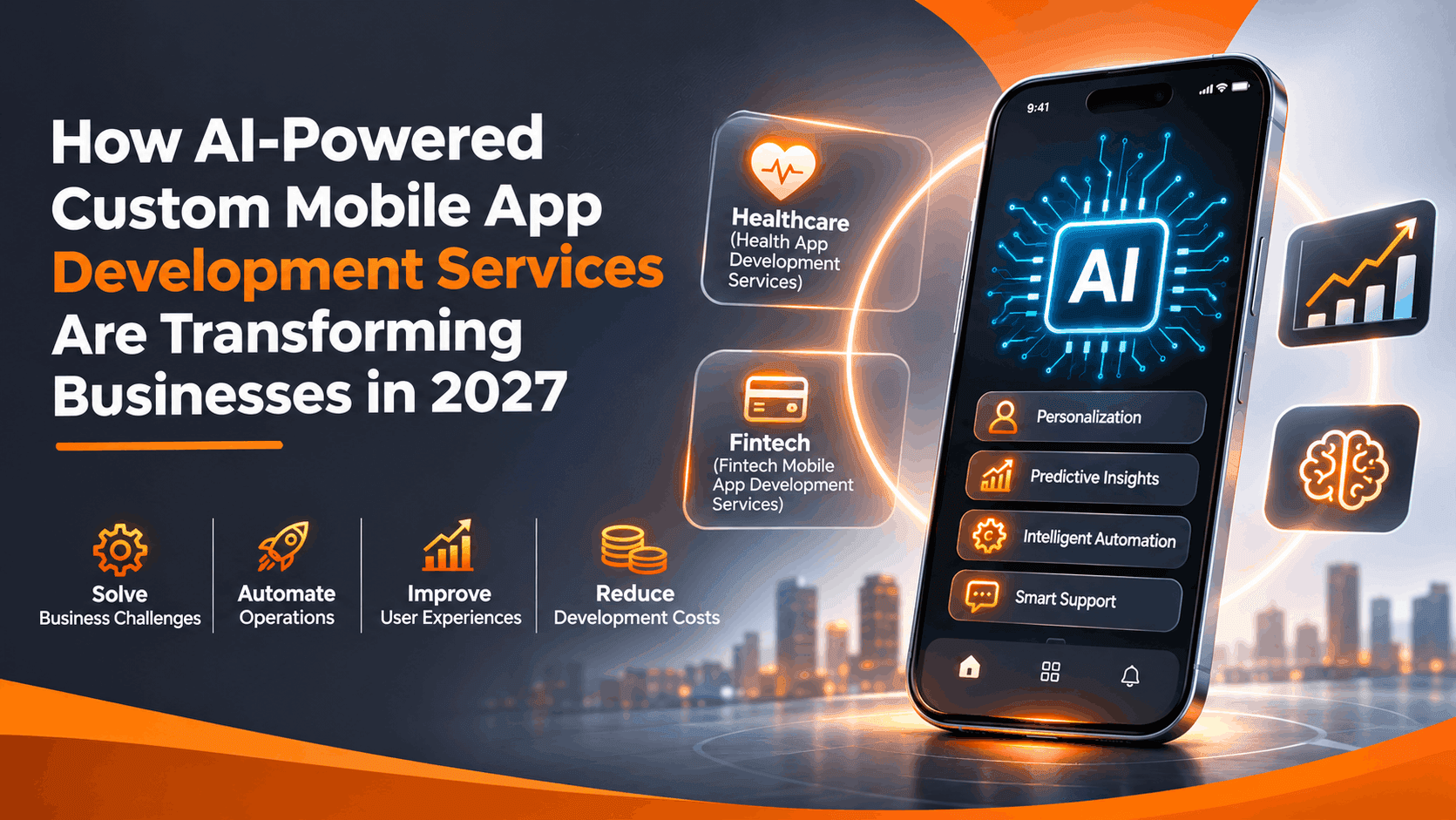
Artificial intelligence is changing what businesses expect from mobile applications. Customers increasingly want faster support, personalized recommendations, and convenient digital experiences. Meanwhile, companies need better ways to manage operations, understand customer behavior, and reduce repetitive work.
This is where custom mobile app development services play a crucial role in helping businesses achieve their goals. By combining tailored software with artificial intelligence, businesses can build applications that respond intelligently to users and support specific operational goals.
As 2027 approaches, understanding these technologies is becoming increasingly important. This guide explores how AI-powered mobile applications work, their benefits, industry applications, development costs, and the factors businesses should consider before investing.
What Are AI-Powered Custom Mobile App Development Services?
AI-powered custom mobile app development services involve designing and building mobile applications tailored to a business's requirements while incorporating artificial intelligence capabilities.
Unlike traditional applications that primarily follow predefined instructions, AI-enabled apps can analyze information, recognize patterns, generate responses, and provide recommendations.
For example, a conventional retail application might display the same product categories to every customer. An AI-powered alternative could recommend products based on browsing history, purchase preferences, and available inventory.
How Custom Mobile App Development Services Integrate AI
Developers can incorporate AI through machine learning models, cloud-based APIs, natural language processing, and on-device intelligence.
However, successful integration requires more than connecting an AI service. Businesses must consider data quality, privacy, response accuracy, infrastructure costs, and how the technology improves the overall user experience.
How AI Is Changing Custom Mobile App Development Services in 2027
Several AI technologies are creating opportunities for businesses preparing their mobile strategies for 2027.
1. AI Chatbots and Virtual Assistants
Intelligent assistants can answer routine questions, guide customers through transactions, and help users navigate applications.
For instance, an e-commerce chatbot could explain delivery options or locate an order without requiring customers to contact support.
2. Predictive Analytics
Predictive models analyze historical information to estimate future outcomes.
Retailers can use forecasting to anticipate demand, while logistics companies can identify potential delivery delays. Nevertheless, prediction quality depends heavily on reliable data.
3. Personalized User Experiences
Machine learning can help applications recommend relevant products, services, and content.
Consequently, businesses can create more useful experiences without manually configuring every recommendation.
4. Natural Language Processing
Natural language processing (NLP) allows applications to interpret and process human language.
For example, customers may search for products conversationally instead of navigating multiple filters.
5. AI-Powered Workflow Automation
AI can assist with document classification, support-ticket routing, data extraction, and administrative processes.
As a result, employees can spend less time on repetitive tasks and focus on activities requiring human judgment.
Key Business Advantages of AI-Powered Custom Mobile App Development
Businesses investing in custom mobile app development services can pursue several measurable improvements.
- Better customer experiences: Intelligent support and personalized interfaces make applications easier to use.
- Reduced manual work: Automated processes can decrease repetitive administrative tasks.
- Improved decisions: AI-generated insights help teams identify trends and operational issues.
- Greater personalization: Recommendations can reflect individual preferences and behavior.
- Operational efficiency: Connected systems can reduce duplicate data entry and unnecessary workflows.
- Scalability: Well-designed architectures can support additional users, features, and integrations.
However, these benefits are not automatic. Companies should establish performance indicators, test AI accuracy, and evaluate whether implementation costs justify the expected improvements.
How AI Is Transforming Healthcare Mobile Applications
Healthcare organizations are exploring AI to improve patient engagement, administrative efficiency, and access to information.
Professional health app development services can support applications with intelligent appointment scheduling, medication reminders, remote monitoring, and personalized wellness features.
For example, a patient engagement application could identify missed appointments and send appropriate follow-up reminders. Similarly, remote monitoring software could highlight unusual readings for clinical review.
Nevertheless, healthcare applications require particular attention to sensitive information. Depending on their intended use and jurisdiction, AI-enabled medical software may need clinical validation, regulatory review, and appropriate privacy safeguards.
The U.S. Food and Drug Administration provides guidance concerning software functions that may qualify as medical devices.
How AI Is Improving Fintech Mobile App Development
Financial technology companies increasingly use intelligent systems to support secure transactions and convenient digital banking.
Specialized fintech mobile app development services can incorporate AI capabilities such as fraud detection, transaction monitoring, customer assistance, and financial analysis.
For example, a payment application might identify unusual transaction patterns and request additional verification. Meanwhile, a budgeting app could categorize spending and help customers understand recurring expenses.
AI can also support risk assessment, although financial decisions require appropriate oversight, fairness testing, and explainability.
Because fintech applications process sensitive financial information, encryption, access controls, model reliability, and applicable regulatory requirements must remain central to development.
Why Businesses Choose Mobile App Development Services in USA
Businesses seeking mobile app development services in usa often prioritize communication, technical expertise, and familiarity with their target market.
A development partner familiar with US business requirements may help teams address industry expectations, accessibility, security, and relevant compliance considerations.
Additionally, effective collaboration can simplify product planning, feedback cycles, and post-launch support.
However, location alone does not determine development quality. Businesses should evaluate technical capabilities, documented experience, communication processes, and security practices before selecting a provider.
Why Mobile App Development Houston Matters for Growing Businesses
Houston's diverse business environment creates opportunities for specialized mobile applications across healthcare, energy, logistics, retail, and professional services.
Companies researching mobile app development houston may need applications that solve operational problems specific to their industries.
For example, an energy services business could develop an application for equipment inspections, while a logistics provider might use predictive analytics to support shipment planning.
Similarly, healthcare providers may benefit from secure patient engagement tools.
App Vertices offers custom application development and AI-related solutions that businesses can evaluate when planning projects for Houston or other US markets.
How Much Do AI-Powered Custom Mobile App Development Services Cost?
The cost of AI-powered custom mobile app development services depends on the application's scope, technical requirements, and ongoing operational needs.
Major pricing factors include:
- Application complexity and feature requirements.
- Native iOS, Android, or cross-platform development.
- AI model selection, integration, and testing.
- Backend infrastructure and third-party integrations.
- Security, privacy, and compliance requirements.
- Maintenance, hosting, and ongoing AI usage.
For example, adding a chatbot to an existing application may require substantially less work than developing a regulated healthcare platform with predictive models and multiple integrations.
Businesses should request an itemized estimate covering development, deployment, testing, and long-term maintenance rather than relying on a single advertised price.
How to Choose the Right AI-Powered Custom Mobile App Development Company
Selecting the right development partner requires evaluating both software engineering capabilities and practical AI experience.
Important Questions to Ask Before Hiring
- Has the company developed applications with comparable technical requirements?
- Which AI models, frameworks, and integrations does it recommend?
- How will user data be protected?
- What testing methods will measure AI accuracy and reliability?
- How are project milestones, costs, and changes managed?
- What maintenance and technical support are available after launch?
Additionally, review the company's UI/UX process, development methodology, and approach to scaling applications.
A reliable partner should explain when AI provides meaningful value—and when conventional software is a better solution.
The Future of AI-Powered Mobile App Development Beyond 2027
Several emerging technologies could influence the next generation of intelligent mobile applications.
On-device AI may enable more processing directly on smartphones, potentially improving responsiveness and reducing the need to transmit certain data.
Meanwhile, multimodal systems could allow applications to understand combinations of text, images, and voice.
Agentic AI workflows may also help users complete multi-step activities, such as arranging appointments or preparing business reports.
However, these opportunities introduce challenges involving accuracy, user permissions, security, and operational oversight.
Businesses should therefore prioritize useful, reliable functionality rather than adopting emerging technologies solely because they are new.
Conclusion
AI-powered mobile applications offer businesses opportunities to improve customer engagement, automate operations, and make more informed decisions.
However, meaningful results depend on selecting appropriate technologies, protecting user information, and building applications around genuine business needs.
As organizations prepare for 2027, investing in well-planned custom mobile app development services can support sustainable digital growth.
Businesses exploring intelligent mobile solutions can consider App Vertices for custom mobile app development services designed around their requirements, technical objectives, and long-term product plans.
Frequently Asked Questions
What are custom mobile app development services?
Custom mobile app development services involve creating applications designed specifically for a business's goals, users, and operational requirements. Unlike generic software, custom applications can incorporate tailored functionality, integrations, branding, and security controls to support particular business processes.
How does AI improve mobile app development?
AI improves mobile applications by enabling intelligent recommendations, conversational assistance, predictive analytics, and workflow automation. These capabilities can make applications more responsive and useful, although successful implementation depends on appropriate data, testing, and ongoing monitoring.
How much does an AI-powered custom mobile app cost?
Development costs vary according to features, platforms, AI complexity, infrastructure, and security requirements. A simple AI integration generally requires fewer resources than a complex enterprise application. Businesses should obtain a project-specific estimate that includes development and ongoing operational expenses.
Which industries benefit from AI-powered mobile applications?
Healthcare, fintech, retail, logistics, education, and professional services can benefit from AI-powered applications. Common uses include customer support automation, personalized recommendations, fraud monitoring, demand forecasting, and administrative assistance. The value depends on each industry's requirements and available data.
How do I choose the best custom mobile app development services in the USA?
Evaluate development companies based on technical expertise, relevant experience, AI capabilities, security practices, communication, and post-launch support. Request detailed proposals, review verifiable work examples, and confirm how each provider plans to measure application performance and manage long-term maintenance.