



Get a QuoteGet a Quote

[Our Blogs]

Houston App Development: Choosing the Right Technology for Your Business App

The right technology decision starts long before development begins. Practical insight on building mobile apps, AI products, custom software and cloud platforms — aimed at the questions businesses need answered before they invest.

Blog11 November 20269 minute read
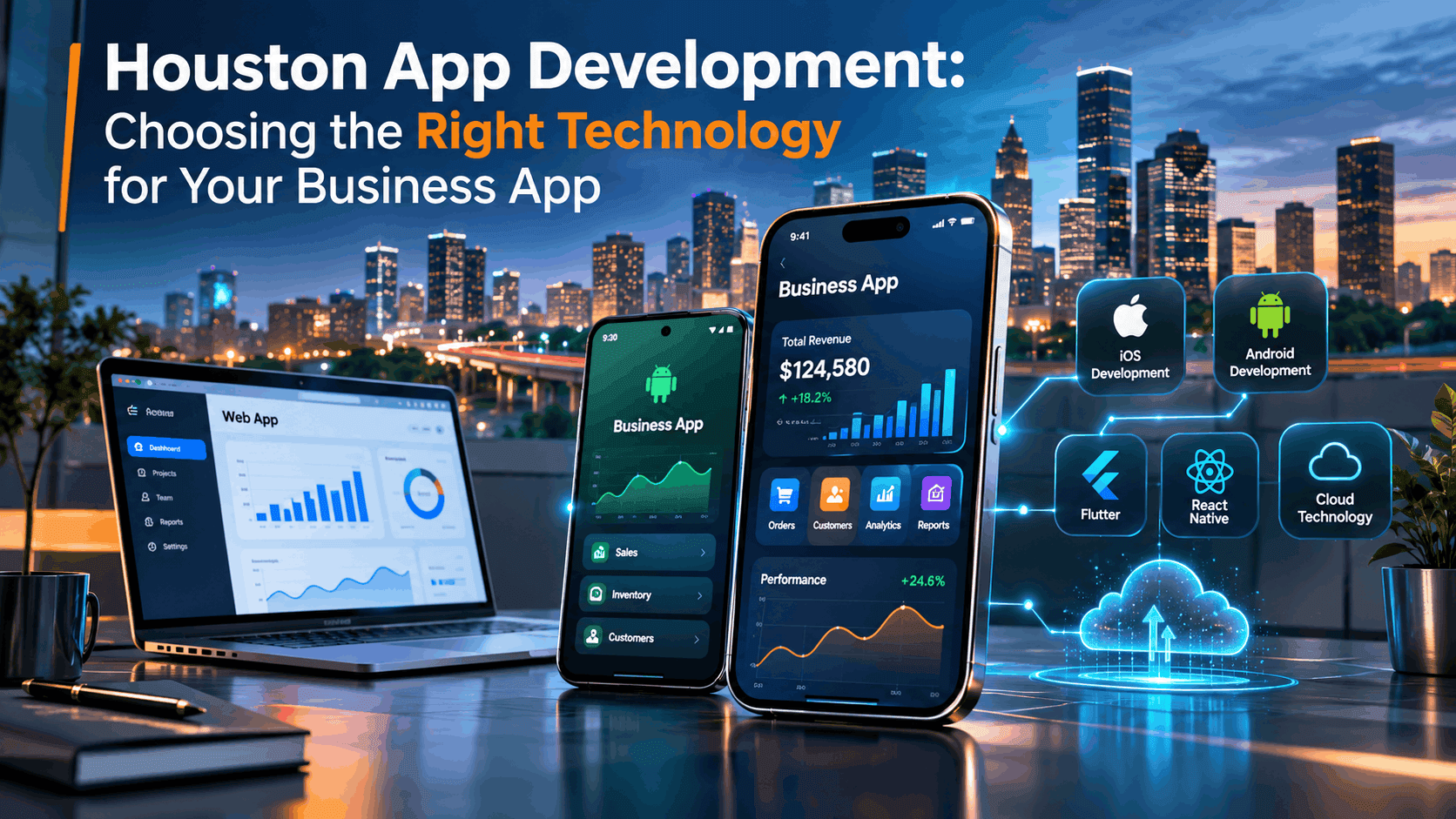
Houston app development technology featuring iOS and Android smartphones, web app dashboards, Flutter, React Native, and cloud solutions with the Houston skyline.

A Houston logistics company needs an application to track deliveries, but its drivers regularly work in areas with unreliable internet access. Meanwhile, a local retailer wants customers to browse products, place orders, and receive personalized offers. Both businesses need software, yet choosing the same development technology could create unnecessary costs and operational problems.

This is why Houston app development should begin with understanding business requirements rather than selecting a popular programming framework.

The wrong technology can lead to slow performance, expensive updates, complicated integrations, and applications that struggle as customer demand grows.

Whether you're building a customer-facing mobile app or an internal business platform, understanding native, cross-platform, and web development will help you invest wisely.

Understanding Your Business Needs Before Choosing App Technology

Before hiring developers, identify the specific problem your application must solve.

For example, a Houston delivery company might struggle with manual dispatching, missed delivery updates, and disconnected customer records. Building an application without addressing these issues would simply replace one inefficient process with another.

Start by answering several questions:

  • Business objectives: Are you trying to increase sales, automate operations, or improve customer service?
  • Target audience: Will employees, customers, or business partners use the application?
  • Essential features: Do users need GPS tracking, secure payments, appointment scheduling, or offline access?
  • Budget: What can your business realistically invest in development and maintenance?
  • Future growth: Will the application need additional users, locations, or integrations?

A practical approach is to define a minimum viable product (MVP) containing only the features necessary to test the application's core value.

For instance, a logistics MVP might include driver assignments, delivery confirmation, and basic tracking before introducing advanced route optimization.

Houston App Development: Native vs. Cross-Platform vs. Web Applications

Choosing between native, cross-platform, and web development depends on how users interact with your software.

Each approach offers different benefits, limitations, and maintenance requirements.

Native iOS App Development

Native iOS applications are built specifically for Apple's ecosystem, commonly using Swift and Apple's development frameworks.

Businesses researching ios app development houston services should consider native development when their applications require advanced iPhone capabilities, sophisticated animations, or extensive integration with Apple-specific technologies.

For example, a healthcare application using supported Apple device features may benefit from native development.

However, a separate Android application may require additional engineering resources.

Native Android App Development

Native Android applications commonly use Kotlin and Google's Android development tools.

Companies evaluating android app development houston solutions may prefer native Android development for applications requiring extensive Android-specific functionality, background processing, or specialized device integrations.

For example, warehouse teams using Android-based scanning devices may need reliable barcode scanning and integration with enterprise hardware.

Nevertheless, Android applications require testing across different screen sizes, operating system versions, and manufacturers.

Cross-Platform Mobile App Development

Cross-platform frameworks allow developers to share substantial portions of application code between iOS and Android.

Two widely used options include:

  • Flutter: Uses Dart and provides a consistent interface rendering system across supported platforms.
  • React Native: Uses JavaScript or TypeScript with React and integrates with native platform capabilities.

For Houston startups targeting both Apple and Android users, cross-platform development can reduce duplicated development work.

However, applications requiring specialized hardware integrations may still need platform-specific code.

Therefore, businesses should evaluate technical requirements before assuming cross-platform development will always be cheaper.

Web App Development

Web applications operate through browsers rather than requiring users to install software from an app store.

Businesses exploring web app development houston services may find web applications suitable for customer dashboards, booking systems, employee portals, and administrative platforms.

Progressive web apps (PWAs) can also provide selected offline capabilities, installation options, and other app-like experiences, depending on browser and operating system support.

However, browser restrictions can limit access to certain device features.

Technology Comparison

TechnologyBest ForMain AdvantageMain Limitation
Native iOSApple-focused usersDeep iOS integrationSeparate Android development
Native AndroidAndroid users and specialized devicesExtensive Android integrationSeparate iOS development
Cross-platformBusinesses targeting both platformsShared development codeSome native work remains
Web applicationsDashboards and browser-based servicesBroad accessibilityBrowser and device limitations

The best choice is not necessarily the newest technology. It is the approach that supports your application's actual requirements.

How Houston Businesses Can Choose the Right Technology Stack

A technology stack includes the programming languages, frameworks, databases, infrastructure, and services supporting an application.

Selecting one requires evaluating several business and technical factors.

1. Understand Your Users

A consumer shopping application may need both iOS and Android support. Meanwhile, an internal warehouse application might only need to operate on company-issued Android devices.

Understanding user behavior prevents unnecessary development.

2. Identify Critical Functionality

Applications requiring continuous GPS tracking, Bluetooth connectivity, or sophisticated camera processing may benefit from native capabilities.

However, basic appointment scheduling or customer account management may work effectively through web technologies.

3. Evaluate Performance Requirements

Applications handling graphics-intensive experiences or demanding real-time interactions require careful performance planning.

For ordinary business workflows, backend responsiveness and efficient data handling may matter more than the choice between native and cross-platform development.

4. Consider Budget and Timeline

Development costs depend on application complexity, integrations, design requirements, security, and testing.

A phased MVP can help businesses validate demand before funding advanced features.

5. Plan Security and Compliance

Healthcare applications handling protected health information may need HIPAA-compliant safeguards and appropriate contractual arrangements.

Similarly, applications processing payments should follow applicable payment security requirements.

Security must influence architecture from the beginning.

6. Examine Integration Requirements

Your application may need to connect with payment gateways, customer relationship management systems, inventory software, or existing databases.

Reliable API integration can be more important than the frontend framework.

7. Prepare for Scalability

Scalability depends on more than cloud hosting.

Database design, caching, monitoring, infrastructure configuration, and efficient APIs all influence how an application performs as usage increases.

App Development Solutions for Houston's Major Industries

Houston businesses operate across industries with very different software requirements.

Consequently, houston custom app development should reflect each industry's operational challenges.

Healthcare

Healthcare providers may require patient portals, appointment scheduling, secure messaging, and electronic health record integrations.

Applications handling protected health information must incorporate appropriate privacy and security safeguards.

Energy

Energy companies often need field-service applications for equipment inspections, maintenance records, and workforce coordination.

Offline data collection can be particularly valuable when employees work at remote facilities.

Logistics and Transportation

Logistics businesses benefit from dispatch management, fleet visibility, GPS tracking, and delivery confirmation.

For example, drivers can record completed deliveries offline and synchronize information when connectivity returns.

Retail and eCommerce

Retail applications may integrate product catalogs, inventory systems, secure checkout, and loyalty programs.

Businesses should also ensure that mobile and web channels share accurate inventory information.

Professional Services

Consultants, contractors, and service providers can use applications for appointment booking, customer communication, invoicing, and workflow automation.

In many cases, a responsive web application may meet these needs without requiring separate mobile apps.

Common App Development Mistakes Houston Businesses Should Avoid

Even a promising application idea can become expensive when development decisions are poorly planned.

Choosing Technology Based on Trends

Selecting a framework simply because competitors use it can introduce unnecessary complexity.

Solution: Compare technologies against documented features, integrations, performance requirements, and maintenance needs.

Building Too Many Features

Adding every requested feature before launch increases development time and makes usability testing harder.

Solution: Release an MVP, measure user behavior, and prioritize improvements based on evidence.

Ignoring Maintenance Costs

Applications require security updates, bug fixes, dependency upgrades, and compatibility testing.

Solution: Include ongoing support in your financial planning and clarify maintenance responsibilities before development begins.

Overlooking Data Security

Weak authentication, insecure APIs, and excessive data collection can expose sensitive information.

Solution: Implement secure authentication, encryption, access controls, and regular security testing.

Choosing the Lowest Quote

An inexpensive proposal may exclude testing, documentation, integrations, or post-launch support.

Solution: Compare detailed project scopes rather than headline prices alone.

Skipping Real-User Testing

An application can function technically while remaining difficult for customers or employees to use.

Solution: Test your application with real users before launch to identify usability issues, improve navigation, and deliver a smoother user experience.

How to Choose the Right App Development Company in Houston

Choosing an app development company in houston involves evaluating technical capability, communication, and long-term reliability.

A dependable development partner should explain why a particular architecture fits your business rather than recommending the same framework for every project.

When comparing a houston mobile app development company, examine its experience with similar applications, discovery process, UI/UX design capabilities, security practices, quality assurance, and maintenance services.

Before signing an agreement, ask:

  • How will you validate our technical requirements?
  • Which development approach do you recommend, and why?
  • What deliverables are included in the quoted price?
  • Who owns the source code and intellectual property?
  • How will testing, deployment, and maintenance be handled?
  • How will changes to project scope affect costs?

Clear answers can prevent misunderstandings and expensive redevelopment.

How App Vertices Helps Businesses Build Scalable Applications

App Vertices provides mobile application and custom software development services for businesses with different operational and technical needs.

Its custom mobile app development services cover iOS and Android applications, Flutter and React Native development, web applications, UI/UX design, backend development, API integrations, testing, and maintenance.

For example, a business seeking to replace disconnected spreadsheets with a centralized operational platform may require a web dashboard, mobile employee access, and integration with existing business systems.

Rather than treating these as unrelated products, a coordinated development approach can help maintain consistent data and workflows.

Businesses can discuss their requirements with App Vertices to explore suitable development options based on functionality, budget, and long-term objectives.

Frequently Asked Questions

What is the best technology for Houston app development?

The best technology depends on your application's users, functionality, budget, and maintenance requirements. Swift and Kotlin are appropriate for native applications, while Flutter and React Native support cross-platform development. Web technologies may be preferable for browser-based business tools. A requirements assessment should guide the final decision.

How much does it cost to develop a mobile app in Houston?

Mobile app development costs vary according to features, design complexity, integrations, security requirements, and development scope. A simple MVP generally requires less investment than a complex enterprise application. Businesses should request an itemized estimate covering discovery, design, development, testing, deployment, and ongoing maintenance.

Should Houston businesses choose native or cross-platform app development?

Native development is often suitable for applications requiring extensive platform-specific capabilities. Cross-platform development can be effective when businesses need comparable functionality on iOS and Android. The decision should consider performance, integrations, user experience, development resources, and future maintenance rather than initial cost alone.

How long does it take to develop a custom business application?

Development timelines depend on application complexity, feature requirements, integrations, stakeholder feedback, and testing. A narrowly scoped MVP may take several months, while complex enterprise platforms can require substantially longer. Discovery and prototyping help establish a more realistic schedule before full development begins.

How can App Vertices help businesses with custom app development?

App Vertices offers services covering mobile application development, web applications, UI/UX design, backend systems, API integrations, testing, and maintenance. Businesses can use these capabilities to plan applications around their operational needs, evaluate suitable technologies, and develop software that supports future improvements and integrations.

Final Thoughts — Making the Right Technology Investment

Successful Houston app development begins with understanding business problems, customer expectations, and long-term operational needs.

Native development offers deep platform integration, cross-platform frameworks support shared development efforts, and web applications provide convenient browser-based access. Each approach has strengths and limitations.

Before investing, define your essential features, evaluate security requirements, consider maintenance costs, and validate your application concept.

If you're planning a new business application, App Vertices can help you explore development approaches and identify solutions aligned with your technical requirements and business goals.

Merry Lana

Digital and AI Content Strategist

Subscription: Subscribe to our newsletter and receive a selection of cool articles every weeks

[Our Blogs]

Houston App Development: Choosing the Right Technology for Your Business App

The right technology decision starts long before development begins. Practical insight on building mobile apps, AI products, custom software and cloud platforms — aimed at the questions businesses need answered before they invest.

  • Blog
  • 11 November 2026
  • 9 minute read
Houston app development technology featuring iOS and Android smartphones, web app dashboards, Flutter, React Native, and cloud solutions with the Houston skyline.

A Houston logistics company needs an application to track deliveries, but its drivers regularly work in areas with unreliable internet access. Meanwhile, a local retailer wants customers to browse products, place orders, and receive personalized offers. Both businesses need software, yet choosing the same development technology could create unnecessary costs and operational problems.

This is why Houston app development should begin with understanding business requirements rather than selecting a popular programming framework.

The wrong technology can lead to slow performance, expensive updates, complicated integrations, and applications that struggle as customer demand grows.

Whether you're building a customer-facing mobile app or an internal business platform, understanding native, cross-platform, and web development will help you invest wisely.

Understanding Your Business Needs Before Choosing App Technology

Before hiring developers, identify the specific problem your application must solve.

For example, a Houston delivery company might struggle with manual dispatching, missed delivery updates, and disconnected customer records. Building an application without addressing these issues would simply replace one inefficient process with another.

Start by answering several questions:

  • Business objectives: Are you trying to increase sales, automate operations, or improve customer service?
  • Target audience: Will employees, customers, or business partners use the application?
  • Essential features: Do users need GPS tracking, secure payments, appointment scheduling, or offline access?
  • Budget: What can your business realistically invest in development and maintenance?
  • Future growth: Will the application need additional users, locations, or integrations?

A practical approach is to define a minimum viable product (MVP) containing only the features necessary to test the application's core value.

For instance, a logistics MVP might include driver assignments, delivery confirmation, and basic tracking before introducing advanced route optimization.

Houston App Development: Native vs. Cross-Platform vs. Web Applications

Choosing between native, cross-platform, and web development depends on how users interact with your software.

Each approach offers different benefits, limitations, and maintenance requirements.

Native iOS App Development

Native iOS applications are built specifically for Apple's ecosystem, commonly using Swift and Apple's development frameworks.

Businesses researching ios app development houston services should consider native development when their applications require advanced iPhone capabilities, sophisticated animations, or extensive integration with Apple-specific technologies.

For example, a healthcare application using supported Apple device features may benefit from native development.

However, a separate Android application may require additional engineering resources.

Native Android App Development

Native Android applications commonly use Kotlin and Google's Android development tools.

Companies evaluating android app development houston solutions may prefer native Android development for applications requiring extensive Android-specific functionality, background processing, or specialized device integrations.

For example, warehouse teams using Android-based scanning devices may need reliable barcode scanning and integration with enterprise hardware.

Nevertheless, Android applications require testing across different screen sizes, operating system versions, and manufacturers.

Cross-Platform Mobile App Development

Cross-platform frameworks allow developers to share substantial portions of application code between iOS and Android.

Two widely used options include:

  • Flutter: Uses Dart and provides a consistent interface rendering system across supported platforms.
  • React Native: Uses JavaScript or TypeScript with React and integrates with native platform capabilities.

For Houston startups targeting both Apple and Android users, cross-platform development can reduce duplicated development work.

However, applications requiring specialized hardware integrations may still need platform-specific code.

Therefore, businesses should evaluate technical requirements before assuming cross-platform development will always be cheaper.

Web App Development

Web applications operate through browsers rather than requiring users to install software from an app store.

Businesses exploring web app development houston services may find web applications suitable for customer dashboards, booking systems, employee portals, and administrative platforms.

Progressive web apps (PWAs) can also provide selected offline capabilities, installation options, and other app-like experiences, depending on browser and operating system support.

However, browser restrictions can limit access to certain device features.

Technology Comparison

TechnologyBest ForMain AdvantageMain Limitation
Native iOSApple-focused usersDeep iOS integrationSeparate Android development
Native AndroidAndroid users and specialized devicesExtensive Android integrationSeparate iOS development
Cross-platformBusinesses targeting both platformsShared development codeSome native work remains
Web applicationsDashboards and browser-based servicesBroad accessibilityBrowser and device limitations

The best choice is not necessarily the newest technology. It is the approach that supports your application's actual requirements.

How Houston Businesses Can Choose the Right Technology Stack

A technology stack includes the programming languages, frameworks, databases, infrastructure, and services supporting an application.

Selecting one requires evaluating several business and technical factors.

1. Understand Your Users

A consumer shopping application may need both iOS and Android support. Meanwhile, an internal warehouse application might only need to operate on company-issued Android devices.

Understanding user behavior prevents unnecessary development.

2. Identify Critical Functionality

Applications requiring continuous GPS tracking, Bluetooth connectivity, or sophisticated camera processing may benefit from native capabilities.

However, basic appointment scheduling or customer account management may work effectively through web technologies.

3. Evaluate Performance Requirements

Applications handling graphics-intensive experiences or demanding real-time interactions require careful performance planning.

For ordinary business workflows, backend responsiveness and efficient data handling may matter more than the choice between native and cross-platform development.

4. Consider Budget and Timeline

Development costs depend on application complexity, integrations, design requirements, security, and testing.

A phased MVP can help businesses validate demand before funding advanced features.

5. Plan Security and Compliance

Healthcare applications handling protected health information may need HIPAA-compliant safeguards and appropriate contractual arrangements.

Similarly, applications processing payments should follow applicable payment security requirements.

Security must influence architecture from the beginning.

6. Examine Integration Requirements

Your application may need to connect with payment gateways, customer relationship management systems, inventory software, or existing databases.

Reliable API integration can be more important than the frontend framework.

7. Prepare for Scalability

Scalability depends on more than cloud hosting.

Database design, caching, monitoring, infrastructure configuration, and efficient APIs all influence how an application performs as usage increases.

App Development Solutions for Houston's Major Industries

Houston businesses operate across industries with very different software requirements.

Consequently, houston custom app development should reflect each industry's operational challenges.

Healthcare

Healthcare providers may require patient portals, appointment scheduling, secure messaging, and electronic health record integrations.

Applications handling protected health information must incorporate appropriate privacy and security safeguards.

Energy

Energy companies often need field-service applications for equipment inspections, maintenance records, and workforce coordination.

Offline data collection can be particularly valuable when employees work at remote facilities.

Logistics and Transportation

Logistics businesses benefit from dispatch management, fleet visibility, GPS tracking, and delivery confirmation.

For example, drivers can record completed deliveries offline and synchronize information when connectivity returns.

Retail and eCommerce

Retail applications may integrate product catalogs, inventory systems, secure checkout, and loyalty programs.

Businesses should also ensure that mobile and web channels share accurate inventory information.

Professional Services

Consultants, contractors, and service providers can use applications for appointment booking, customer communication, invoicing, and workflow automation.

In many cases, a responsive web application may meet these needs without requiring separate mobile apps.

Common App Development Mistakes Houston Businesses Should Avoid

Even a promising application idea can become expensive when development decisions are poorly planned.

Choosing Technology Based on Trends

Selecting a framework simply because competitors use it can introduce unnecessary complexity.

Solution: Compare technologies against documented features, integrations, performance requirements, and maintenance needs.

Building Too Many Features

Adding every requested feature before launch increases development time and makes usability testing harder.

Solution: Release an MVP, measure user behavior, and prioritize improvements based on evidence.

Ignoring Maintenance Costs

Applications require security updates, bug fixes, dependency upgrades, and compatibility testing.

Solution: Include ongoing support in your financial planning and clarify maintenance responsibilities before development begins.

Overlooking Data Security

Weak authentication, insecure APIs, and excessive data collection can expose sensitive information.

Solution: Implement secure authentication, encryption, access controls, and regular security testing.

Choosing the Lowest Quote

An inexpensive proposal may exclude testing, documentation, integrations, or post-launch support.

Solution: Compare detailed project scopes rather than headline prices alone.

Skipping Real-User Testing

An application can function technically while remaining difficult for customers or employees to use.

Solution: Test your application with real users before launch to identify usability issues, improve navigation, and deliver a smoother user experience.

How to Choose the Right App Development Company in Houston

Choosing an app development company in houston involves evaluating technical capability, communication, and long-term reliability.

A dependable development partner should explain why a particular architecture fits your business rather than recommending the same framework for every project.

When comparing a houston mobile app development company, examine its experience with similar applications, discovery process, UI/UX design capabilities, security practices, quality assurance, and maintenance services.

Before signing an agreement, ask:

  • How will you validate our technical requirements?
  • Which development approach do you recommend, and why?
  • What deliverables are included in the quoted price?
  • Who owns the source code and intellectual property?
  • How will testing, deployment, and maintenance be handled?
  • How will changes to project scope affect costs?

Clear answers can prevent misunderstandings and expensive redevelopment.

How App Vertices Helps Businesses Build Scalable Applications

App Vertices provides mobile application and custom software development services for businesses with different operational and technical needs.

Its custom mobile app development services cover iOS and Android applications, Flutter and React Native development, web applications, UI/UX design, backend development, API integrations, testing, and maintenance.

For example, a business seeking to replace disconnected spreadsheets with a centralized operational platform may require a web dashboard, mobile employee access, and integration with existing business systems.

Rather than treating these as unrelated products, a coordinated development approach can help maintain consistent data and workflows.

Businesses can discuss their requirements with App Vertices to explore suitable development options based on functionality, budget, and long-term objectives.

Frequently Asked Questions

What is the best technology for Houston app development?

The best technology depends on your application's users, functionality, budget, and maintenance requirements. Swift and Kotlin are appropriate for native applications, while Flutter and React Native support cross-platform development. Web technologies may be preferable for browser-based business tools. A requirements assessment should guide the final decision.

How much does it cost to develop a mobile app in Houston?

Mobile app development costs vary according to features, design complexity, integrations, security requirements, and development scope. A simple MVP generally requires less investment than a complex enterprise application. Businesses should request an itemized estimate covering discovery, design, development, testing, deployment, and ongoing maintenance.

Should Houston businesses choose native or cross-platform app development?

Native development is often suitable for applications requiring extensive platform-specific capabilities. Cross-platform development can be effective when businesses need comparable functionality on iOS and Android. The decision should consider performance, integrations, user experience, development resources, and future maintenance rather than initial cost alone.

How long does it take to develop a custom business application?

Development timelines depend on application complexity, feature requirements, integrations, stakeholder feedback, and testing. A narrowly scoped MVP may take several months, while complex enterprise platforms can require substantially longer. Discovery and prototyping help establish a more realistic schedule before full development begins.

How can App Vertices help businesses with custom app development?

App Vertices offers services covering mobile application development, web applications, UI/UX design, backend systems, API integrations, testing, and maintenance. Businesses can use these capabilities to plan applications around their operational needs, evaluate suitable technologies, and develop software that supports future improvements and integrations.

Final Thoughts — Making the Right Technology Investment

Successful Houston app development begins with understanding business problems, customer expectations, and long-term operational needs.

Native development offers deep platform integration, cross-platform frameworks support shared development efforts, and web applications provide convenient browser-based access. Each approach has strengths and limitations.

Before investing, define your essential features, evaluate security requirements, consider maintenance costs, and validate your application concept.

If you're planning a new business application, App Vertices can help you explore development approaches and identify solutions aligned with your technical requirements and business goals.

Merry LanaDigital and AI Content Strategist

Subscription: Subscribe to our newsletter and receive a selection of cool articles every weeks

The Latest

You May Also Like