



Get a QuoteGet a Quote

[Our Blogs]

Hire iOS App Developer: 7 Things to Check Before You Decide

The right technology decision starts long before development begins. Practical insight on building mobile apps, AI products, custom software and cloud platforms — aimed at the questions businesses need answered before they invest.

Blog13 November 20267 minute read
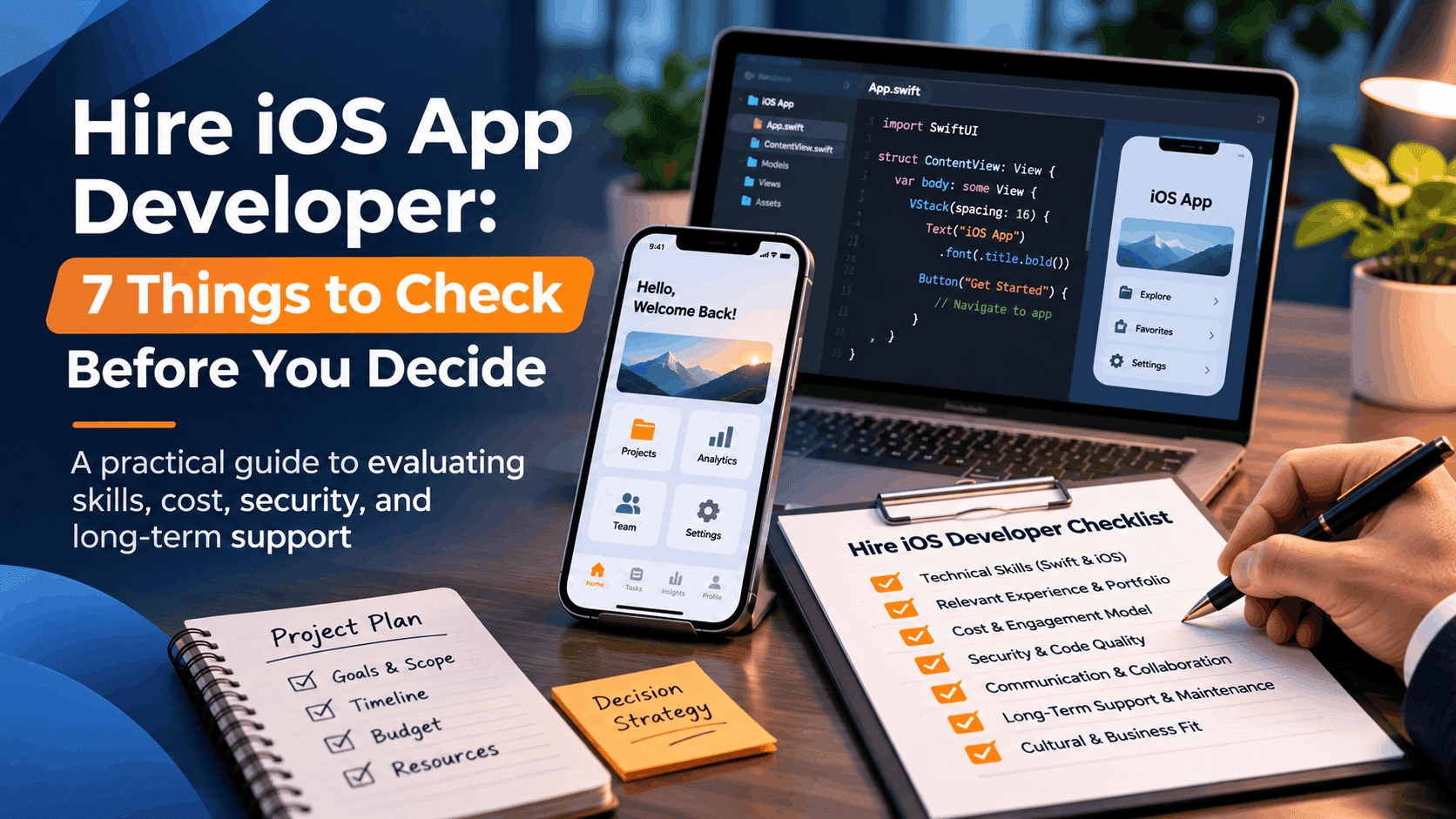
Professional iOS app development workspace featuring an iPhone, Swift coding on a laptop, and a seven-point developer hiring checklist.

You have a promising app idea, a clear business goal, and a budget ready for development. But choosing the wrong developer could leave you with missed deadlines, unexpected expenses, security vulnerabilities, or an application that struggles to meet customer expectations.

When you decide to hire iOS app developer professionals, technical experience should be only one part of your evaluation. A polished portfolio doesn’t necessarily prove that someone can develop secure, scalable software or manage a project effectively.

The cheapest proposal can also become the most expensive when essential services are excluded.

Whether you’re launching a startup application or improving an existing business platform, understanding what separates reliable developers from inexperienced providers matters.

This guide explains seven essential checks to help you compare candidates, protect your investment, and choose a development partner with confidence.

What Should You Check Before Hiring an iOS App Developer?

Before hiring an iOS developer, assess these seven factors:

  1. Relevant experience: Confirm their background in developing real iPhone applications.
  2. Portfolio quality: Examine functionality, usability, and published applications.
  3. Technical expertise: Evaluate Swift knowledge, architecture, integrations, and testing.
  4. Communication: Review project planning, reporting, and collaboration practices.
  5. Pricing transparency: Compare detailed estimates, deliverables, and additional costs.
  6. Security and compliance: Verify testing processes and familiarity with Apple’s requirements.
  7. Post-launch support: Establish maintenance responsibilities, source-code ownership, and handover arrangements.

Together, these checks help identify developers capable of delivering sustainable business value.

1. Evaluate Their iOS Development Experience

Experience matters, but years in software development don’t automatically translate into iOS expertise.

Look for developers who have built applications with requirements similar to yours. A developer experienced in simple informational apps may need additional expertise to build complex booking platforms, financial applications, or real-time communication systems.

Strong candidates should demonstrate proficiency in Swift, practical experience with SwiftUI or UIKit, and familiarity with Apple’s Human Interface Guidelines.

They should also understand API integrations, authentication systems, and device-specific behavior.

When evaluating experienced iPhone app developers, request examples of applications they personally developed rather than projects their previous employer completed.

Interview question: “What was the most technically challenging feature you implemented in a released iOS application?”

A convincing answer should explain the problem, architectural decisions, implementation challenges, and how the developer validated the solution.

Relevant experience is demonstrated through specific engineering decisions, not impressive terminology.

2. Review Their Portfolio and App Quality

An attractive portfolio is a useful starting point, but screenshots reveal very little about application reliability.

Whenever possible, download published applications from the App Store and test them yourself.

Examine navigation, screen responsiveness, onboarding, accessibility features, loading behavior, and error handling.

Effective iOS app design combines visual clarity with intuitive interactions and dependable performance.

For example, imagine reviewing a developer’s restaurant-ordering application. Rather than judging the homepage, complete a realistic ordering journey.

Can you find products quickly? Does the cart update correctly? What happens when the internet connection drops?

These details reveal more than promotional images.

Check application update histories and read user reviews carefully. Repeated complaints about crashes or broken features deserve investigation, although reviews alone cannot establish responsibility.

Ask whether the developer continues maintaining the application.

A strong portfolio demonstrates the ability to deliver usable software, resolve problems, and improve products after release.

3. Verify Their Technical Skills and Development Approach

Reliable custom iOS app development requires more than writing functional Swift code.

A capable developer should understand application architecture, API communication, data persistence, secure authentication, debugging, automated testing, and performance optimization.

Experience with Git, code reviews, and maintainable documentation is equally important.

Ask how they decide between SwiftUI and UIKit. Both have valid applications, and the right choice depends on existing code, required functionality, and long-term maintenance.

For applications that must operate with unreliable connectivity, discuss local storage, synchronization, and offline behavior.

Consider a hypothetical fitness application that manages appointments, payments, and membership information.

Poorly structured networking and booking logic could make future integrations expensive. Separating responsibilities into maintainable components can reduce that risk.

Ask developers to explain their architectural approach using an actual project.

Professional native mobile app development services should prioritize maintainability and engineering quality rather than unnecessary technical complexity.

The best technology decisions support your product requirements, not a developer’s preferred tools.

4. Examine Communication and Project Management

Even technically skilled developers can struggle when requirements, responsibilities, and expectations remain unclear.

A reliable development partner begins by understanding your business objectives, target audience, essential features, and existing systems.

They should translate those requirements into documented deliverables, realistic milestones, and measurable acceptance criteria.

Compare a vague promise such as “Your application will be completed soon” with a plan covering discovery, design, development, testing, and deployment.

The second approach makes progress easier to evaluate.

Ask two important questions:

  • “How frequently will we receive working demonstrations and progress reports?”
  • “What happens when we request changes after development begins?”

Strong answers should establish communication channels, feedback cycles, change-request procedures, and approval responsibilities.

Request access to project documentation and agreed reporting tools.

Clear communication helps identify misunderstandings early, preventing small problems from becoming expensive delays.

5. Compare Development Costs and Pricing Transparency

The cost of hiring an iOS developer depends on application complexity, feature requirements, design expectations, backend integrations, testing, and ongoing maintenance.

Developer experience, location, and engagement arrangements also influence pricing.

Understanding your available hiring models is essential.

Hiring modelMost suitable forMain consideration
Freelance developerSmaller applications or specific tasksLimited backup resources
Dedicated developer or teamContinuous development requiring close collaborationRequires clear management responsibilities
Development agencyComplex applications requiring multiple specialistsBroader services may increase initial costs

Professional custom mobile app development services may include business analysis, UI/UX design, backend engineering, quality assurance, and deployment assistance.

Request itemized proposals rather than comparing total prices alone.

For example, a low-cost proposal might cover coding but exclude interface design, integration testing, App Store submission, and post-launch corrections.

Those exclusions can increase the final investment substantially.

Clarify payment milestones, revision limits, third-party charges, and maintenance fees before signing.

Compare the complete scope of work, not merely the quoted development price.

6. Check Their Security, Testing, and App Store Knowledge

Security should be considered throughout development, particularly when applications handle customer accounts, payments, or sensitive information.

Ask how developers implement secure authentication, authorization, encrypted network communication, and safe data storage.

Apple’s Keychain can help protect suitable sensitive credentials, while OWASP Mobile Application Security resources provide recognized guidance for evaluating mobile security controls.

Testing also requires careful evaluation.

Unit and integration tests help identify functional defects, while manual device testing assesses usability and real-world behavior.

Security reviews address different risks, including data exposure and weak authentication.

Ask about TestFlight beta testing, App Store Connect, privacy disclosures, permissions, and Apple’s App Review Guidelines.

No developer can guarantee complete security or App Store approval.

However, a credible developer should explain potential risks, demonstrate testing evidence, and describe how compliance issues will be addressed.

7. Confirm Post-Launch Support and Code Ownership

An application requires ongoing attention after its initial release.

Future iOS updates, changing business requirements, security improvements, and unexpected bugs can all create maintenance needs.

Before hiring, establish who will manage updates, monitor performance, investigate incidents, and implement new features.

Equally important is ownership.

Your development agreement should clarify intellectual property rights, source-code licensing, repository access, third-party dependencies, and administrative control over developer accounts.

Before signing, confirm:

  • Who owns the final code and design deliverables?
  • Will your business receive repository and account access?
  • What documentation and technical handover are included?
  • What are the maintenance fees and expected support response times?

A clear agreement protects business continuity if you change developers later.

Reliable iOS app maintenance should be planned before launch, not negotiated only after something breaks.

Common Mistakes to Avoid When Hiring iOS Developers

  • Choosing the lowest quote: Compare complete deliverables, testing, and support instead of price alone.
  • Skipping technical validation: Ask candidates to explain real implementations and demonstrate relevant applications.
  • Ignoring ownership terms: Establish contractual rights to code, documentation, and accounts before work begins.
  • Overlooking maintenance: Budget for updates, security reviews, and ongoing improvements.

The most effective hiring decisions consider delivery risk and long-term value alongside initial cost.

Frequently Asked Questions

How much does it cost to hire an iOS app developer?

Costs depend on developer experience, engagement model, application complexity, integrations, design requirements, and support. Request detailed estimates based on documented requirements rather than relying on generic market averages.

Should I hire a freelance iOS developer or an agency?

Freelancers can suit smaller projects with clearly defined requirements. Agencies may be better for complex applications requiring designers, backend engineers, testers, and coordinated project management.

What programming language should an iOS developer know?

Swift is the primary language to evaluate for modern native iOS development. Objective-C knowledge can also be valuable when maintaining older applications or integrating legacy code.

How long does custom iOS app development take?

Timelines depend on scope, integrations, technical complexity, testing, and feedback cycles. Request a milestone-based schedule with reasonable contingency rather than an unsupported completion promise.

What should I ask before hiring an iOS app developer?

Ask about published work, technical decisions, testing, communication, pricing, intellectual property ownership, deployment responsibilities, and post-launch support.

Final Thoughts: Hire the Right iOS Developer With Confidence

Hiring an iOS developer is a business decision that influences product quality, customer experience, development costs, and future growth.

Prioritize demonstrated experience, sound technical judgment, transparent pricing, effective communication, security practices, and long-term support.

Before approaching candidates, document your application’s purpose, target users, essential features, required integrations, and estimated budget.

These details make proposals easier to compare and help developers recommend an appropriate solution.

Planning an iOS application for your business? Speak with an experienced mobile development team to discuss your requirements, explore technical options, and establish a realistic development plan before committing your budget.

Merry Lana

Digital and AI Content Strategist

Subscription: Subscribe to our newsletter and receive a selection of cool articles every weeks

[Our Blogs]

Hire iOS App Developer: 7 Things to Check Before You Decide

The right technology decision starts long before development begins. Practical insight on building mobile apps, AI products, custom software and cloud platforms — aimed at the questions businesses need answered before they invest.

  • Blog
  • 13 November 2026
  • 7 minute read
Professional iOS app development workspace featuring an iPhone, Swift coding on a laptop, and a seven-point developer hiring checklist.

You have a promising app idea, a clear business goal, and a budget ready for development. But choosing the wrong developer could leave you with missed deadlines, unexpected expenses, security vulnerabilities, or an application that struggles to meet customer expectations.

When you decide to hire iOS app developer professionals, technical experience should be only one part of your evaluation. A polished portfolio doesn’t necessarily prove that someone can develop secure, scalable software or manage a project effectively.

The cheapest proposal can also become the most expensive when essential services are excluded.

Whether you’re launching a startup application or improving an existing business platform, understanding what separates reliable developers from inexperienced providers matters.

This guide explains seven essential checks to help you compare candidates, protect your investment, and choose a development partner with confidence.

What Should You Check Before Hiring an iOS App Developer?

Before hiring an iOS developer, assess these seven factors:

  1. Relevant experience: Confirm their background in developing real iPhone applications.
  2. Portfolio quality: Examine functionality, usability, and published applications.
  3. Technical expertise: Evaluate Swift knowledge, architecture, integrations, and testing.
  4. Communication: Review project planning, reporting, and collaboration practices.
  5. Pricing transparency: Compare detailed estimates, deliverables, and additional costs.
  6. Security and compliance: Verify testing processes and familiarity with Apple’s requirements.
  7. Post-launch support: Establish maintenance responsibilities, source-code ownership, and handover arrangements.

Together, these checks help identify developers capable of delivering sustainable business value.

1. Evaluate Their iOS Development Experience

Experience matters, but years in software development don’t automatically translate into iOS expertise.

Look for developers who have built applications with requirements similar to yours. A developer experienced in simple informational apps may need additional expertise to build complex booking platforms, financial applications, or real-time communication systems.

Strong candidates should demonstrate proficiency in Swift, practical experience with SwiftUI or UIKit, and familiarity with Apple’s Human Interface Guidelines.

They should also understand API integrations, authentication systems, and device-specific behavior.

When evaluating experienced iPhone app developers, request examples of applications they personally developed rather than projects their previous employer completed.

Interview question: “What was the most technically challenging feature you implemented in a released iOS application?”

A convincing answer should explain the problem, architectural decisions, implementation challenges, and how the developer validated the solution.

Relevant experience is demonstrated through specific engineering decisions, not impressive terminology.

2. Review Their Portfolio and App Quality

An attractive portfolio is a useful starting point, but screenshots reveal very little about application reliability.

Whenever possible, download published applications from the App Store and test them yourself.

Examine navigation, screen responsiveness, onboarding, accessibility features, loading behavior, and error handling.

Effective iOS app design combines visual clarity with intuitive interactions and dependable performance.

For example, imagine reviewing a developer’s restaurant-ordering application. Rather than judging the homepage, complete a realistic ordering journey.

Can you find products quickly? Does the cart update correctly? What happens when the internet connection drops?

These details reveal more than promotional images.

Check application update histories and read user reviews carefully. Repeated complaints about crashes or broken features deserve investigation, although reviews alone cannot establish responsibility.

Ask whether the developer continues maintaining the application.

A strong portfolio demonstrates the ability to deliver usable software, resolve problems, and improve products after release.

3. Verify Their Technical Skills and Development Approach

Reliable custom iOS app development requires more than writing functional Swift code.

A capable developer should understand application architecture, API communication, data persistence, secure authentication, debugging, automated testing, and performance optimization.

Experience with Git, code reviews, and maintainable documentation is equally important.

Ask how they decide between SwiftUI and UIKit. Both have valid applications, and the right choice depends on existing code, required functionality, and long-term maintenance.

For applications that must operate with unreliable connectivity, discuss local storage, synchronization, and offline behavior.

Consider a hypothetical fitness application that manages appointments, payments, and membership information.

Poorly structured networking and booking logic could make future integrations expensive. Separating responsibilities into maintainable components can reduce that risk.

Ask developers to explain their architectural approach using an actual project.

Professional native mobile app development services should prioritize maintainability and engineering quality rather than unnecessary technical complexity.

The best technology decisions support your product requirements, not a developer’s preferred tools.

4. Examine Communication and Project Management

Even technically skilled developers can struggle when requirements, responsibilities, and expectations remain unclear.

A reliable development partner begins by understanding your business objectives, target audience, essential features, and existing systems.

They should translate those requirements into documented deliverables, realistic milestones, and measurable acceptance criteria.

Compare a vague promise such as “Your application will be completed soon” with a plan covering discovery, design, development, testing, and deployment.

The second approach makes progress easier to evaluate.

Ask two important questions:

  • “How frequently will we receive working demonstrations and progress reports?”
  • “What happens when we request changes after development begins?”

Strong answers should establish communication channels, feedback cycles, change-request procedures, and approval responsibilities.

Request access to project documentation and agreed reporting tools.

Clear communication helps identify misunderstandings early, preventing small problems from becoming expensive delays.

5. Compare Development Costs and Pricing Transparency

The cost of hiring an iOS developer depends on application complexity, feature requirements, design expectations, backend integrations, testing, and ongoing maintenance.

Developer experience, location, and engagement arrangements also influence pricing.

Understanding your available hiring models is essential.

Hiring modelMost suitable forMain consideration
Freelance developerSmaller applications or specific tasksLimited backup resources
Dedicated developer or teamContinuous development requiring close collaborationRequires clear management responsibilities
Development agencyComplex applications requiring multiple specialistsBroader services may increase initial costs

Professional custom mobile app development services may include business analysis, UI/UX design, backend engineering, quality assurance, and deployment assistance.

Request itemized proposals rather than comparing total prices alone.

For example, a low-cost proposal might cover coding but exclude interface design, integration testing, App Store submission, and post-launch corrections.

Those exclusions can increase the final investment substantially.

Clarify payment milestones, revision limits, third-party charges, and maintenance fees before signing.

Compare the complete scope of work, not merely the quoted development price.

6. Check Their Security, Testing, and App Store Knowledge

Security should be considered throughout development, particularly when applications handle customer accounts, payments, or sensitive information.

Ask how developers implement secure authentication, authorization, encrypted network communication, and safe data storage.

Apple’s Keychain can help protect suitable sensitive credentials, while OWASP Mobile Application Security resources provide recognized guidance for evaluating mobile security controls.

Testing also requires careful evaluation.

Unit and integration tests help identify functional defects, while manual device testing assesses usability and real-world behavior.

Security reviews address different risks, including data exposure and weak authentication.

Ask about TestFlight beta testing, App Store Connect, privacy disclosures, permissions, and Apple’s App Review Guidelines.

No developer can guarantee complete security or App Store approval.

However, a credible developer should explain potential risks, demonstrate testing evidence, and describe how compliance issues will be addressed.

7. Confirm Post-Launch Support and Code Ownership

An application requires ongoing attention after its initial release.

Future iOS updates, changing business requirements, security improvements, and unexpected bugs can all create maintenance needs.

Before hiring, establish who will manage updates, monitor performance, investigate incidents, and implement new features.

Equally important is ownership.

Your development agreement should clarify intellectual property rights, source-code licensing, repository access, third-party dependencies, and administrative control over developer accounts.

Before signing, confirm:

  • Who owns the final code and design deliverables?
  • Will your business receive repository and account access?
  • What documentation and technical handover are included?
  • What are the maintenance fees and expected support response times?

A clear agreement protects business continuity if you change developers later.

Reliable iOS app maintenance should be planned before launch, not negotiated only after something breaks.

Common Mistakes to Avoid When Hiring iOS Developers

  • Choosing the lowest quote: Compare complete deliverables, testing, and support instead of price alone.
  • Skipping technical validation: Ask candidates to explain real implementations and demonstrate relevant applications.
  • Ignoring ownership terms: Establish contractual rights to code, documentation, and accounts before work begins.
  • Overlooking maintenance: Budget for updates, security reviews, and ongoing improvements.

The most effective hiring decisions consider delivery risk and long-term value alongside initial cost.

Frequently Asked Questions

How much does it cost to hire an iOS app developer?

Costs depend on developer experience, engagement model, application complexity, integrations, design requirements, and support. Request detailed estimates based on documented requirements rather than relying on generic market averages.

Should I hire a freelance iOS developer or an agency?

Freelancers can suit smaller projects with clearly defined requirements. Agencies may be better for complex applications requiring designers, backend engineers, testers, and coordinated project management.

What programming language should an iOS developer know?

Swift is the primary language to evaluate for modern native iOS development. Objective-C knowledge can also be valuable when maintaining older applications or integrating legacy code.

How long does custom iOS app development take?

Timelines depend on scope, integrations, technical complexity, testing, and feedback cycles. Request a milestone-based schedule with reasonable contingency rather than an unsupported completion promise.

What should I ask before hiring an iOS app developer?

Ask about published work, technical decisions, testing, communication, pricing, intellectual property ownership, deployment responsibilities, and post-launch support.

Final Thoughts: Hire the Right iOS Developer With Confidence

Hiring an iOS developer is a business decision that influences product quality, customer experience, development costs, and future growth.

Prioritize demonstrated experience, sound technical judgment, transparent pricing, effective communication, security practices, and long-term support.

Before approaching candidates, document your application’s purpose, target users, essential features, required integrations, and estimated budget.

These details make proposals easier to compare and help developers recommend an appropriate solution.

Planning an iOS application for your business? Speak with an experienced mobile development team to discuss your requirements, explore technical options, and establish a realistic development plan before committing your budget.

Merry LanaDigital and AI Content Strategist

Subscription: Subscribe to our newsletter and receive a selection of cool articles every weeks

The Latest

You May Also Like