

[Our Blogs]
Food Delivery App Development: Complete Guide to Features, Costs, and Trends in 2027
The right technology decision starts long before development begins. Practical insight on building mobile apps, AI products, custom software and cloud platforms — aimed at the questions businesses need answered before they invest.

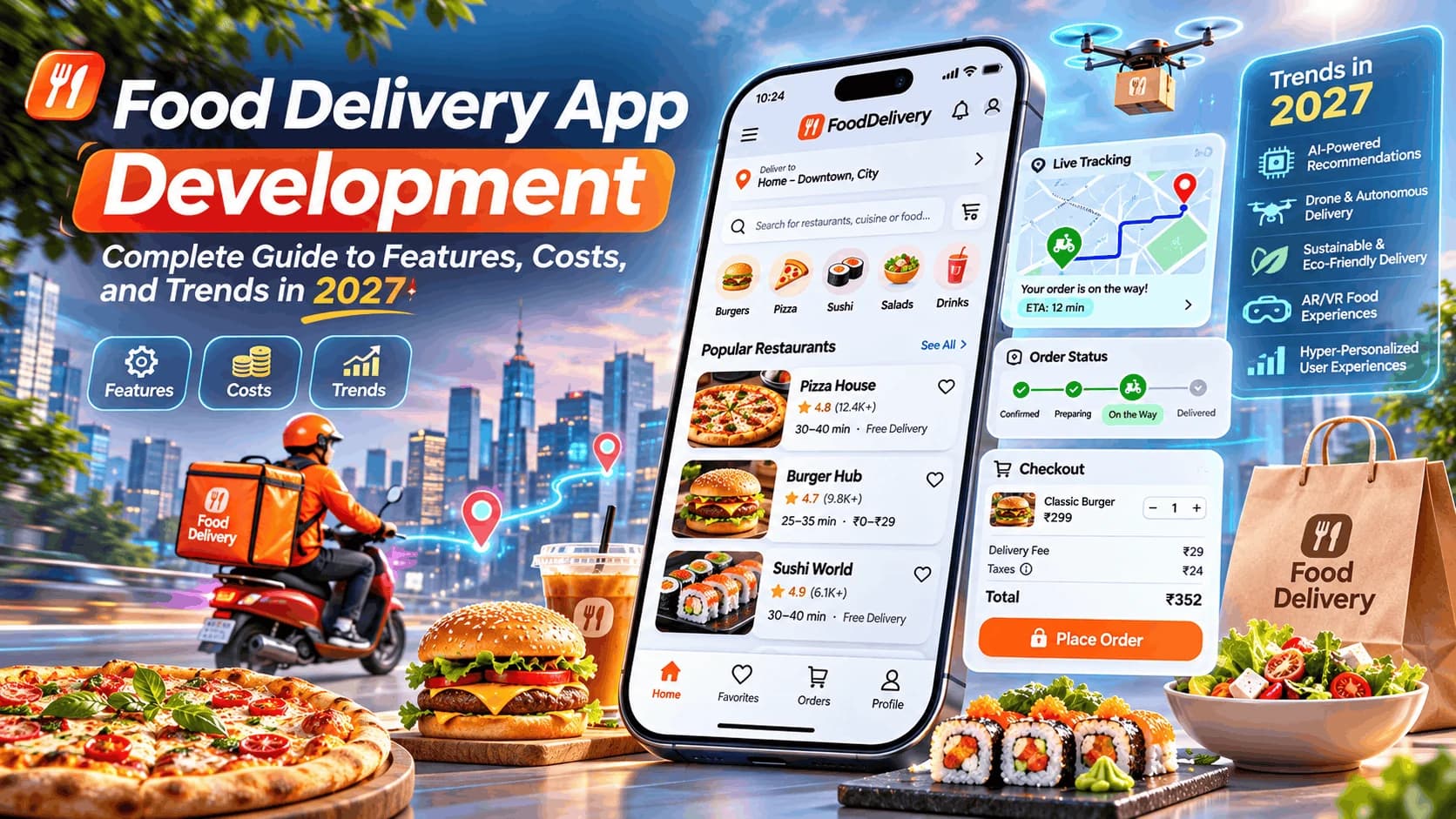
The way people order food has changed dramatically. Instead of calling restaurants or waiting in long queues, customers can now explore menus, customize meals, make payments, and track deliveries directly from their smartphones. Consequently, food delivery app development has become an important investment opportunity for restaurants, startups, cloud kitchens, and entrepreneurs.
As digital convenience continues to shape consumer expectations, businesses need more than a basic ordering platform. They require reliable technology, intuitive interfaces, secure payment systems, and efficient delivery management. Moreover, artificial intelligence, automation, and personalized recommendations are opening new opportunities for food delivery businesses.
However, developing a successful platform requires careful planning, the right technology, and a realistic budget.
This comprehensive guide explores food delivery app features, development costs, business models, technologies, and emerging trends for 2027. Additionally, it explains how businesses can build scalable applications that improve customer satisfaction and support long-term growth.
What Is Food Delivery App Development?
Food delivery app development is the process of designing, building, testing, and maintaining mobile applications that allow customers to order food from restaurants and receive deliveries at their preferred locations.
Typically, these applications connect customers, restaurant owners, delivery partners, and platform administrators through an integrated digital ecosystem.
For example, platforms such as Uber Eats and DoorDash demonstrate how food ordering, payment processing, restaurant management, and delivery tracking can work within a connected system.
Furthermore, modern food delivery mobile app development includes backend infrastructure, cloud services, GPS integration, and real-time communication.
Businesses can choose between dedicated restaurant applications and multi-restaurant marketplaces, depending on their target audience and business objectives.
Why Should Businesses Invest in Food Delivery Apps in 2027?
Mobile ordering creates opportunities for restaurants and technology-driven startups. Although competition remains strong, businesses can differentiate themselves through service quality, convenience, and specialized offerings.
1. Improved Customer Convenience
Customers appreciate the ability to browse menus, compare prices, and place orders without making phone calls. Additionally, saved addresses and preferred payment methods simplify repeat purchases.
2. Greater Business Visibility
A dedicated application creates another digital channel for reaching customers. Furthermore, promotional notifications, loyalty programs, and personalized offers can encourage repeat engagement.
3. Better Operational Efficiency
Digital ordering reduces manual data entry and helps restaurant employees organize incoming requests. Meanwhile, automated notifications keep customers informed about order preparation and delivery progress.
4. Access to Valuable Business Insights
Food delivery applications generate useful information about popular dishes, order frequency, customer preferences, and peak delivery periods. Therefore, businesses can make more informed decisions about marketing, staffing, and inventory.
5. Opportunities for Revenue Growth
Restaurants can introduce membership programs, promotional bundles, scheduled orders, and premium delivery options. However, sustainable profitability still depends on delivery costs, pricing, customer retention, and operational efficiency.
Different Types of Food Delivery Applications
Before starting on demand food delivery app development, businesses should identify the most suitable business model.
Restaurant-Owned Food Delivery Apps
These applications belong to individual restaurants or restaurant chains. Customers order directly from the business rather than using a third-party marketplace.
Consequently, restaurants gain greater control over branding, customer relationships, promotions, and ordering experiences.
Multi-Restaurant Marketplace Apps
Marketplace platforms connect multiple restaurants with customers through a single application.
For instance, customers can explore different cuisines, compare delivery charges, and order from participating restaurants.
Additionally, marketplace operators can generate revenue through restaurant commissions, advertisements, and subscription services.
Cloud Kitchen Delivery Apps
Cloud kitchens operate primarily through delivery and takeaway orders rather than traditional dine-in services.
Therefore, their applications focus on digital menus, efficient order management, accurate preparation times, and delivery coordination.
Delivery Aggregator Applications
These platforms connect businesses with independent delivery partners. Instead of managing restaurant operations, they primarily coordinate pickup, transportation, and delivery.
Essential Features of a Successful Food Delivery App
The success of a food delivery application depends on features that simplify the ordering process and support smooth operations.
Customer Application Features
Customers should have access to easy registration, restaurant discovery, menu browsing, secure checkout, order tracking, ratings, reviews, and notifications. Moreover, filters for cuisine, dietary preferences, pricing, and delivery time can improve the experience.
Restaurant Management Features
Restaurant owners require dashboards for managing menus, accepting orders, updating preparation times, and monitoring sales. Additionally, inventory synchronization and performance reports help reduce operational mistakes.
Delivery Partner Features
Drivers need order notifications, pickup details, navigation assistance, delivery confirmation, and earnings summaries. Furthermore, accurate status updates improve communication between restaurants, customers, and couriers.
Administrator Dashboard Features
Administrators require centralized control over users, restaurants, delivery partners, payments, commissions, and customer complaints. Consequently, reporting tools and permission-based access become essential as the platform grows.
How to Create a Food Delivery App: Step-by-Step Process
Understanding how to create a food delivery app helps businesses avoid expensive mistakes and unnecessary development delays.
Step 1: Research Your Target Market
First, identify the customer segments, geographic locations, and restaurant categories your platform will serve.
Additionally, evaluate competitors, customer expectations, delivery challenges, and local market conditions.
Step 2: Define Core Features
Next, prioritize features according to your business model and available budget.
For example, an MVP should focus on restaurant listings, ordering, payments, and basic delivery management. Advanced loyalty systems and AI personalization can be introduced later.
Step 3: Create UI/UX Designs
A professional user interface should simplify navigation and minimize unnecessary steps.
Therefore, designers should create wireframes, interactive prototypes, and accessible interfaces before development begins.
Step 4: Select the Technology Stack
Developers must choose appropriate mobile frameworks, backend technologies, databases, and third-party integrations.
For instance, Flutter and React Native support cross-platform applications, while Swift and Kotlin enable native iOS and Android development.
Step 5: Develop and Integrate Features
During development, engineers build customer interfaces, restaurant dashboards, delivery systems, and backend APIs.
Meanwhile, integrations connect payment gateways, mapping services, push notifications, and analytics platforms.
Step 6: Test the Application
Quality assurance should cover payment errors, order failures, location accuracy, usability, security, and application performance.
Furthermore, testing under heavy traffic helps identify reliability problems before launch.
Step 7: Launch and Maintain the App
Finally, publish the applications and monitor real customer interactions.
However, development does not end after launch. Regular updates, security patches, performance improvements, and customer feedback analysis remain essential.
How Much Does Food Delivery App Development Cost in 2027?
The cost of food delivery app development depends on application complexity, development location, number of platforms, integrations, and customization requirements.
For 2027 planning, businesses can use the following indicative USD ranges, informed by published 2026 industry estimates. These are not verified 2027 market rates or fixed quotations.
| Application Type | Estimated Development Cost |
|---|---|
| Basic MVP | $30,000–$60,000 |
| Mid-Level Delivery Platform | $60,000–$120,000 |
| Advanced Enterprise Solution | $120,000–$250,000+ |
What Factors Affect Development Costs?
Several factors influence the final investment.
- Application complexity: Advanced dispatch algorithms, real-time tracking, and customized dashboards require additional engineering.
- Platform selection: Developing separate native applications may involve more platform-specific work than using a shared cross-platform codebase.
- Development team: Pricing differs according to team expertise, location, scope, and project management requirements.
- Third-party integrations: Payment processing, SMS notifications, mapping APIs, and cloud infrastructure create additional expenses.
- Maintenance: Businesses must also budget for hosting, security updates, monitoring, and ongoing improvements.
Additionally, Apple lists its Developer Program at $99 annually, while Google lists a $25 one-time Play Console registration fee. These are separate from application development expenses.
Best Technologies for Food Delivery Mobile App Development
Selecting the right technology improves application performance, scalability, and maintainability.
| Development Area | Recommended Technologies |
|---|---|
| Native Android | Kotlin, Java |
| Native iOS | Swift |
| Cross-Platform | Flutter, React Native |
| Backend | Node.js, Python, Java |
| Database | PostgreSQL, MySQL |
| Cloud Infrastructure | AWS, Google Cloud, Azure |
| Maps and Navigation | Google Maps Platform, Mapbox |
| Payments | Stripe, PayPal and regional gateways |
Businesses requiring custom android app development can use Kotlin for Android-specific capabilities and deeper platform integration.
Similarly, professional ios app development services can help organizations build applications optimized for Apple devices.
However, the best technology depends on the application architecture, expected traffic, budget, and future expansion plans.
Top Food Delivery App Development Trends for 2027
As technology evolves, several developments are likely to influence food delivery platforms in 2027.
AI-Powered Personalization
Artificial intelligence can analyze ordering history and customer preferences to recommend relevant restaurants or meals.
Consequently, businesses may improve product discovery and create more personalized experiences.
Intelligent Delivery Route Optimization
Route optimization systems can consider traffic conditions, delivery distances, and driver availability.
Furthermore, predictive models may improve estimated arrival times and help dispatchers coordinate multiple orders more efficiently.
Voice-Enabled Food Ordering
Voice interfaces could provide a convenient alternative to traditional search and menu navigation.
However, businesses should prioritize accurate order confirmation, accessibility, and clear payment authorization.
Contactless and Digital Payments
Digital wallets, secure saved-payment options, and contactless handoffs can simplify transactions.
Additionally, businesses should implement appropriate payment security controls to protect customer information.
Sustainable Delivery Operations
Restaurants and delivery platforms may increasingly explore route consolidation, reusable packaging, and electric delivery vehicles.
Nevertheless, environmental improvements should be measured against actual operating conditions rather than assumed benefits.
Food Delivery App Development Houston: Opportunities for Local Businesses
Food Delivery App Development Houston is a relevant service area for restaurants, cloud kitchens, and entrepreneurs targeting customers in Houston, Texas.
Houston's geographically distributed neighborhoods make delivery coverage, travel distances, and delivery-zone planning important business considerations.
Therefore, a locally focused application should support accurate address selection, configurable delivery fees, location-based restaurant listings, and reliable estimated delivery times.
Moreover, businesses can introduce neighborhood-specific promotions and location-based marketing campaigns.
Working with an experienced development partner can help Houston businesses evaluate their requirements and build applications designed around their operational goals.
How to Choose the Right Food Delivery App Development Company
Selecting among food delivery app development companies requires more than comparing project quotations.
Businesses should evaluate technical expertise, previous projects, communication processes, and post-launch support.
Additionally, reliable development partners should explain their approach to security, scalability, testing, integrations, and project documentation.
Before signing an agreement, request a detailed scope of work, development milestones, ownership terms, and maintenance arrangements.
Most importantly, choose a company that understands your business model rather than recommending unnecessary features.
Why Choose App Vertices for Food Delivery App Development?
At App Vertices, businesses can explore custom mobile app development services tailored to their requirements.
Whether you are planning a restaurant ordering application, a multi-vendor delivery marketplace, or a scalable on-demand platform, the right development strategy begins with clearly defined business goals.
From UI/UX design and mobile development to backend integrations, testing, and ongoing support, App Vertices offers services relevant to building modern digital products.
Additionally, businesses can explore Android, iOS, and cross-platform development options based on their budget, audience, and growth plans.
Explore food delivery app development solutions: Visit App Vertices
Frequently Asked Questions About Food Delivery App Development
What Is the Estimated Cost of Food Delivery App Development in 2027?
A custom food delivery app MVP may cost approximately $30,000–$60,000, while more advanced multi-vendor platforms can exceed $120,000. However, final pricing depends on features, integrations, platforms, and development requirements.
How long does it take to build a food delivery app?
A basic MVP may take approximately three to five months, while more complex platforms may require six to twelve months or longer. Nevertheless, the actual timeline depends on project scope, team capacity, testing, and integration complexity.
What are the essential features of a food delivery application?
Essential features include user registration, restaurant listings, menu browsing, order placement, payment processing, delivery tracking, notifications, and management dashboards.
Which technology is best for food delivery app development?
Flutter and React Native are common choices for cross-platform projects. Alternatively, Kotlin and Swift are suitable for native Android and iOS applications. The best option depends on technical requirements and business priorities.
Can AI be integrated into a food delivery application?
Yes. AI can support personalized recommendations, demand forecasting, customer service automation, and delivery optimization. However, successful integration requires suitable data, ongoing monitoring, and reliable system design.
Conclusion
Food delivery app development offers businesses an opportunity to improve digital ordering, simplify restaurant operations, and create convenient customer experiences.
However, building a successful platform requires careful decisions about features, technology, pricing, and long-term maintenance.
As businesses prepare for 2027, AI personalization, intelligent delivery management, secure payments, and scalable architecture are likely to remain important considerations.
Therefore, whether you operate an established restaurant or plan to launch a delivery startup, investing in a well-designed application can create a foundation for sustainable growth.
With a clear development roadmap and the right technical expertise, businesses can turn food delivery ideas into practical digital solutions.