



Get a QuoteGet a Quote

[Our Blogs]

Can AI Development Finally Fix Healthcare’s Biggest Problems?

The right technology decision starts long before development begins. Practical insight on building mobile apps, AI products, custom software and cloud platforms — aimed at the questions businesses need answered before they invest.

Blog23 November 20268 minute read
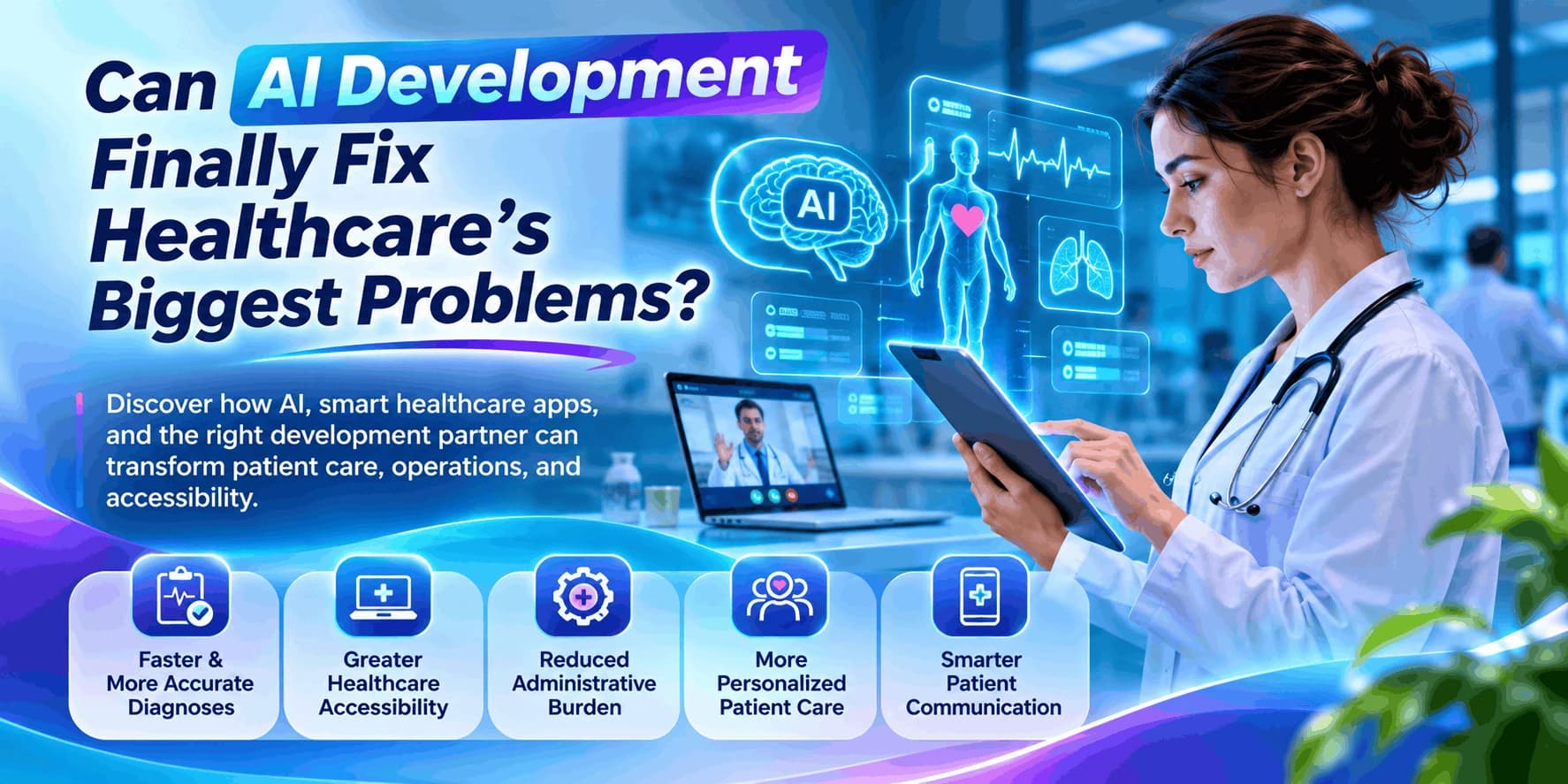
AI Development in healthcare featuring a doctor using a tablet with AI-powered diagnostics, digital patient monitoring, and smart healthcare technology.

Healthcare has entered an era where groundbreaking medical innovations coexist with frustrating everyday challenges. Patients still experience delayed appointments, physicians struggle with administrative workloads, and healthcare organizations face rising operational pressures. Meanwhile, disconnected medical records and inefficient communication systems frequently interrupt the delivery of quality care. AI Development is emerging as a powerful solution to these long-standing healthcare problems. By combining artificial intelligence, predictive analytics, intelligent automation, and custom healthcare applications, medical organizations can create faster, more accessible, and increasingly personalized healthcare experiences.

However, can artificial intelligence genuinely solve healthcare's biggest problems, or will it simply introduce another layer of technological complexity?

The answer depends on how intelligently healthcare organizations implement it.

What Is AI Development in Healthcare?

AI Development in healthcare involves designing intelligent software systems that analyze medical information, automate repetitive processes, identify meaningful patterns, and support healthcare professionals in making informed decisions.

Unlike traditional software, which primarily follows predefined instructions, AI-powered systems can recognize complex relationships within large datasets and generate predictions or recommendations.

For example, an AI-enabled healthcare application might identify patients requiring additional attention, simplify appointment scheduling, or help physicians review clinical information.

Furthermore, AI Development becomes particularly valuable when integrated with electronic health records (EHRs), telemedicine platforms, and remote patient monitoring systems.

According to the U.S. Food and Drug Administration, more than 1,600 AI-enabled medical devices had received marketing authorization in the United States by September 2026.

Consequently, AI is no longer merely an experimental healthcare technology. It is increasingly becoming part of real clinical and operational environments.

What Are the Biggest Problems Facing Healthcare Today?

Despite remarkable medical advancements, several structural challenges continue to affect healthcare systems worldwide.

1. Physician Burnout and Administrative Overload

Healthcare professionals spend significant time documenting consultations, reviewing records, coordinating appointments, and completing administrative tasks.

According to the American Medical Association, 41.9% of physicians reported experiencing at least one symptom of burnout in 2025.

Although burnout rates have declined, administrative responsibilities remain a substantial concern.

Fortunately, AI-powered documentation assistants, workflow automation, and intelligent scheduling systems can reduce some repetitive responsibilities. As a result, healthcare professionals may have more opportunities to focus on direct patient care.

2. Delayed Diagnoses and Fragmented Patient Information

Accurate diagnosis often requires evaluating laboratory reports, medical histories, imaging results, and patient symptoms.

However, important information may be distributed across different healthcare systems.

AI-powered clinical decision-support tools can help identify abnormalities, organize relevant medical information, and highlight patterns that deserve professional attention.

Nevertheless, these technologies must complement clinical judgment rather than replace qualified medical professionals.

3. Limited Healthcare Accessibility

Patients in rural communities and underserved regions frequently experience difficulties accessing specialized healthcare services.

Additionally, transportation limitations, appointment availability, and workforce shortages can delay treatment.

AI-enabled telemedicine platforms and mobile healthcare applications offer opportunities to improve access through virtual consultations, automated reminders, and remote monitoring.

Therefore, thoughtfully designed digital healthcare solutions can help reduce geographical barriers while supporting continuity of care.

How Is AI Development Transforming Healthcare Delivery?

The greatest advantage of AI Development is its ability to connect information, automate workflows, and support timely decisions.

AI-Powered Diagnostics and Predictive Healthcare

Machine learning systems can analyze medical imaging, physiological measurements, and historical clinical data to identify potentially concerning patterns.

For instance, certain regulated AI-enabled devices assist in detecting diabetic retinopathy, interpreting medical images, or monitoring cardiovascular indicators.

Similarly, predictive models may help healthcare teams identify patients at increased risk of complications.

However, their effectiveness depends on validated training data, suitable clinical settings, and continuous performance monitoring.

Intelligent Healthcare Automation

Automation can simplify appointment coordination, patient intake, documentation preparation, and routine administrative communication.

Furthermore, AI-assisted systems can prioritize incoming requests and direct patients toward appropriate services.

Instead of replacing healthcare workers, effective automation removes unnecessary friction from their daily responsibilities.

Personalized Patient Engagement

AI-powered applications can support individualized medication reminders, educational resources, and follow-up schedules based on approved patient information.

Meanwhile, a healthcare communications app can connect patients, physicians, and administrative teams through secure messaging and coordinated care updates.

Consequently, patients can remain better informed and engaged throughout their healthcare journeys.

Why Healthcare App Development Is Essential for Successful AI Integration

Although AI algorithms generate valuable insights, patients and medical professionals need practical tools to access those insights.

This is where healthcare app development becomes essential.

A thoughtfully developed application transforms complex technology into accessible functionality. Moreover, effective healthcare app design considers patient accessibility, clinical workflows, navigation simplicity, and information security from the beginning.

For businesses exploring promising healthcare app ideas, opportunities include AI-assisted patient portals, remote monitoring dashboards, telehealth applications, medication management platforms, and clinical workflow systems.

Nevertheless, developing a successful app healthcare solution requires more than attractive screens or sophisticated algorithms.

It requires an understanding of real healthcare challenges.

Healthcare organizations planning to build a healthcare app should therefore prioritize reliable functionality, interoperability, usability, and carefully defined AI capabilities.

Why App Vertices Is a Strong Choice for Healthcare App Development

As healthcare organizations accelerate their digital transformation, choosing the right technology partner becomes increasingly important.

App Vertices offers healthcare-focused mobile and web application development services designed to connect practical business requirements with modern technology.

Rather than approaching healthcare software as a generic application, App Vertices emphasizes customized digital solutions that address patient engagement, clinical workflows, and operational efficiency.

Additionally, its broader capabilities in AI Development, mobile applications, and custom software make it a relevant partner for organizations exploring intelligent healthcare platforms.

For hospitals, clinics, and healthcare startups, the objective should not simply be launching another application. Instead, it should be developing a reliable digital product that solves measurable problems.

Healthcare App Design That Prioritizes Real Users

Effective healthcare app design must serve individuals with different technical abilities, accessibility needs, and medical responsibilities.

For example, patients require straightforward appointment booking, understandable health information, and intuitive navigation.

Meanwhile, healthcare professionals need efficient interfaces that reduce unnecessary steps.

App Vertices provides UI/UX design and custom application development services that can support these distinct user experiences.

Custom AI Development and Healthcare Integration

Different healthcare organizations require different technology solutions.

Therefore, working with a healthcare app development company that offers customization can be more valuable than relying on rigid, ready-made software.

App Vertices provides AI development and software integration capabilities that can support projects involving intelligent workflows, patient-facing applications, and connected digital platforms.

Importantly, specific clinical AI features, integrations, and regulatory requirements should always be evaluated during project discovery.

How App Vertices Can Help Turn Healthcare App Ideas Into Practical Solutions

A successful healthcare application begins with identifying a genuine operational or patient-care problem.

For example, a clinic experiencing frequent missed appointments might benefit from an intelligent scheduling and reminder application.

Similarly, a healthcare startup could explore remote patient monitoring, virtual consultations, or secure patient-provider messaging.

App Vertices can support the journey from initial concept to application design, development, testing, and deployment.

Furthermore, organizations seeking a healthcare communications app can explore tailored solutions for appointment updates, care coordination, and secure patient engagement.

However, every project should begin with clearly defined users, measurable objectives, and an appropriate security assessment.

This approach helps organizations avoid investing in impressive features that deliver little practical value.

Why Healthcare App Testing Must Never Be Overlooked

Healthcare applications frequently process sensitive information and support important medical workflows. Consequently, reliability is a fundamental requirement.

Comprehensive healthcare app testing should evaluate functionality, performance, accessibility, security, and interoperability.

AI-powered features require additional assessment because model behavior may change across different patient populations and clinical environments.

Essential evaluation areas include:

  • Functional testing: Confirming that booking, messaging, records, and other features operate correctly.
  • Security testing: Identifying vulnerabilities and verifying authorization controls.
  • Integration testing: Ensuring connected healthcare systems exchange information accurately.
  • AI validation: Measuring accuracy, bias, reliability, and performance under realistic conditions.

Additionally, ongoing monitoring is necessary after deployment.

The HIPAA Security Rule requires regulated organizations to implement appropriate administrative, physical, and technical safeguards for electronic protected health information.

Therefore, compliance requires documented organizational practices alongside secure software engineering; no application becomes compliant merely by including encryption.

What Does the Future of AI Development in Healthcare Look Like?

The next phase of healthcare innovation will likely focus on connecting intelligent applications with everyday clinical operations.

For instance, AI-assisted virtual care may support more efficient patient intake, while remote monitoring platforms could help healthcare teams recognize concerning changes sooner.

Similarly, interoperable applications can improve information exchange between patients, providers, and healthcare systems.

According to U.S. health IT research, approximately nine in ten hospitals enabled electronic patient access to health information through an API in 2024.

Consequently, healthcare software developers have growing opportunities to create connected experiences using established interoperability approaches, including HL7 FHIR.

However, technological progress must remain balanced with privacy, accessibility, clinical validation, and responsible human oversight.

The World Health Organization also emphasizes ethical governance and equitable implementation when introducing AI into healthcare.

Frequently Asked Questions About AI Development in Healthcare

Can AI Development completely solve healthcare problems?

No. AI Development can improve efficiency, support clinical decisions, and strengthen patient engagement. However, workforce shortages, healthcare affordability, public health inequalities, and clinical responsibilities require broader organizational and policy solutions.

How much does it cost to build a healthcare app?

Healthcare application costs depend on platform complexity, design requirements, integrations, security controls, and AI functionality. Consequently, organizations should request a customized estimate after defining their project requirements.

What features should an AI healthcare application include?

Depending on its purpose, an application may include secure authentication, appointment management, telemedicine, patient records, medication reminders, messaging, analytics, and carefully validated AI features.

Why hire a professional healthcare app development company?

A specialized development partner can coordinate product strategy, user experience, engineering, integrations, security testing, and deployment. Furthermore, experienced technical guidance helps reduce preventable development risks.

Is AI safe for healthcare applications?

AI can be used responsibly when its intended purpose is clearly defined and supported by appropriate testing, security controls, clinical oversight, and regulatory review where necessary.

Final Thoughts: Building a Smarter Healthcare Future With App Vertices

AI Development cannot independently eliminate every healthcare challenge. Nevertheless, it offers meaningful opportunities to reduce administrative burdens, improve care coordination, and make healthcare technology more responsive to patient needs.

Ultimately, successful healthcare innovation depends on combining intelligent technology with practical design, trustworthy data, and responsible implementation.

For organizations ready to modernize their digital healthcare services, App Vertices offers a compelling combination of custom application development, AI capabilities, and user-focused software design.

Whether you are exploring innovative healthcare app ideas, improving an existing patient platform, or developing a new AI-enabled healthcare solution, selecting the right development partner is an important first step.

Ready to transform your healthcare idea into a powerful digital solution?

Connect with App Vertices to discuss your healthcare application requirements and explore a development approach aligned with your goals.

Merry Lana

Digital and AI Content Strategist

Subscription: Subscribe to our newsletter and receive a selection of cool articles every weeks

[Our Blogs]

Can AI Development Finally Fix Healthcare’s Biggest Problems?

The right technology decision starts long before development begins. Practical insight on building mobile apps, AI products, custom software and cloud platforms — aimed at the questions businesses need answered before they invest.

  • Blog
  • 23 November 2026
  • 8 minute read
AI Development in healthcare featuring a doctor using a tablet with AI-powered diagnostics, digital patient monitoring, and smart healthcare technology.

Healthcare has entered an era where groundbreaking medical innovations coexist with frustrating everyday challenges. Patients still experience delayed appointments, physicians struggle with administrative workloads, and healthcare organizations face rising operational pressures. Meanwhile, disconnected medical records and inefficient communication systems frequently interrupt the delivery of quality care. AI Development is emerging as a powerful solution to these long-standing healthcare problems. By combining artificial intelligence, predictive analytics, intelligent automation, and custom healthcare applications, medical organizations can create faster, more accessible, and increasingly personalized healthcare experiences.

However, can artificial intelligence genuinely solve healthcare's biggest problems, or will it simply introduce another layer of technological complexity?

The answer depends on how intelligently healthcare organizations implement it.

What Is AI Development in Healthcare?

AI Development in healthcare involves designing intelligent software systems that analyze medical information, automate repetitive processes, identify meaningful patterns, and support healthcare professionals in making informed decisions.

Unlike traditional software, which primarily follows predefined instructions, AI-powered systems can recognize complex relationships within large datasets and generate predictions or recommendations.

For example, an AI-enabled healthcare application might identify patients requiring additional attention, simplify appointment scheduling, or help physicians review clinical information.

Furthermore, AI Development becomes particularly valuable when integrated with electronic health records (EHRs), telemedicine platforms, and remote patient monitoring systems.

According to the U.S. Food and Drug Administration, more than 1,600 AI-enabled medical devices had received marketing authorization in the United States by September 2026.

Consequently, AI is no longer merely an experimental healthcare technology. It is increasingly becoming part of real clinical and operational environments.

What Are the Biggest Problems Facing Healthcare Today?

Despite remarkable medical advancements, several structural challenges continue to affect healthcare systems worldwide.

1. Physician Burnout and Administrative Overload

Healthcare professionals spend significant time documenting consultations, reviewing records, coordinating appointments, and completing administrative tasks.

According to the American Medical Association, 41.9% of physicians reported experiencing at least one symptom of burnout in 2025.

Although burnout rates have declined, administrative responsibilities remain a substantial concern.

Fortunately, AI-powered documentation assistants, workflow automation, and intelligent scheduling systems can reduce some repetitive responsibilities. As a result, healthcare professionals may have more opportunities to focus on direct patient care.

2. Delayed Diagnoses and Fragmented Patient Information

Accurate diagnosis often requires evaluating laboratory reports, medical histories, imaging results, and patient symptoms.

However, important information may be distributed across different healthcare systems.

AI-powered clinical decision-support tools can help identify abnormalities, organize relevant medical information, and highlight patterns that deserve professional attention.

Nevertheless, these technologies must complement clinical judgment rather than replace qualified medical professionals.

3. Limited Healthcare Accessibility

Patients in rural communities and underserved regions frequently experience difficulties accessing specialized healthcare services.

Additionally, transportation limitations, appointment availability, and workforce shortages can delay treatment.

AI-enabled telemedicine platforms and mobile healthcare applications offer opportunities to improve access through virtual consultations, automated reminders, and remote monitoring.

Therefore, thoughtfully designed digital healthcare solutions can help reduce geographical barriers while supporting continuity of care.

How Is AI Development Transforming Healthcare Delivery?

The greatest advantage of AI Development is its ability to connect information, automate workflows, and support timely decisions.

AI-Powered Diagnostics and Predictive Healthcare

Machine learning systems can analyze medical imaging, physiological measurements, and historical clinical data to identify potentially concerning patterns.

For instance, certain regulated AI-enabled devices assist in detecting diabetic retinopathy, interpreting medical images, or monitoring cardiovascular indicators.

Similarly, predictive models may help healthcare teams identify patients at increased risk of complications.

However, their effectiveness depends on validated training data, suitable clinical settings, and continuous performance monitoring.

Intelligent Healthcare Automation

Automation can simplify appointment coordination, patient intake, documentation preparation, and routine administrative communication.

Furthermore, AI-assisted systems can prioritize incoming requests and direct patients toward appropriate services.

Instead of replacing healthcare workers, effective automation removes unnecessary friction from their daily responsibilities.

Personalized Patient Engagement

AI-powered applications can support individualized medication reminders, educational resources, and follow-up schedules based on approved patient information.

Meanwhile, a healthcare communications app can connect patients, physicians, and administrative teams through secure messaging and coordinated care updates.

Consequently, patients can remain better informed and engaged throughout their healthcare journeys.

Why Healthcare App Development Is Essential for Successful AI Integration

Although AI algorithms generate valuable insights, patients and medical professionals need practical tools to access those insights.

This is where healthcare app development becomes essential.

A thoughtfully developed application transforms complex technology into accessible functionality. Moreover, effective healthcare app design considers patient accessibility, clinical workflows, navigation simplicity, and information security from the beginning.

For businesses exploring promising healthcare app ideas, opportunities include AI-assisted patient portals, remote monitoring dashboards, telehealth applications, medication management platforms, and clinical workflow systems.

Nevertheless, developing a successful app healthcare solution requires more than attractive screens or sophisticated algorithms.

It requires an understanding of real healthcare challenges.

Healthcare organizations planning to build a healthcare app should therefore prioritize reliable functionality, interoperability, usability, and carefully defined AI capabilities.

Why App Vertices Is a Strong Choice for Healthcare App Development

As healthcare organizations accelerate their digital transformation, choosing the right technology partner becomes increasingly important.

App Vertices offers healthcare-focused mobile and web application development services designed to connect practical business requirements with modern technology.

Rather than approaching healthcare software as a generic application, App Vertices emphasizes customized digital solutions that address patient engagement, clinical workflows, and operational efficiency.

Additionally, its broader capabilities in AI Development, mobile applications, and custom software make it a relevant partner for organizations exploring intelligent healthcare platforms.

For hospitals, clinics, and healthcare startups, the objective should not simply be launching another application. Instead, it should be developing a reliable digital product that solves measurable problems.

Healthcare App Design That Prioritizes Real Users

Effective healthcare app design must serve individuals with different technical abilities, accessibility needs, and medical responsibilities.

For example, patients require straightforward appointment booking, understandable health information, and intuitive navigation.

Meanwhile, healthcare professionals need efficient interfaces that reduce unnecessary steps.

App Vertices provides UI/UX design and custom application development services that can support these distinct user experiences.

Custom AI Development and Healthcare Integration

Different healthcare organizations require different technology solutions.

Therefore, working with a healthcare app development company that offers customization can be more valuable than relying on rigid, ready-made software.

App Vertices provides AI development and software integration capabilities that can support projects involving intelligent workflows, patient-facing applications, and connected digital platforms.

Importantly, specific clinical AI features, integrations, and regulatory requirements should always be evaluated during project discovery.

How App Vertices Can Help Turn Healthcare App Ideas Into Practical Solutions

A successful healthcare application begins with identifying a genuine operational or patient-care problem.

For example, a clinic experiencing frequent missed appointments might benefit from an intelligent scheduling and reminder application.

Similarly, a healthcare startup could explore remote patient monitoring, virtual consultations, or secure patient-provider messaging.

App Vertices can support the journey from initial concept to application design, development, testing, and deployment.

Furthermore, organizations seeking a healthcare communications app can explore tailored solutions for appointment updates, care coordination, and secure patient engagement.

However, every project should begin with clearly defined users, measurable objectives, and an appropriate security assessment.

This approach helps organizations avoid investing in impressive features that deliver little practical value.

Why Healthcare App Testing Must Never Be Overlooked

Healthcare applications frequently process sensitive information and support important medical workflows. Consequently, reliability is a fundamental requirement.

Comprehensive healthcare app testing should evaluate functionality, performance, accessibility, security, and interoperability.

AI-powered features require additional assessment because model behavior may change across different patient populations and clinical environments.

Essential evaluation areas include:

  • Functional testing: Confirming that booking, messaging, records, and other features operate correctly.
  • Security testing: Identifying vulnerabilities and verifying authorization controls.
  • Integration testing: Ensuring connected healthcare systems exchange information accurately.
  • AI validation: Measuring accuracy, bias, reliability, and performance under realistic conditions.

Additionally, ongoing monitoring is necessary after deployment.

The HIPAA Security Rule requires regulated organizations to implement appropriate administrative, physical, and technical safeguards for electronic protected health information.

Therefore, compliance requires documented organizational practices alongside secure software engineering; no application becomes compliant merely by including encryption.

What Does the Future of AI Development in Healthcare Look Like?

The next phase of healthcare innovation will likely focus on connecting intelligent applications with everyday clinical operations.

For instance, AI-assisted virtual care may support more efficient patient intake, while remote monitoring platforms could help healthcare teams recognize concerning changes sooner.

Similarly, interoperable applications can improve information exchange between patients, providers, and healthcare systems.

According to U.S. health IT research, approximately nine in ten hospitals enabled electronic patient access to health information through an API in 2024.

Consequently, healthcare software developers have growing opportunities to create connected experiences using established interoperability approaches, including HL7 FHIR.

However, technological progress must remain balanced with privacy, accessibility, clinical validation, and responsible human oversight.

The World Health Organization also emphasizes ethical governance and equitable implementation when introducing AI into healthcare.

Frequently Asked Questions About AI Development in Healthcare

Can AI Development completely solve healthcare problems?

No. AI Development can improve efficiency, support clinical decisions, and strengthen patient engagement. However, workforce shortages, healthcare affordability, public health inequalities, and clinical responsibilities require broader organizational and policy solutions.

How much does it cost to build a healthcare app?

Healthcare application costs depend on platform complexity, design requirements, integrations, security controls, and AI functionality. Consequently, organizations should request a customized estimate after defining their project requirements.

What features should an AI healthcare application include?

Depending on its purpose, an application may include secure authentication, appointment management, telemedicine, patient records, medication reminders, messaging, analytics, and carefully validated AI features.

Why hire a professional healthcare app development company?

A specialized development partner can coordinate product strategy, user experience, engineering, integrations, security testing, and deployment. Furthermore, experienced technical guidance helps reduce preventable development risks.

Is AI safe for healthcare applications?

AI can be used responsibly when its intended purpose is clearly defined and supported by appropriate testing, security controls, clinical oversight, and regulatory review where necessary.

Final Thoughts: Building a Smarter Healthcare Future With App Vertices

AI Development cannot independently eliminate every healthcare challenge. Nevertheless, it offers meaningful opportunities to reduce administrative burdens, improve care coordination, and make healthcare technology more responsive to patient needs.

Ultimately, successful healthcare innovation depends on combining intelligent technology with practical design, trustworthy data, and responsible implementation.

For organizations ready to modernize their digital healthcare services, App Vertices offers a compelling combination of custom application development, AI capabilities, and user-focused software design.

Whether you are exploring innovative healthcare app ideas, improving an existing patient platform, or developing a new AI-enabled healthcare solution, selecting the right development partner is an important first step.

Ready to transform your healthcare idea into a powerful digital solution?

Connect with App Vertices to discuss your healthcare application requirements and explore a development approach aligned with your goals.

Merry LanaDigital and AI Content Strategist

Subscription: Subscribe to our newsletter and receive a selection of cool articles every weeks

The Latest

You May Also Like