



Get a QuoteGet a Quote

[Our Blogs]

AI Agents Platform: How Intelligent AI Agents Are Transforming Business Automation

The right technology decision starts long before development begins. Practical insight on building mobile apps, AI products, custom software and cloud platforms — aimed at the questions businesses need answered before they invest.

Blog17 November 20269 minute read
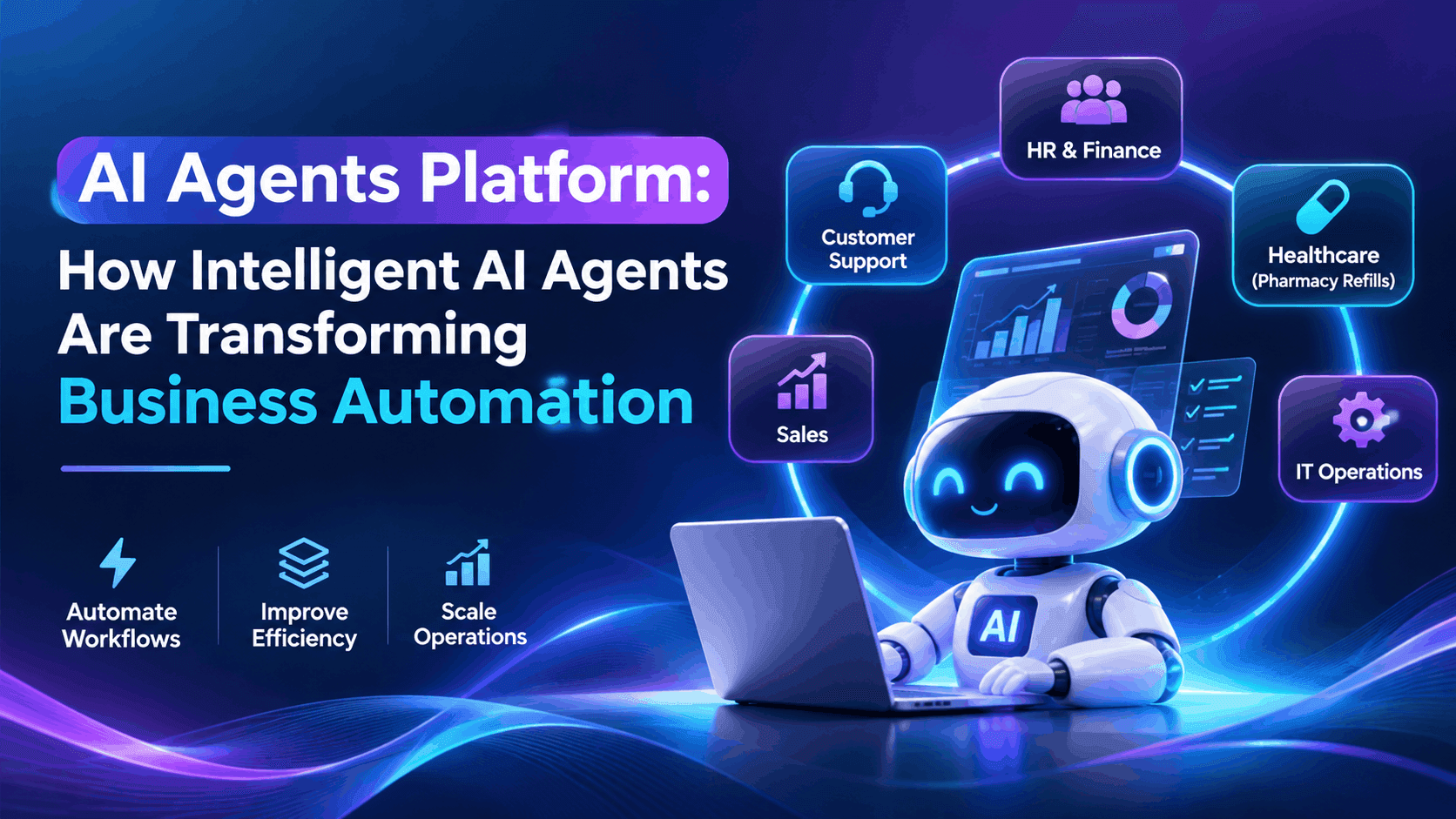
AI Agents Platform transforming business automation through intelligent AI agents for customer support, sales, healthcare, HR, and IT operations.

Businesses lose valuable time managing repetitive tasks, switching between disconnected applications, and manually coordinating workflows. Customer service teams handle the same questions repeatedly, HR departments process routine requests, and operations managers spend hours tracking information across different systems.

Traditional automation helps, but it often struggles when a process requires understanding context, interpreting unfamiliar information, or adapting to changing circumstances.

An AI Agents Platform offers a more flexible approach to business automation. It enables intelligent software agents to understand objectives, retrieve relevant information, interact with authorized systems, and perform tasks with appropriate human oversight.

From customer support and enterprise operations to healthcare administration, AI-powered agents are creating new opportunities to improve productivity.

But how do these systems work, which platforms deserve consideration, and when should businesses invest in custom AI agents?

Understanding these questions is essential before implementing agentic AI.

What Is an AI Agents Platform?

An AI Agents Platform is a software environment for building, deploying, managing, and monitoring intelligent AI agents that perform tasks using artificial intelligence, business data, and connected tools. Unlike basic chatbots, AI agents can coordinate multiple workflow steps, interact with authorized applications, and adapt their actions to specific objectives while operating within established security and approval boundaries.

A modern AI agent platform typically includes:

  • AI models: Interpret requests, generate responses, and select appropriate actions.
  • API integrations: Connect agents to CRM, ERP, databases, and other applications.
  • Workflow orchestration: Coordinate multistep tasks and interactions between agents.
  • Business knowledge access: Retrieve relevant information from approved sources.
  • Human governance: Enforce permissions, approval checkpoints, and operational policies.
  • Monitoring: Track agent performance, errors, costs, and workflow outcomes.

AI Agents vs. Traditional Automation and Chatbots

Traditional automation follows predefined instructions. Chatbots primarily answer questions or guide conversations. AI agents can go further by selecting tools and performing authorized actions based on context.

For example, a traditional chatbot might explain how to check an order. An AI agent could retrieve the order status, identify a shipping issue, prepare a support ticket, and notify the appropriate employee.

However, agents are not inherently more reliable than deterministic software. For predictable, high-risk operations, conventional rules remain essential.

How Do AI Agents Work in Business Automation?

AI agents combine language understanding, business context, connected tools, and workflow controls to complete defined objectives.

A typical agent workflow follows six stages:

  1. Receive a request: A customer or employee submits a task.
  2. Understand the context: The agent interprets the objective and retrieves relevant information.
  3. Select tools: It identifies authorized applications or APIs.
  4. Execute actions: The agent performs permitted workflow steps.
  5. Validate results: It checks outcomes and requests approval for sensitive decisions.
  6. Report completion: The system records its actions and communicates the result.

Practical Example: Automating Customer Support

Imagine an e-commerce company receiving hundreds of daily delivery inquiries.

An AI agent could identify a customer's order, check shipment information through an authorized API, and draft a personalized response.

If the delivery is delayed, it could create a support ticket and assign it to the appropriate team.

For refunds or compensation, the system would follow company policies and request human approval when required.

This approach reduces repetitive coordination without removing accountability.

Key Benefits of Using an AI Agents Platform

An effective AI-powered automation strategy can improve business operations in several ways.

  • Reduced administrative workload: Agents can prepare reports, classify documents, update records, and organize routine requests.
  • Faster response times: Automated routing helps inquiries reach the correct system or employee more quickly.
  • Improved workflow coordination: Connected agents can share relevant information across approved business applications.
  • Better knowledge accessibility: Employees can retrieve information from authorized documentation without manually searching multiple repositories.
  • Consistent service delivery: Defined rules and response standards can reduce variations in routine processes.
  • Scalable automation: Organizations can expand successful workflows across departments without rebuilding every process.

These benefits depend on reliable integrations, accurate business information, clear permissions, and continuous testing.

Poorly configured agents may introduce errors instead of eliminating them. Businesses should measure actual task completion, accuracy, escalation rates, and employee time savings rather than assuming automation automatically improves performance.

Real-World Applications of AI Agents Across Industries

AI-powered workflows can support multiple business functions, although the degree of autonomy should reflect each task's risk.

AI Agents for Customer Support and Sales

Customer-facing agents can classify support tickets, answer questions using approved knowledge sources, and escalate complicated inquiries.

Sales teams can use agents to organize lead information, update CRM records, prepare follow-up drafts, and identify inquiries requiring immediate attention.

For example, an agent might review a prospect's submitted requirements and recommend the appropriate sales representative based on territory, industry, and service needs.

The agent should avoid inventing product capabilities, pricing commitments, or customer details.

Workday AI Agents for HR and Finance

Organizations investigating workday ai agents can explore specialized capabilities for human resources, payroll, recruiting, and financial operations.

Workday documents a Recruiting Agent that supports recruiting workflows and a Payroll Agent that helps identify payroll issues. Its product resources list both as generally available, subject to applicable subscriptions and entitlements.

Other financial capabilities have different availability classifications. Workday's Financial Audit Agent, for example, is described as Early Adopter in its agent availability resources.

Workday also announced additional autopilot capabilities on October 13, 2026, emphasizing operation within organizational policies, permissions, and approvals. Announced functionality should not automatically be interpreted as universally available.

Businesses should confirm current regional availability, licensing, configuration requirements, and human-review controls before deployment.

Voice AI Agents for Pharmacy Refill Requests

Pharmacies regularly manage prescription refill inquiries, medication availability questions, and administrative telephone requests.

Businesses researching the top voice ai agents for pharmacy refill requests should prioritize healthcare-specific workflow capabilities rather than conversational fluency alone.

A properly designed voice AI solution could:

  • Collect the caller's refill request.
  • Verify identity using an approved process.
  • Retrieve permitted prescription information.
  • Route requests to the pharmacy management system.
  • Escalate exceptions to authorized pharmacy personnel.
  • Provide approved status updates.

AI should not independently authorize prescriptions, determine clinical appropriateness, or override pharmacist judgment.

For U.S. pharmacies, HIPAA requirements, applicable state pharmacy laws, secure integrations, and vendor agreements must be evaluated. The Department of Health and Human Services provides guidance on limiting protected health information uses and disclosures where its minimum-necessary requirement applies.

AI Agents for IT and Business Operations

IT departments can use agents to answer internal support questions, classify incidents, retrieve troubleshooting procedures, and coordinate routine service requests.

Operations teams may automate document classification, inventory alerts, meeting preparation, and administrative reporting.

For sensitive activities such as changing account permissions or deleting records, agents should require explicit authorization or use strictly controlled workflows.

Custom AI Development Services vs. Ready-Made AI Agent Platforms

Ready-made platforms are attractive when businesses need standard integrations and established administration tools.

However, custom ai development services may be preferable when workflows involve proprietary systems, specialized permissions, unique customer experiences, or complex business rules.

FactorReady-made platformCustom AI solution
CustomizationPlatform-dependentExtensive
ImplementationOften fasterRequires development
IntegrationsExisting connectorsTailored APIs
MaintenanceShared with vendorGreater internal responsibility
Long-term controlVendor-dependentMore architectural flexibility

A business using common CRM and productivity tools may benefit from an existing platform.

A healthcare provider integrating specialized applications may require tailored architecture, security controls, and operational workflows.

Custom development can also use managed AI infrastructure. The decision is not necessarily between building everything internally and purchasing an entirely closed product.

AI MVP Development: How to Launch an AI Agent Solution

Starting with ai mvp development allows organizations to validate one practical use case before committing to larger automation initiatives.

A focused implementation roadmap includes:

  1. Identify the problem: Choose one repetitive, measurable workflow.
  2. Define boundaries: Specify permitted actions, exclusions, and escalation conditions.
  3. Prepare data: Organize reliable documents and secure API access.
  4. Choose technology: Evaluate models, hosting, integrations, and governance.
  5. Build the MVP: Implement only the features needed to test the workflow.
  6. Test thoroughly: Assess accuracy, privacy, reliability, permissions, and failure handling.
  7. Measure outcomes: Compare costs, time savings, errors, and user satisfaction before expanding.

For example, a small business could launch an AI agent that categorizes incoming support emails and drafts responses for employee approval.

This limited MVP provides measurable results without immediately allowing the agent to send messages or modify customer accounts independently.

AI App Development Cost: What Affects Your Budget?

AI app development cost depends on workflow scope, integration complexity, data requirements, and operational safeguards.

The largest cost drivers typically include:

  • Workflow complexity: Multistep processes require more development and testing.
  • AI model usage: Charges vary with model selection, requests, and processing volume.
  • Integrations: Connecting legacy systems may require additional engineering.
  • Data preparation: Inconsistent documents and databases increase implementation effort.
  • Security and compliance: Sensitive environments require stronger controls.
  • Testing: Reliability evaluations, exception handling, and regression testing add costs.
  • Infrastructure: Hosting, monitoring, and storage create recurring expenses.
  • Human oversight: Employees may still need to review exceptions and sensitive outputs.

Initial costs include discovery, design, development, integration, and deployment.

Recurring costs include model usage, infrastructure, monitoring, maintenance, and human review.

Because requirements vary substantially, a universal development estimate would be misleading.

Businesses should request a scope-based quotation and calculate the expected cost per successfully completed workflow.

Challenges and Best Practices for AI Agent Adoption

AI agents introduce risks that organizations must address before allowing production access.

Hallucinations can produce incorrect information, while poorly controlled tools may execute unintended actions. Sensitive data may also be exposed through inappropriate permissions or insecure integrations.

The NIST AI Risk Management Framework provides a useful foundation for identifying, measuring, and managing AI-related risks.

Effective safeguards include:

  • Granting agents only the permissions necessary for assigned tasks.
  • Requiring human approval for financial, legal, clinical, or irreversible actions.
  • Validating tool inputs and outputs against business rules.
  • Testing misleading instructions and malicious content in retrieved documents.
  • Maintaining useful audit trails without unnecessary sensitive-data exposure.
  • Monitoring failed tasks, unexpected costs, and accuracy changes.
  • Establishing fallback procedures when models or integrations fail.
  • Reviewing vendor dependence, data portability, and contractual obligations.

Responsible adoption means increasing automation only after a workflow demonstrates dependable performance.

Frequently Asked Questions About AI Agents Platforms

What is an AI agents platform?

An AI agents platform provides the infrastructure to create, connect, deploy, and manage intelligent software agents. These agents can interpret requests, retrieve authorized information, and execute defined workflow actions. Businesses use such platforms to coordinate automation across applications while maintaining access controls, monitoring, and human approval mechanisms.

What Is the Difference Between an AI Agent and a Traditional Chatbot?

A chatbot usually focuses on conversation, information retrieval, or predefined interactions. An AI agent can also select tools and perform authorized tasks across connected systems. For example, a chatbot might explain a refund policy, while an agent could retrieve transaction details and prepare a refund request for approval.

What are the best AI agents for business automation?

The best solution depends on existing systems, business requirements, and security needs. Microsoft Copilot Studio, Salesforce Agentforce, Google Cloud's Gemini Enterprise Agent Platform, and Workday AI agents serve different organizational priorities. Businesses should compare integrations, permissions, automation capabilities, implementation effort, and ongoing costs before choosing.

Can AI agents automate HR and pharmacy workflows?

Yes, AI agents can assist with HR administration, payroll checks, scheduling, and pharmacy refill intake. However, regulated or high-impact decisions require appropriate safeguards. Pharmacy workflows must protect patient information and preserve pharmacist authority, while HR systems need controls for employee privacy, fairness, and employment-related decisions.

What Factors Determine the Cost of Developing an AI Agent Application?

Development costs vary according to the number of workflows, software integrations, model usage, compliance requirements, and maintenance responsibilities. A limited document-processing agent usually involves fewer components than a deeply integrated enterprise system. Businesses should distinguish implementation expenses from recurring operating costs and obtain estimates based on documented requirements.

Can a small business start with an AI agent MVP?

Yes. Small businesses can begin with a focused AI MVP for tasks such as inquiry classification, appointment request handling, or internal knowledge retrieval. The safest approach is to limit the initial permissions, involve employees in reviewing results, establish success metrics, and expand automation only after demonstrating reliable performance.

Conclusion: Building Smarter Business Workflows With AI Agents

An AI Agents Platform can help businesses move beyond repetitive automation toward more adaptable, connected workflows.

From customer service and sales to HR, finance, and IT operations, intelligent agents can reduce administrative effort, improve information accessibility, and support more efficient decision-making.

However, successful adoption requires more than selecting an advanced AI model. Reliable integrations, secure data access, measurable business objectives, and human oversight remain essential.

Organizations should begin with a clearly defined problem, evaluate available platforms, and test results before scaling.

If your business requires specialized automation, exploring custom AI development services or launching a focused AI MVP can provide a practical starting point for building secure, scalable, and business-ready AI solutions.

Merry Lana

Digital and AI Content Strategist

Subscription: Subscribe to our newsletter and receive a selection of cool articles every weeks

[Our Blogs]

AI Agents Platform: How Intelligent AI Agents Are Transforming Business Automation

The right technology decision starts long before development begins. Practical insight on building mobile apps, AI products, custom software and cloud platforms — aimed at the questions businesses need answered before they invest.

  • Blog
  • 17 November 2026
  • 9 minute read
AI Agents Platform transforming business automation through intelligent AI agents for customer support, sales, healthcare, HR, and IT operations.

Businesses lose valuable time managing repetitive tasks, switching between disconnected applications, and manually coordinating workflows. Customer service teams handle the same questions repeatedly, HR departments process routine requests, and operations managers spend hours tracking information across different systems.

Traditional automation helps, but it often struggles when a process requires understanding context, interpreting unfamiliar information, or adapting to changing circumstances.

An AI Agents Platform offers a more flexible approach to business automation. It enables intelligent software agents to understand objectives, retrieve relevant information, interact with authorized systems, and perform tasks with appropriate human oversight.

From customer support and enterprise operations to healthcare administration, AI-powered agents are creating new opportunities to improve productivity.

But how do these systems work, which platforms deserve consideration, and when should businesses invest in custom AI agents?

Understanding these questions is essential before implementing agentic AI.

What Is an AI Agents Platform?

An AI Agents Platform is a software environment for building, deploying, managing, and monitoring intelligent AI agents that perform tasks using artificial intelligence, business data, and connected tools. Unlike basic chatbots, AI agents can coordinate multiple workflow steps, interact with authorized applications, and adapt their actions to specific objectives while operating within established security and approval boundaries.

A modern AI agent platform typically includes:

  • AI models: Interpret requests, generate responses, and select appropriate actions.
  • API integrations: Connect agents to CRM, ERP, databases, and other applications.
  • Workflow orchestration: Coordinate multistep tasks and interactions between agents.
  • Business knowledge access: Retrieve relevant information from approved sources.
  • Human governance: Enforce permissions, approval checkpoints, and operational policies.
  • Monitoring: Track agent performance, errors, costs, and workflow outcomes.

AI Agents vs. Traditional Automation and Chatbots

Traditional automation follows predefined instructions. Chatbots primarily answer questions or guide conversations. AI agents can go further by selecting tools and performing authorized actions based on context.

For example, a traditional chatbot might explain how to check an order. An AI agent could retrieve the order status, identify a shipping issue, prepare a support ticket, and notify the appropriate employee.

However, agents are not inherently more reliable than deterministic software. For predictable, high-risk operations, conventional rules remain essential.

How Do AI Agents Work in Business Automation?

AI agents combine language understanding, business context, connected tools, and workflow controls to complete defined objectives.

A typical agent workflow follows six stages:

  1. Receive a request: A customer or employee submits a task.
  2. Understand the context: The agent interprets the objective and retrieves relevant information.
  3. Select tools: It identifies authorized applications or APIs.
  4. Execute actions: The agent performs permitted workflow steps.
  5. Validate results: It checks outcomes and requests approval for sensitive decisions.
  6. Report completion: The system records its actions and communicates the result.

Practical Example: Automating Customer Support

Imagine an e-commerce company receiving hundreds of daily delivery inquiries.

An AI agent could identify a customer's order, check shipment information through an authorized API, and draft a personalized response.

If the delivery is delayed, it could create a support ticket and assign it to the appropriate team.

For refunds or compensation, the system would follow company policies and request human approval when required.

This approach reduces repetitive coordination without removing accountability.

Key Benefits of Using an AI Agents Platform

An effective AI-powered automation strategy can improve business operations in several ways.

  • Reduced administrative workload: Agents can prepare reports, classify documents, update records, and organize routine requests.
  • Faster response times: Automated routing helps inquiries reach the correct system or employee more quickly.
  • Improved workflow coordination: Connected agents can share relevant information across approved business applications.
  • Better knowledge accessibility: Employees can retrieve information from authorized documentation without manually searching multiple repositories.
  • Consistent service delivery: Defined rules and response standards can reduce variations in routine processes.
  • Scalable automation: Organizations can expand successful workflows across departments without rebuilding every process.

These benefits depend on reliable integrations, accurate business information, clear permissions, and continuous testing.

Poorly configured agents may introduce errors instead of eliminating them. Businesses should measure actual task completion, accuracy, escalation rates, and employee time savings rather than assuming automation automatically improves performance.

Real-World Applications of AI Agents Across Industries

AI-powered workflows can support multiple business functions, although the degree of autonomy should reflect each task's risk.

AI Agents for Customer Support and Sales

Customer-facing agents can classify support tickets, answer questions using approved knowledge sources, and escalate complicated inquiries.

Sales teams can use agents to organize lead information, update CRM records, prepare follow-up drafts, and identify inquiries requiring immediate attention.

For example, an agent might review a prospect's submitted requirements and recommend the appropriate sales representative based on territory, industry, and service needs.

The agent should avoid inventing product capabilities, pricing commitments, or customer details.

Workday AI Agents for HR and Finance

Organizations investigating workday ai agents can explore specialized capabilities for human resources, payroll, recruiting, and financial operations.

Workday documents a Recruiting Agent that supports recruiting workflows and a Payroll Agent that helps identify payroll issues. Its product resources list both as generally available, subject to applicable subscriptions and entitlements.

Other financial capabilities have different availability classifications. Workday's Financial Audit Agent, for example, is described as Early Adopter in its agent availability resources.

Workday also announced additional autopilot capabilities on October 13, 2026, emphasizing operation within organizational policies, permissions, and approvals. Announced functionality should not automatically be interpreted as universally available.

Businesses should confirm current regional availability, licensing, configuration requirements, and human-review controls before deployment.

Voice AI Agents for Pharmacy Refill Requests

Pharmacies regularly manage prescription refill inquiries, medication availability questions, and administrative telephone requests.

Businesses researching the top voice ai agents for pharmacy refill requests should prioritize healthcare-specific workflow capabilities rather than conversational fluency alone.

A properly designed voice AI solution could:

  • Collect the caller's refill request.
  • Verify identity using an approved process.
  • Retrieve permitted prescription information.
  • Route requests to the pharmacy management system.
  • Escalate exceptions to authorized pharmacy personnel.
  • Provide approved status updates.

AI should not independently authorize prescriptions, determine clinical appropriateness, or override pharmacist judgment.

For U.S. pharmacies, HIPAA requirements, applicable state pharmacy laws, secure integrations, and vendor agreements must be evaluated. The Department of Health and Human Services provides guidance on limiting protected health information uses and disclosures where its minimum-necessary requirement applies.

AI Agents for IT and Business Operations

IT departments can use agents to answer internal support questions, classify incidents, retrieve troubleshooting procedures, and coordinate routine service requests.

Operations teams may automate document classification, inventory alerts, meeting preparation, and administrative reporting.

For sensitive activities such as changing account permissions or deleting records, agents should require explicit authorization or use strictly controlled workflows.

Custom AI Development Services vs. Ready-Made AI Agent Platforms

Ready-made platforms are attractive when businesses need standard integrations and established administration tools.

However, custom ai development services may be preferable when workflows involve proprietary systems, specialized permissions, unique customer experiences, or complex business rules.

FactorReady-made platformCustom AI solution
CustomizationPlatform-dependentExtensive
ImplementationOften fasterRequires development
IntegrationsExisting connectorsTailored APIs
MaintenanceShared with vendorGreater internal responsibility
Long-term controlVendor-dependentMore architectural flexibility

A business using common CRM and productivity tools may benefit from an existing platform.

A healthcare provider integrating specialized applications may require tailored architecture, security controls, and operational workflows.

Custom development can also use managed AI infrastructure. The decision is not necessarily between building everything internally and purchasing an entirely closed product.

AI MVP Development: How to Launch an AI Agent Solution

Starting with ai mvp development allows organizations to validate one practical use case before committing to larger automation initiatives.

A focused implementation roadmap includes:

  1. Identify the problem: Choose one repetitive, measurable workflow.
  2. Define boundaries: Specify permitted actions, exclusions, and escalation conditions.
  3. Prepare data: Organize reliable documents and secure API access.
  4. Choose technology: Evaluate models, hosting, integrations, and governance.
  5. Build the MVP: Implement only the features needed to test the workflow.
  6. Test thoroughly: Assess accuracy, privacy, reliability, permissions, and failure handling.
  7. Measure outcomes: Compare costs, time savings, errors, and user satisfaction before expanding.

For example, a small business could launch an AI agent that categorizes incoming support emails and drafts responses for employee approval.

This limited MVP provides measurable results without immediately allowing the agent to send messages or modify customer accounts independently.

AI App Development Cost: What Affects Your Budget?

AI app development cost depends on workflow scope, integration complexity, data requirements, and operational safeguards.

The largest cost drivers typically include:

  • Workflow complexity: Multistep processes require more development and testing.
  • AI model usage: Charges vary with model selection, requests, and processing volume.
  • Integrations: Connecting legacy systems may require additional engineering.
  • Data preparation: Inconsistent documents and databases increase implementation effort.
  • Security and compliance: Sensitive environments require stronger controls.
  • Testing: Reliability evaluations, exception handling, and regression testing add costs.
  • Infrastructure: Hosting, monitoring, and storage create recurring expenses.
  • Human oversight: Employees may still need to review exceptions and sensitive outputs.

Initial costs include discovery, design, development, integration, and deployment.

Recurring costs include model usage, infrastructure, monitoring, maintenance, and human review.

Because requirements vary substantially, a universal development estimate would be misleading.

Businesses should request a scope-based quotation and calculate the expected cost per successfully completed workflow.

Challenges and Best Practices for AI Agent Adoption

AI agents introduce risks that organizations must address before allowing production access.

Hallucinations can produce incorrect information, while poorly controlled tools may execute unintended actions. Sensitive data may also be exposed through inappropriate permissions or insecure integrations.

The NIST AI Risk Management Framework provides a useful foundation for identifying, measuring, and managing AI-related risks.

Effective safeguards include:

  • Granting agents only the permissions necessary for assigned tasks.
  • Requiring human approval for financial, legal, clinical, or irreversible actions.
  • Validating tool inputs and outputs against business rules.
  • Testing misleading instructions and malicious content in retrieved documents.
  • Maintaining useful audit trails without unnecessary sensitive-data exposure.
  • Monitoring failed tasks, unexpected costs, and accuracy changes.
  • Establishing fallback procedures when models or integrations fail.
  • Reviewing vendor dependence, data portability, and contractual obligations.

Responsible adoption means increasing automation only after a workflow demonstrates dependable performance.

Frequently Asked Questions About AI Agents Platforms

What is an AI agents platform?

An AI agents platform provides the infrastructure to create, connect, deploy, and manage intelligent software agents. These agents can interpret requests, retrieve authorized information, and execute defined workflow actions. Businesses use such platforms to coordinate automation across applications while maintaining access controls, monitoring, and human approval mechanisms.

What Is the Difference Between an AI Agent and a Traditional Chatbot?

A chatbot usually focuses on conversation, information retrieval, or predefined interactions. An AI agent can also select tools and perform authorized tasks across connected systems. For example, a chatbot might explain a refund policy, while an agent could retrieve transaction details and prepare a refund request for approval.

What are the best AI agents for business automation?

The best solution depends on existing systems, business requirements, and security needs. Microsoft Copilot Studio, Salesforce Agentforce, Google Cloud's Gemini Enterprise Agent Platform, and Workday AI agents serve different organizational priorities. Businesses should compare integrations, permissions, automation capabilities, implementation effort, and ongoing costs before choosing.

Can AI agents automate HR and pharmacy workflows?

Yes, AI agents can assist with HR administration, payroll checks, scheduling, and pharmacy refill intake. However, regulated or high-impact decisions require appropriate safeguards. Pharmacy workflows must protect patient information and preserve pharmacist authority, while HR systems need controls for employee privacy, fairness, and employment-related decisions.

What Factors Determine the Cost of Developing an AI Agent Application?

Development costs vary according to the number of workflows, software integrations, model usage, compliance requirements, and maintenance responsibilities. A limited document-processing agent usually involves fewer components than a deeply integrated enterprise system. Businesses should distinguish implementation expenses from recurring operating costs and obtain estimates based on documented requirements.

Can a small business start with an AI agent MVP?

Yes. Small businesses can begin with a focused AI MVP for tasks such as inquiry classification, appointment request handling, or internal knowledge retrieval. The safest approach is to limit the initial permissions, involve employees in reviewing results, establish success metrics, and expand automation only after demonstrating reliable performance.

Conclusion: Building Smarter Business Workflows With AI Agents

An AI Agents Platform can help businesses move beyond repetitive automation toward more adaptable, connected workflows.

From customer service and sales to HR, finance, and IT operations, intelligent agents can reduce administrative effort, improve information accessibility, and support more efficient decision-making.

However, successful adoption requires more than selecting an advanced AI model. Reliable integrations, secure data access, measurable business objectives, and human oversight remain essential.

Organizations should begin with a clearly defined problem, evaluate available platforms, and test results before scaling.

If your business requires specialized automation, exploring custom AI development services or launching a focused AI MVP can provide a practical starting point for building secure, scalable, and business-ready AI solutions.

Merry LanaDigital and AI Content Strategist

Subscription: Subscribe to our newsletter and receive a selection of cool articles every weeks

The Latest

You May Also Like