Introduction
Enterprise data engineering is under pressure like never before. Data volumes are exploding, pipelines are growing more complex, and business leaders expect insights faster than ever. At the same time, regulatory scrutiny is increasing, costs are rising, and talent shortages continue to slow delivery.
As a result, many organizations are asking the same question: How can we build data systems that are faster, more resilient, and less dependent on manual intervention?
This is where Agentic AI enters the picture.
Agentic AI represents a shift from passive automation to goal-driven, autonomous systems that can observe, decide, and act across data workflows. When applied to enterprise data engineering, these AI agents can transform ingestion, transformation, quality monitoring, and orchestration—while still operating within governance and compliance boundaries.
In this guide, we’ll explore how enterprises can strategically adopt agentic AI for data engineering, how governance must evolve to support autonomy, and how organizations can measure real ROI. Along the way, we’ll also connect broader technology trends—from crypto analytics to platform scalability—to show why this shift is happening now.
What Is Agentic AI (and Why It Matters for Data Engineering)?
Before diving into architecture and ROI, it’s important to define what we mean by agentic AI.
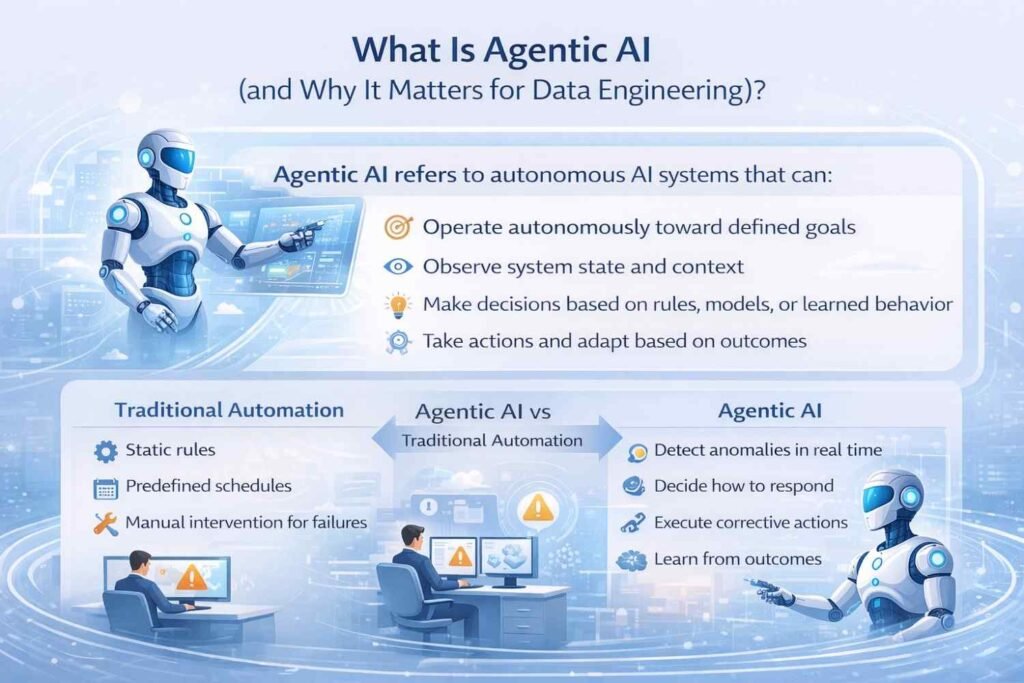
Agentic AI refers to AI systems designed to:
- Operate autonomously toward defined goals
- Observe system state and context
- Make decisions based on rules, models, or learned behavior
- Take actions and adapt based on outcomes
Unlike traditional automation scripts, agentic systems are state-aware, adaptive, and persistent.
Agentic AI vs Traditional Data Automation
Traditional data automation focuses on:
- Static rules
- Predefined schedules
- Manual intervention when failures occur
In contrast, agentic AI systems:
- Detect anomalies in real time
- Decide how to respond
- Execute corrective actions
- Learn from outcomes
Therefore, instead of reacting to broken pipelines, enterprises can move toward self-healing data systems.
Why Enterprise Data Engineering Needs Agentic AI Now
Several forces are converging to make agentic AI not just attractive—but necessary.
Data Complexity Is Accelerating
Modern enterprises manage:
- Streaming and batch data
- Structured and unstructured sources
- Multi-cloud and hybrid environments
Consequently, pipelines are harder to maintain and troubleshoot manually.
Schema Drift Is Becoming a Major Risk
One of the most persistent challenges in data engineering is schema drift when source data structures change unexpectedly.
Even small schema changes can:
- Break downstream transformations
- Corrupt analytics
- Trigger compliance issues
Agentic AI systems can continuously monitor schemas, detect drift, and decide whether to auto-map, alert, or halt pipelines.
Fast Enterprises Can’t Afford Slow Pipelines
In today’s market, fast enterprises win by acting on data sooner than competitors.
However, slow pipeline recovery, manual QA, and brittle orchestration create bottlenecks. Agentic AI reduces time-to-insight by minimizing human-in-the-loop intervention.
Data Teams Are Stretched Thin
Hiring experienced data engineers is expensive and competitive. Therefore, organizations must amplify existing teams rather than expand endlessly.
Agentic AI acts as a force multiplier—handling repetitive operational decisions so humans can focus on strategy and innovation.
Core Use Cases of Agentic AI in Enterprise Data Engineering
Agentic AI does not replace data engineers. Instead, it augments them across the lifecycle.
Autonomous Data Ingestion
AI agents can:
- Monitor source reliability
- Adjust ingestion frequency
- Detect incomplete or delayed feeds
- Switch fallback sources automatically
This is especially valuable in multi-vendor ecosystems where data reliability varies.
Intelligent Schema Management
As mentioned earlier, schema drift is a silent killer.
Agentic AI can:
- Compare incoming schemas to historical baselines
- Predict downstream impact
- Apply safe transformations automatically
- Escalate only high-risk changes
As a result, data platforms become more resilient without constant manual oversight.
Data Quality and Anomaly Detection
Beyond schemas, agentic AI monitors:
- Volume anomalies
- Distribution shifts
- Missing or duplicated records
This approach mirrors techniques used in financial platforms and trading systems—similar to the analytical depth users expect when reading a Swyftx review, where transparency and reliability are non-negotiable.
Self-Healing Pipelines
When failures occur, agentic systems can:
- Diagnose root causes
- Retry with modified parameters
- Reroute data
- Notify teams with context-rich explanations
Instead of static alerts, teams receive actionable intelligence.
Adaptive Orchestration
Agentic AI can dynamically adjust:
- Execution order
- Resource allocation
- Parallelism levels
This is particularly valuable in cloud environments where cost and performance must be balanced continuously.
Strategy: How Enterprises Should Adopt Agentic AI
While the technology is powerful, success depends on strategy.
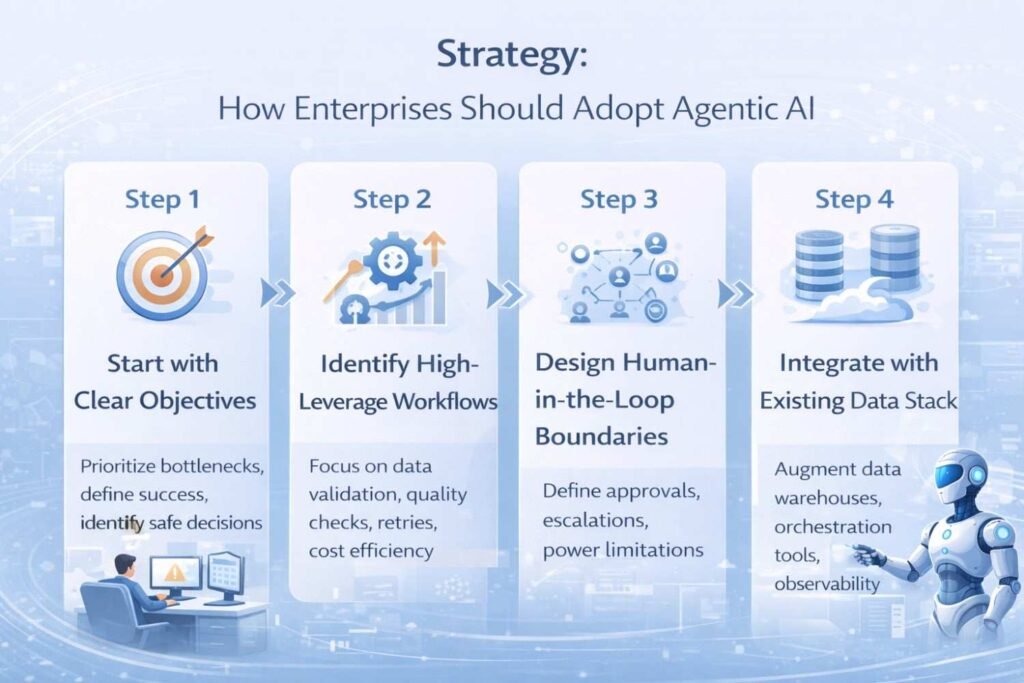
Step 1: Start with Clear Objectives
Before building agents, define:
- Which bottlenecks matter most
- What success looks like
- Which decisions can safely be automated
Without clarity, autonomy can introduce risk rather than reduce it.
Step 2: Identify High-Leverage Workflows
The best early candidates include:
- Schema validation
- Data quality checks
- Pipeline retries
- Cost optimization
These areas offer high ROI with relatively low risk.
Step 3: Design Human-in-the-Loop Boundaries
Even advanced agents need guardrails.
Therefore:
- Define approval thresholds
- Set escalation rules
- Maintain override mechanisms
This balance builds trust across engineering, compliance, and leadership teams.
Step 4: Integrate with Existing Data Stack
Agentic AI should augment—not replace—your stack.
Most enterprises integrate agents with:
- Data warehouses and lakehouses
- Orchestration tools
- Observability platforms
Organizations often work with partners offering enterprise app development to embed agentic capabilities cleanly into existing systems.
Governance: Controlling Autonomous Systems at Scale
Autonomy without governance is chaos. Consequently, governance must evolve alongside agentic AI.
Decision Transparency and Auditability
Every agent action should be:
- Logged
- Explainable
- Reproducible
This is essential for compliance, debugging, and trust.
Policy-Driven Autonomy
Rather than hard-coding behavior, enterprises define policies:
- What agents are allowed to do
- Under which conditions
- With what constraints
This approach aligns with regulatory expectations across industries.
Security and Access Controls
Agentic systems must follow the principle of least privilege.
That means:
- Limited access scopes
- Secure credential handling
- Continuous monitoring
Security is especially critical as agents gain write access to production systems.
Ethical and Operational Safeguards
Autonomous systems must avoid:
- Data leakage
- Biased decision patterns
- Unintended feedback loops
Strong governance ensures AI serves business goals rather than undermining them.
Also, As enterprises expand their AI-driven data platforms, it’s also useful to examine how intelligent financial systems apply similar data engineering principles. For example, modern investment portfolio management software relies heavily on real-time data pipelines, analytics, and governed automation—many of the same capabilities enabled by agentic AI. Exploring this approach to scalable financial platforms helps illustrate how autonomous data workflows and intelligent decision-making translate into high-impact, production-ready enterprise solutions.
Architecture Considerations for Agentic AI in Data Engineering
From an architectural standpoint, agentic AI introduces new layers.
Agent Components Typically Include:
- Observers (data and system monitors)
- Decision engines (rules + ML models)
- Action executors (pipeline controls, alerts)
- Memory and context stores
This modularity supports scalability and control.
Cloud-Native and Scalable by Design
Because agentic systems operate continuously, cloud-native architectures are often preferred. Providers like TechFast-style infrastructure vendors emphasize low-latency, high-availability environments that suit always-on agents.
ROI: Measuring the Business Impact of Agentic AI
Ultimately, enterprise adoption depends on ROI.
Direct Cost Savings
Agentic AI reduces:
- Manual incident response
- Pipeline downtime
- Over-provisioned resources
Over time, these savings compound significantly.
Productivity Gains
Data engineers spend less time firefighting and more time:
- Designing better models
- Improving analytics
- Supporting business initiatives
This shift alone often justifies the investment.
Faster Time to Insight
By minimizing delays, enterprises:
- Respond to market changes faster
- Improve decision quality
- Gain competitive advantage
In fast-moving markets, speed translates directly to revenue.
Reduced Risk Exposure
Early detection of issues—such as schema drift or data anomalies—reduces:
- Compliance risk
- Reputational damage
- Downstream analytics errors
Risk avoidance is a powerful but often under-measured ROI component.
Agentic AI Beyond Data Engineering: Broader Enterprise Impact
Interestingly, agentic AI concepts extend beyond data.
For example:
- In immersive digital platforms, autonomous agents help manage load and interactions, reducing metaverse strain on infrastructure.
- In fintech and trading platforms, agentic analytics drive smarter monitoring and alerts.
Therefore, investments in agentic data systems often unlock capabilities across the enterprise.
Organizations frequently expand these initiatives into broader ai solutions, leveraging shared governance, infrastructure, and expertise.
Common Enterprise Questions Answered
What is agentic AI in simple terms?
Agentic AI refers to autonomous systems that can observe, decide, and act toward goals without constant human input.
Is agentic AI safe for enterprise data systems?
Yes—when deployed with proper governance, auditability, and security controls.
How long does it take to implement?
Most enterprises start with pilots in 3–6 months, followed by phased expansion.
Does agentic AI replace data engineers?
No. It augments teams by handling repetitive operational decisions.
Global Enterprises and Regional Compliance
For global organizations, geography matters.
Agentic AI must account for:
- Data residency laws
- Regional compliance requirements
- Latency and infrastructure constraints
Enterprises operating across regions should design agents with geo-aware policies from day one.
Final Thoughts: From Reactive Pipelines to Autonomous Systems
Agentic AI marks a fundamental shift in enterprise data engineering—from reactive, manual operations to proactive, autonomous systems.
By combining thoughtful strategy, robust governance, and clear ROI metrics, enterprises can safely unlock the benefits of autonomy without sacrificing control.
In a world where data velocity defines competitiveness, agentic AI is not a futuristic concept—it is an emerging standard. Organizations that adopt it early will not only move faster but operate smarter, safer, and more efficiently at scale.