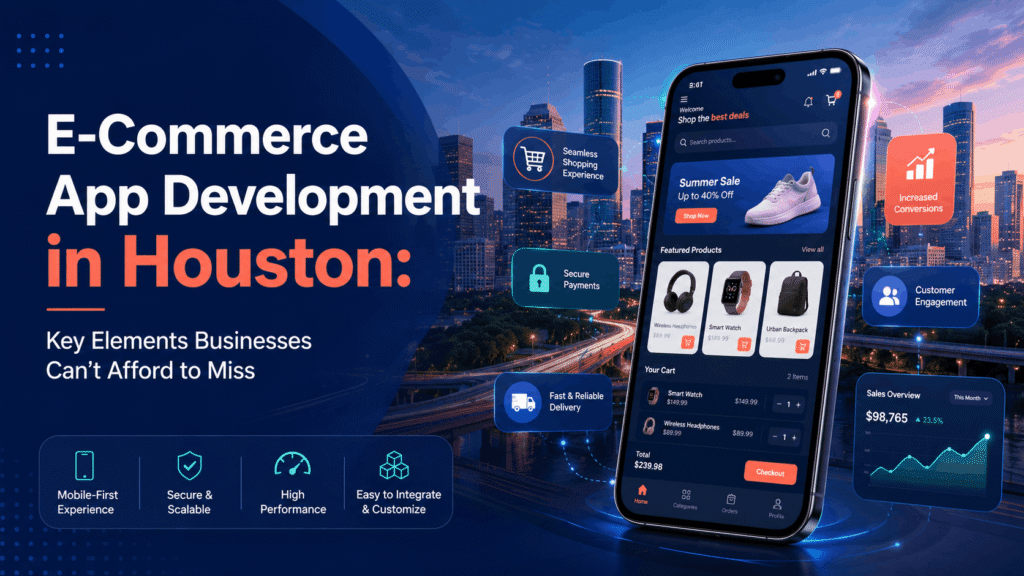
E-Commerce App Development in Houston: Key Elements Businesses Can’t Afford to Miss
E-commerce is no longer simply about putting products on a website and waiting for customers to buy. Today, customers expect fast product discovery, personalized experiences, secure payments, convenient checkout, real-time order information, and a seamless experience across smartphones, tablets, and desktops. For Houston businesses, this makes e-commerce app development an important part of building a competitive digital presence. Whether you run a retail store, wholesale business, fashion brand, food business, B2B company, or growing startup, a well-designed e-commerce application can turn digital traffic into measurable revenue. However, developing an app is only the beginning. Businesses also need to consider performance, scalability, user experience, security, search visibility, integrations, and long-term maintenance. So, before investing in e-commerce mobile app development, here are the key things Houston businesses should never miss. What Is E-Commerce App Development? E-commerce app development is the process of designing and building a digital application through which customers can discover products, compare options, add products to a cart, make payments, manage accounts, and track purchases. Depending on the business model, an e-commerce solution may include: However, successful development isn’t about adding every available feature. Instead, businesses should identify what their customers actually need and build the buying journey around those requirements. Why Should Houston Businesses Invest in E-Commerce Mobile App Development? A mobile-friendly website remains essential. Nevertheless, a dedicated mobile application can provide additional ways to build stronger relationships with frequent customers. For instance, an app can keep users signed in, save preferences, deliver relevant push notifications, simplify repeat purchases, and provide personalized recommendations. Furthermore, customers increasingly expect consistency across channels. Someone might discover your Houston business through Google, browse products on your website, download your app, and eventually complete a purchase from their phone. Therefore, your app shouldn’t operate as an isolated platform. Instead, it should become part of a broader digital commerce ecosystem that connects your website, inventory, customer data, payments, marketing, and support systems. 1. Start With Customer Research, Not Technology One of the biggest mistakes businesses make is choosing technology before understanding their customers. Before development begins, determine: Who will use the application? What problems are they trying to solve? Why would they use an app instead of your website? For example, a Houston retailer might discover that customers mainly want faster repeat ordering. In contrast, a B2B supplier might need bulk ordering, account-specific pricing, invoices, and purchase histories. Therefore, your development roadmap should be based on genuine customer behavior. A qualified e-commerce app development company should consequently begin with discovery, competitor research, customer journey mapping, technical planning, and feature prioritization rather than immediately jumping into coding. 2. Make Mobile UX a Priority A beautiful interface doesn’t automatically create a good shopping experience. Customers should be able to move naturally from product discovery to checkout. Therefore, navigation should remain simple, buttons should be easy to tap, text should be readable, and important information shouldn’t be buried underneath unnecessary screens. This becomes particularly important during checkout. Baymard Institute reports that roughly 70% of e-commerce shopping carts are abandoned. Checkout design and usability challenges can also play a major role in causing customers to abandon their purchases. Consequently, businesses should simplify checkout wherever possible. Consider features such as: Most importantly, never force customers through unnecessary steps merely to complete a purchase. 3. Speed Can Directly Influence the Shopping Experience Customers don’t care how sophisticated your technology is if the application feels slow. Therefore, performance should be treated as a core business requirement. Images should be optimized, APIs should respond efficiently, unnecessary scripts should be minimized, and frequently accessed information should be cached appropriately. Moreover, your development team should test performance under realistic traffic conditions. An application that performs perfectly with 50 visitors may behave very differently when thousands of shoppers arrive during a promotion. For Houston businesses planning rapid growth, scalability should consequently be considered from day one rather than after performance problems appear. 4. Don’t Treat Security as an Afterthought An e-commerce application handles sensitive customer and transaction information. Therefore, security should be integrated into the application’s architecture from the very beginning. OWASP’s mobile application security guidance recommends a secure-by-design approach and emphasizes secure APIs, server-side authentication and authorization, appropriate credential handling, and protection of locally stored information. Accordingly, e-commerce app development services should address areas such as: Additionally, avoid storing sensitive information unnecessarily. The less sensitive data your system retains, the smaller the potential exposure if something goes wrong. 5. Build a Checkout Designed for Conversion Getting customers to the cart is only half the challenge. You still need to help them complete the transaction. For example, unexpected costs, forced account creation, complicated forms, and limited payment choices can create unnecessary friction. Baymard’s checkout research identifies these among common reasons shoppers abandon purchases. Therefore, show shipping charges, taxes, delivery expectations, and other relevant costs as early as reasonably possible. Additionally, provide a visible guest checkout option. Baymard reports that almost one in five surveyed U.S. adults had abandoned an order because they didn’t want to create an account. Consequently, forcing registration before purchase may cost businesses conversions that could otherwise have been captured. 6. Connect Your App With the Rest of Your Business Modern e-commerce depends heavily on integrations. Your application may need to communicate with: Therefore, integration planning should happen before development reaches its final stages. For example, if your app displays inventory that doesn’t match your warehouse system, customers could purchase products that aren’t actually available. Likewise, disconnected customer information makes personalized marketing and support significantly harder. Strong integrations, therefore, create both better customer experiences and more efficient internal operations. 7. Think Beyond Native Apps: Consider a Progressive Web App Not every Houston business immediately needs separate iOS and Android applications. In some cases, a progressive web app (PWA) may offer a practical alternative or complement to native applications. A PWA uses modern web technologies to provide an app-like experience through the browser. Depending on implementation and business requirements, progressive web applications can provide fast loading, responsive interfaces, installable experiences, and certain