
A-to-Z Complete E-commerce Solution for Startups: Build, Launch, and Scale Your Online Store
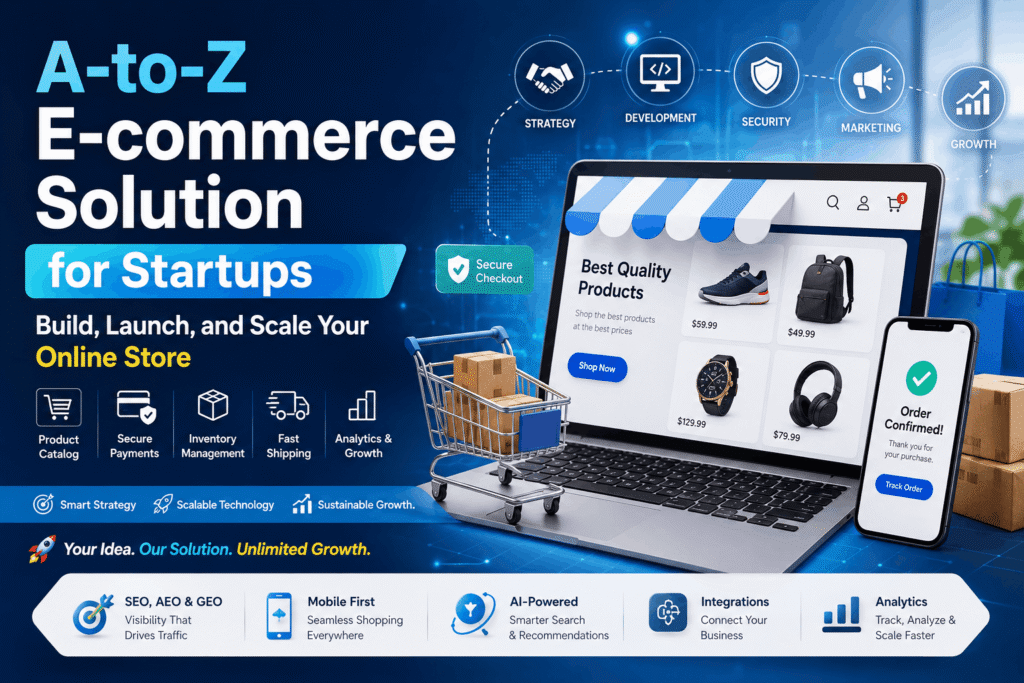
Launching an online store is easier than ever. However, building an e-commerce business that attracts customers, converts visitors, manages operations, and scales profitably requires much more than choosing a website template.A complete e-commerce solution combines technology, strategy, customer experience, payments, inventory, marketing, analytics, mobile commerce, security, SEO, and business operations into one connected ecosystem.For startups, this is especially important. Limited budgets and small teams mean every technology decision must support growth instead of creating unnecessary complexity. Moreover, customers now discover products through Google, marketplaces, social media, recommendation engines, AI search tools, and conversational platforms. Therefore, modern e-commerce website development must be designed not only for human visitors but also for search engines, answer engines, and AI-powered discovery systems. This guide explains the complete A-to-Z approach startups can use to build, launch, optimize, and scale a successful online store. What Is an E-commerce Solution? An e-commerce solution is a combination of software, infrastructure, integrations, and business processes that enables a company to sell products or services online. At the most basic level, an e-commerce solution includes: However, growing businesses usually need much more. Therefore, startups should not think only about building an online store. Instead, they should think about building a complete digital commerce ecosystem. 1. Start With Your Business Model Before choosing technology, determine how your e-commerce business will work. For instance, a startup selling 30 handmade products does not need the same architecture as a marketplace managing thousands of products and multiple vendors. Likewise, a subscription business requires recurring payments, while a B2B e-commerce company may need bulk pricing, quotation systems, purchase orders, and customer-specific catalogs. Therefore, define: Most importantly, focus on your minimum viable product. Startups often waste money by developing advanced features before proving demand. Instead, launch a reliable version of the store, collect customer data, and improve the platform based on real behavior. 2. Create an E-commerce Business Development Strategy Technology alone will not build a successful business. Therefore, every startup needs an e commerce business development strategy that connects acquisition, conversion, retention, partnerships, pricing, and profitability. First, identify why customers should buy from your store instead of purchasing from an established competitor. Then, determine where potential customers can be reached. Possible acquisition channels include: However, generating traffic is only the beginning. Startups should also track important e-commerce metrics such as: Consequently, the goal is not simply to increase traffic. Instead, the objective is to build a profitable system that consistently converts and retains customers. 3. Choose the Right E-commerce Technology Once the business strategy is clear, startups can select the right platform. Generally, there are three common approaches. SaaS E-commerce Platforms Hosted e-commerce platforms provide ready-made tools for product management, checkout, hosting, themes, payments, and extensions. Therefore, they can be ideal for startups that want to launch quickly without maintaining complicated infrastructure. Open-Source Platforms Open-source solutions provide more flexibility and control. However, they also require greater responsibility for hosting, security, updates, performance, and development. Custom E-commerce Development Custom e-commerce development is ideal for businesses that need specialized features, workflows, or integrations that standard e-commerce platforms may not support effectively.For example, custom solutions may be suitable for: Nevertheless, startups should avoid building everything from scratch. Instead, custom functionality should focus on areas that create competitive advantage, while proven third-party services can handle standard functions such as payments, shipping, email, and analytics. 4. Focus E-commerce Website Development on User Experience Successful e-commerce website development begins with understanding how customers shop. A typical buying journey looks like: Discovery → Category → Product → Cart → Checkout → Payment → Confirmation → Delivery → Repeat Purchase Every stage should reduce friction. Product pages, for example, should clearly communicate: Moreover, navigation should be simple. Customers should be able to browse categories, search products, apply filters, compare options, and reach checkout without confusion. Checkout should also be optimized carefully. Guest checkout, clear shipping costs, autofill, mobile-friendly forms, secure payments, and transparent order totals can significantly improve the purchasing experience. 5. Build a Scalable Technical Architecture Every online store is a collection of connected technologies. Modern e commerce applications software development may include: Frontend: The customer-facing interface. Backend: Business logic, products, carts, orders, and customer data. Database: Stores product, customer, and transaction information. Payment Gateway: Handles online transactions. CMS: Manages landing pages, blogs, and marketing content. CRM: Organizes customer relationships. PIM: Manages product information. OMS: Controls order processing. ERP: Connects finance, inventory, and operations. APIs: Allow systems to communicate. However, startups should avoid unnecessary architectural complexity. Therefore, architecture should scale according to business demand. 6. Treat Product Data as an Important Asset Product information affects customers, search engines, marketplaces, shopping platforms, and AI discovery tools. Therefore, each product should have accurate and consistent information. Important product data includes: Additionally, structured data helps search engines understand product information more accurately. Schema such as Product, Offer, ProductGroup, Review, AggregateRating, Organization, and BreadcrumbList can improve machine understanding. Therefore, good product data supports SEO, Google Shopping, personalization, AI recommendations, and omnichannel commerce. 7. Optimize Checkout and Payments Checkout is one of the most important stages in e-commerce. If customers experience unnecessary steps, unexpected fees, payment failures, or confusing forms, they may abandon their purchase. Therefore, an effective checkout should provide: Furthermore, customers should understand the total cost before reaching the final payment step. Security is equally important. Startups should use reputable payment providers and avoid unnecessarily storing sensitive payment information. 8. Develop for Mobile Customers Mobile commerce continues to play a major role in online shopping. Therefore, every e-commerce website should be responsive and designed with mobile users in mind. However, some businesses may eventually benefit from e commerce app development services. A dedicated app can provide: Nevertheless, startups should not build an app simply because competitors have one. Instead, develop an app when it creates measurable value through engagement, convenience, customer retention, or repeat purchases. 9. Integrate Essential Business Systems As an e-commerce startup grows, manual processes become increasingly inefficient. Therefore, integrations become important. A scalable e-commerce solution may connect: APIs and webhooks allow