How Custom Mobile App Development Helps Build an App Like Uber
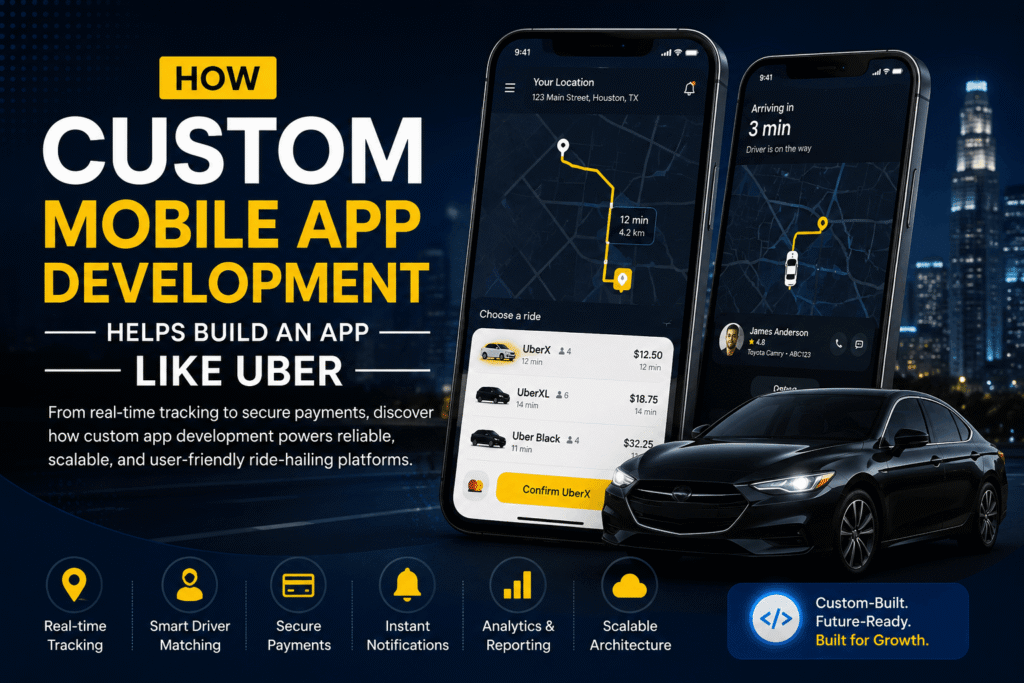
Uber changed the way people think about transportation, but the technology behind an Uber-like app goes far beyond placing a map on a smartphone and adding a “Book Ride” button. A modern ride-hailing platform requires real-time location tracking, intelligent driver matching, route calculation, secure payments, push notifications, user authentication, trip management, ratings, analytics, and a scalable backend that can coordinate thousands—or potentially millions—of interactions. That is precisely where Custom Mobile App Development becomes important. Instead of forcing a ride-hailing business into a generic application template, custom development allows the product to be designed around its specific users, operating model, service area, pricing rules, driver workflows, and long-term growth strategy. Consequently, entrepreneurs can build something inspired by Uber’s business model without simply creating another Uber clone. More importantly, an effective on-demand transportation platform is actually an ecosystem of connected applications and services. Therefore, businesses considering an Uber-like product need to think beyond the passenger app itself. What Is Custom Mobile App Development? Custom mobile app development involves creating a mobile application tailored to the specific needs, goals, users, workflows, and technology requirements of a business.. Unlike an off-the-shelf solution, a custom application can be engineered around specific functionality, integrations, branding, security requirements, data models, and growth plans. For example, an Uber-like business may need: Therefore, choosing custom mobile app development services provides significantly more flexibility than trying to adapt a prebuilt app template to a complex on-demand business model. Quick Answer: How Does Custom Mobile App Development Help Build an App Like Uber? Custom mobile app development helps build an app like Uber by allowing developers to create a complete ride-hailing ecosystem around the business’s requirements. This can include separate passenger and driver apps, GPS tracking, maps, route optimization, ride matching, fare calculation, payment gateways, notifications, admin controls, analytics, security, and scalable cloud infrastructure. Furthermore, because the application is custom-built, features and business rules can evolve as the platform grows. In other words, custom development does not simply create an app that looks like Uber. Instead, it provides the technical foundation required to build an on-demand mobility platform that actually works. Why an Uber-Like App Requires Custom Development At first glance, the user experience of a ride-hailing application appears relatively simple. A passenger opens the app, chooses a destination, requests a ride, gets matched with a driver, follows the vehicle on a map, completes the trip, pays, and leaves a rating. However, several systems are communicating behind the scenes during that seemingly straightforward journey. For instance, the platform may need to determine: Additionally, these events must be synchronized across the passenger application, driver application, backend infrastructure, payment services, mapping services, notification systems, and administrative dashboard. As a result, a one-size-fits-all application is rarely sufficient for a serious ride-hailing product. The Core Architecture of an Uber-Like Application One of the biggest advantages of working with a custom mobile app development company is the ability to design the entire platform as an interconnected system. Generally, an Uber-like platform consists of four major components. 1. Passenger App The passenger application is the customer-facing side of the platform. Therefore, its primary goal should be to make requesting and managing transportation as frictionless as possible. Important passenger features can include: However, adding features is not enough. The experience must also be intuitive. For example, users should not need to navigate through six screens simply to request transportation. Consequently, UI/UX design becomes just as important as backend engineering. 2. Driver App While passengers require simplicity, drivers need operational information. Therefore, the driver application may include: Moreover, driver location often needs to update during active operations. This makes mobile location services particularly important. On iOS, Apple’s Core Location framework provides access to geographic location and movement-related information. Apple also recommends selecting location services based on the accuracy actually required because higher-frequency, higher-accuracy tracking can increase energy consumption. Similarly, Android provides location capabilities, while Android’s documentation recommends Google Location Services APIs for many applications because they provide additional capabilities such as low-power geofencing and activity recognition. Therefore, location functionality should be engineered carefully rather than treated as a simple GPS switch. 3. Admin Dashboard The third major component is often overlooked: the administrative platform. A ride-hailing company needs visibility into what is happening across the marketplace. Consequently, administrators may require tools for: The dashboard effectively becomes the operational control center of the platform. Therefore, professional custom mobile app development services should consider internal operations from the beginning rather than focusing exclusively on the customer-facing application. 4. Backend and Cloud Infrastructure Finally, the backend connects everything. Whenever a passenger requests a ride, the backend may need to process the request, identify available drivers, calculate data, update trip states, trigger notifications, store records, and communicate information to multiple devices. Therefore, backend architecture may include: As traffic increases, scalability becomes increasingly important. A system that works perfectly with 200 users may behave very differently with 200,000 concurrent users. For that reason, architecture decisions should reflect both current requirements and realistic growth expectations. How Real-Time GPS Tracking Powers an Uber-Like App Location is one of the most important technical components of ride-hailing software. Without reliable geolocation, the platform cannot accurately determine passenger pickup locations, nearby drivers, vehicle movement, or estimated arrival times. For iOS applications, Apple’s Core Location framework can obtain location information using technologies such as GPS, Wi-Fi, cellular hardware, Bluetooth and other device capabilities. However, continuously requesting maximum-accuracy location information can consume additional power. Therefore, Apple recommends choosing the most power-efficient location service that satisfies the application’s requirements and stopping unnecessary updates when location information is no longer needed. This is an important example of why iOS app development services for a ride-hailing application require platform-specific expertise. Meanwhile, Android development presents its own location APIs, permissions, device behaviors, and optimization considerations. Therefore, professional Android app development services should account for Android’s broader device ecosystem and location-service implementation requirements. Maps, Routes, ETA and Journey Sharing Finding a driver’s coordinates is only the beginning. The application also needs to understand how the